
War playbook: Former F-15E pilot reveals hidden tactics by Iran to challenge US air dominance
Bodenheimer said the broader challenge is not just Iranian air defences, but the layered threat posed by drones, ballistic missiles, fast attack boats and underwater unmanned vehicles, particularly around the Strait of Hormuz.
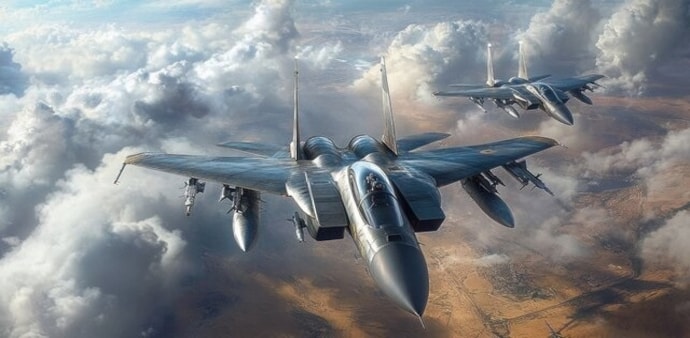
- Apr 4, 2026,
- Updated Apr 4, 2026 9:29 PM IST
Former F-15E Strike Eagle pilot Ryan Bodenheimer says the recent hits on US aircraft over Iran do not necessarily mean Tehran has denied American air superiority, but they do show that Iran remains capable of inflicting damage through mobile and hidden air defence tactics.
Bodenheimer, who flew the F-15E and completed 70 combat missions in Afghanistan, said such incidents underline the uncertainty and danger of modern air operations even when one side has overwhelming aerial dominance. He explained that aircraft like the F-15E do carry electronic countermeasures, chaff and flares, but those systems are not foolproof if a missile is launched from close range or from a concealed position.
Speaking to ANI, Bodenheimer said Iran appears to be relying on a familiar playbook: holding back some surface-to-air missile capability, keeping radars off, and activating them only at the last moment to target passing aircraft. In his view, that can leave even advanced US fighter crews with very little time to react.
On reports of multiple US assets being hit, including an F-15E and an A-10, Bodenheimer urged caution around unverified claims, especially those circulating during wartime. He said some visuals being shared online did not conclusively match the aircraft they were claimed to show, and stressed that official confirmation and post-strike assessments remain critical.
Drawing on his combat experience and years spent studying Iran-related operational scenarios in the US Air Force, Bodenheimer said the broader challenge is not just Iranian air defences, but the layered threat posed by drones, ballistic missiles, fast attack boats and underwater unmanned vehicles, particularly around the Strait of Hormuz.
He also warned against assuming that a wider US ground invasion would be easy or wise. Based on what he saw in Afghanistan, Bodenheimer argued that large-scale occupation campaigns carry enormous risks and costs. He said a more limited approach focused on special operations, control of key maritime routes and support for anti-regime forces inside Iran would be more realistic than a boots-on-the-ground invasion.
Throughout the conversation, Bodenheimer returned to one central point: air superiority reduces danger, but it does not eliminate it. In a conflict like this, he suggested, even technologically superior forces remain vulnerable to surprise attacks, hidden launch platforms and the fog of war.
Former F-15E Strike Eagle pilot Ryan Bodenheimer says the recent hits on US aircraft over Iran do not necessarily mean Tehran has denied American air superiority, but they do show that Iran remains capable of inflicting damage through mobile and hidden air defence tactics.
Bodenheimer, who flew the F-15E and completed 70 combat missions in Afghanistan, said such incidents underline the uncertainty and danger of modern air operations even when one side has overwhelming aerial dominance. He explained that aircraft like the F-15E do carry electronic countermeasures, chaff and flares, but those systems are not foolproof if a missile is launched from close range or from a concealed position.
Speaking to ANI, Bodenheimer said Iran appears to be relying on a familiar playbook: holding back some surface-to-air missile capability, keeping radars off, and activating them only at the last moment to target passing aircraft. In his view, that can leave even advanced US fighter crews with very little time to react.
On reports of multiple US assets being hit, including an F-15E and an A-10, Bodenheimer urged caution around unverified claims, especially those circulating during wartime. He said some visuals being shared online did not conclusively match the aircraft they were claimed to show, and stressed that official confirmation and post-strike assessments remain critical.
Drawing on his combat experience and years spent studying Iran-related operational scenarios in the US Air Force, Bodenheimer said the broader challenge is not just Iranian air defences, but the layered threat posed by drones, ballistic missiles, fast attack boats and underwater unmanned vehicles, particularly around the Strait of Hormuz.
He also warned against assuming that a wider US ground invasion would be easy or wise. Based on what he saw in Afghanistan, Bodenheimer argued that large-scale occupation campaigns carry enormous risks and costs. He said a more limited approach focused on special operations, control of key maritime routes and support for anti-regime forces inside Iran would be more realistic than a boots-on-the-ground invasion.
Throughout the conversation, Bodenheimer returned to one central point: air superiority reduces danger, but it does not eliminate it. In a conflict like this, he suggested, even technologically superior forces remain vulnerable to surprise attacks, hidden launch platforms and the fog of war.