
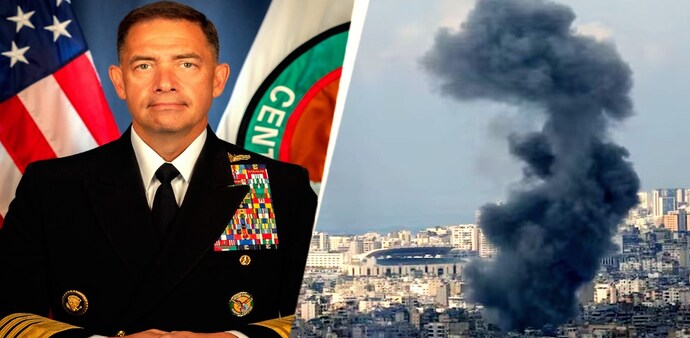
Who is Brad Cooper? The CENTCOM commander leading America's 'Epic Fury' campaign against Iran
A graduate of the U.S. Naval Academy, Cooper holds a master's degree in Strategic Intelligence from the National Intelligence University and has studied international relations at Harvard and Tufts Universities
- Mar 5, 2026,
- Updated Mar 5, 2026 2:46 PM IST
Admiral Brad Cooper, commander of U.S. Central Command, is overseeing Operation Epic Fury, the largest U.S. military offensive in the Middle East in a generation. The military campaign, conducted jointly with Israel, is aimed at eliminating Iran's military capabilities.
US-Israel-Iran War Live: Iran missiles fall near Azerbaijan airport
On Tuesday, Cooper provided an operational update, detailing the ongoing strikes that have already made significant inroads into Iran's military infrastructure.
Also read: Qatar halts LNG supply: How Pakistan and Bangladesh are staring at energy abyss
Cooper said the operation has brought together over 50,000 troops, 200 fighter jets, and two aircraft carriers to target Iran's ability to project force in the region. The operation, which began last Saturday (February 28), has already seen 2,000 targets struck, including key ballistic missile facilities, Iranian naval assets, and air defenses.
"We're focused on shooting all the things that can shoot at us," Cooper said, stressing that B-2 and B-1 bombers have carried out surgical strikes on multiple missile sites deep inside Iran, while B-52 bombers have hit command-and-control posts. He also revealed that 17 Iranian ships have been destroyed, including the country’s most operational submarine.
Cooper described the naval assault as a decisive move to neutralise Iran's maritime forces, adding that, for the first time in decades, there is no Iranian ship in operation in the Strait of Hormuz or the Arabian Gulf. He said, "There's not a single Iranian ship underway in the Arabian Gulf, Strait of Hormuz, or Gulf of Oman."
The U.S. Navy has also deployed multiple waves of cruise missiles, crippling Iran's air defense capabilities. Cooper noted that the operation marks the largest buildup by the U.S. in the Middle East since the Cold War, signaling a substantial shift in America’s posture in the region.
Who is Brad Cooper?
Admiral Cooper is the commander of U.S. Central Command. He has an extensive military career spanning over three decades. A graduate of the U.S. Naval Academy, Cooper holds a master's degree in Strategic Intelligence from the National Intelligence University and has studied international relations at Harvard and Tufts Universities.
As a career Navy Surface Warfare Officer, Cooper has served in various theaters of operation, including a tour in Afghanistan. His command tours include leadership roles in Bahrain, where he commanded U.S. Naval Forces Central Command, FIFTH Fleet, and Combined Maritime Forces, as well as command positions in Okinawa, Japan, and Busan, South Korea. Cooper has also commanded several ships, including the USS Russell (DDG 59) and USS Gettysburg (CG 64).
Ashore, Cooper has held various key leadership positions, including Deputy Commander of U.S. Central Command, Navy Chief of Legislative Affairs, and Director of Surface Warfare Officer assignments. He has also worked in senior executive and military roles at the White House, U.S. Africa Command, and U.S. Pacific Fleet Headquarters.
Cooper's leadership has earned him the Admiral Elmo Zumwalt Award for Visionary Leadership. He has served with the crew of the USS Gettysburg, which earned the Battenberg Cup for being the best ship, submarine, or aircraft carrier in the Navy's Atlantic Fleet.
With his extensive experience in both naval and strategic roles, Admiral Cooper is at the forefront of Operation Epic Fury, overseeing a critical phase in the ongoing conflict with Iran.
Admiral Brad Cooper, commander of U.S. Central Command, is overseeing Operation Epic Fury, the largest U.S. military offensive in the Middle East in a generation. The military campaign, conducted jointly with Israel, is aimed at eliminating Iran's military capabilities.
US-Israel-Iran War Live: Iran missiles fall near Azerbaijan airport
On Tuesday, Cooper provided an operational update, detailing the ongoing strikes that have already made significant inroads into Iran's military infrastructure.
Also read: Qatar halts LNG supply: How Pakistan and Bangladesh are staring at energy abyss
Cooper said the operation has brought together over 50,000 troops, 200 fighter jets, and two aircraft carriers to target Iran's ability to project force in the region. The operation, which began last Saturday (February 28), has already seen 2,000 targets struck, including key ballistic missile facilities, Iranian naval assets, and air defenses.
"We're focused on shooting all the things that can shoot at us," Cooper said, stressing that B-2 and B-1 bombers have carried out surgical strikes on multiple missile sites deep inside Iran, while B-52 bombers have hit command-and-control posts. He also revealed that 17 Iranian ships have been destroyed, including the country’s most operational submarine.
Cooper described the naval assault as a decisive move to neutralise Iran's maritime forces, adding that, for the first time in decades, there is no Iranian ship in operation in the Strait of Hormuz or the Arabian Gulf. He said, "There's not a single Iranian ship underway in the Arabian Gulf, Strait of Hormuz, or Gulf of Oman."
The U.S. Navy has also deployed multiple waves of cruise missiles, crippling Iran's air defense capabilities. Cooper noted that the operation marks the largest buildup by the U.S. in the Middle East since the Cold War, signaling a substantial shift in America’s posture in the region.
Who is Brad Cooper?
Admiral Cooper is the commander of U.S. Central Command. He has an extensive military career spanning over three decades. A graduate of the U.S. Naval Academy, Cooper holds a master's degree in Strategic Intelligence from the National Intelligence University and has studied international relations at Harvard and Tufts Universities.
As a career Navy Surface Warfare Officer, Cooper has served in various theaters of operation, including a tour in Afghanistan. His command tours include leadership roles in Bahrain, where he commanded U.S. Naval Forces Central Command, FIFTH Fleet, and Combined Maritime Forces, as well as command positions in Okinawa, Japan, and Busan, South Korea. Cooper has also commanded several ships, including the USS Russell (DDG 59) and USS Gettysburg (CG 64).
Ashore, Cooper has held various key leadership positions, including Deputy Commander of U.S. Central Command, Navy Chief of Legislative Affairs, and Director of Surface Warfare Officer assignments. He has also worked in senior executive and military roles at the White House, U.S. Africa Command, and U.S. Pacific Fleet Headquarters.
Cooper's leadership has earned him the Admiral Elmo Zumwalt Award for Visionary Leadership. He has served with the crew of the USS Gettysburg, which earned the Battenberg Cup for being the best ship, submarine, or aircraft carrier in the Navy's Atlantic Fleet.
With his extensive experience in both naval and strategic roles, Admiral Cooper is at the forefront of Operation Epic Fury, overseeing a critical phase in the ongoing conflict with Iran.