
'World order will collapse if...': Pakistan sounds alarm over India's Indus Waters Treaty move
India has maintained that the treaty will remain in abeyance until Pakistan takes credible and irreversible action against cross-border terrorism.
- Jul 1, 2026,
- Updated Jul 1, 2026 10:42 AM IST
Pakistan on Tuesday hosted an international conference on the Indus Waters Treaty (IWT), where senior leaders and experts criticised India's decision to place the 1960 agreement in suspension and argued that the treaty remains essential for regional peace, stability and international law.
The conference, titled "Indus Waters Treaty as an Enduring Legal and Institutional Framework," comes amid growing tensions after India suspended the treaty following the April 2025 terror attack in Pahalgam, Jammu and Kashmir, which killed 26 civilians. India has maintained that the treaty will remain in abeyance until Pakistan takes credible and irreversible action against cross-border terrorism.
READ THIS: 'We will cut off those hands': Pakistan minister threatens India over Indus water row
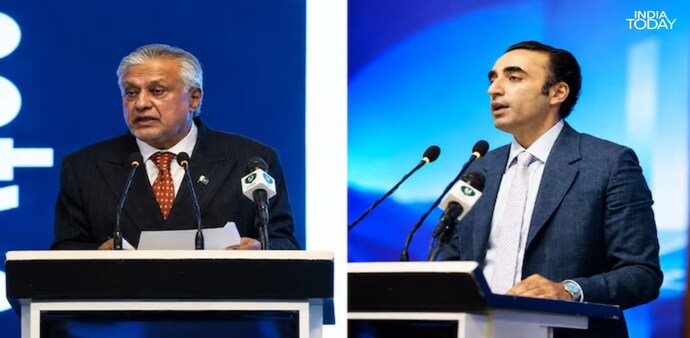
Speaking at the conference, Pakistan Deputy Prime Minister and Foreign Minister Ishaq Dar described the treaty as more than a water-sharing arrangement.
"The Indus Waters Treaty is not merely a water-sharing arrangement but a vital instrument of regional peace, stability, and cooperation," Dar said during his address. Dar later restated Pakistan's position in a post on X, saying, "Shared waters must never be weaponised. They must remain a bridge between nations, guided by cooperation, dialogue, and respect for international law," Dar wrote.
He also warned that any effort to deprive Pakistan of its rights under the treaty would have "profound consequences" for regional peace and security and could affect the shared interests of nearly two billion people across South Asia.
Pakistan Peoples Party Chairman Bilawal Bhutto Zardari also defended the agreement, stressing that it was a legally binding arrangement rather than a concession. "The treaty was never a favour to Pakistan," Bilawal said at the conference.
One of the strongest statements came from Pakistani Senator Musadik Malik, who argued that the future of the treaty would determine the credibility of international agreements worldwide.
ALSO READ: India hasn’t stopped the water flow, so why is Pakistan sounding the alarm?
"The Indus Waters Treaty has witnessed three wars between the two nuclear powers. If this treaty doesn't hold, no world order that is on paper post World War II will remain secure," Malik said.
"When a law needs to be tested, it must be done at the weakest point and not the strongest point. The Indus Waters Treaty is the strongest pact the world has ever seen," Malik added.
Pakistan has been increasingly raising the issue of the treaty's suspension at international forums while seeking to strengthen its legal and diplomatic case against India's decision, according to Arab News, which reported on the conference.
Pakistan on Tuesday hosted an international conference on the Indus Waters Treaty (IWT), where senior leaders and experts criticised India's decision to place the 1960 agreement in suspension and argued that the treaty remains essential for regional peace, stability and international law.
The conference, titled "Indus Waters Treaty as an Enduring Legal and Institutional Framework," comes amid growing tensions after India suspended the treaty following the April 2025 terror attack in Pahalgam, Jammu and Kashmir, which killed 26 civilians. India has maintained that the treaty will remain in abeyance until Pakistan takes credible and irreversible action against cross-border terrorism.
READ THIS: 'We will cut off those hands': Pakistan minister threatens India over Indus water row
Speaking at the conference, Pakistan Deputy Prime Minister and Foreign Minister Ishaq Dar described the treaty as more than a water-sharing arrangement.
"The Indus Waters Treaty is not merely a water-sharing arrangement but a vital instrument of regional peace, stability, and cooperation," Dar said during his address. Dar later restated Pakistan's position in a post on X, saying, "Shared waters must never be weaponised. They must remain a bridge between nations, guided by cooperation, dialogue, and respect for international law," Dar wrote.
He also warned that any effort to deprive Pakistan of its rights under the treaty would have "profound consequences" for regional peace and security and could affect the shared interests of nearly two billion people across South Asia.
Pakistan Peoples Party Chairman Bilawal Bhutto Zardari also defended the agreement, stressing that it was a legally binding arrangement rather than a concession. "The treaty was never a favour to Pakistan," Bilawal said at the conference.
One of the strongest statements came from Pakistani Senator Musadik Malik, who argued that the future of the treaty would determine the credibility of international agreements worldwide.
ALSO READ: India hasn’t stopped the water flow, so why is Pakistan sounding the alarm?
"The Indus Waters Treaty has witnessed three wars between the two nuclear powers. If this treaty doesn't hold, no world order that is on paper post World War II will remain secure," Malik said.
"When a law needs to be tested, it must be done at the weakest point and not the strongest point. The Indus Waters Treaty is the strongest pact the world has ever seen," Malik added.
Pakistan has been increasingly raising the issue of the treaty's suspension at international forums while seeking to strengthen its legal and diplomatic case against India's decision, according to Arab News, which reported on the conference.