
‘You know, there is a telephone…’: Donald Trump says Iran must reach out to US for the peace deal
US-Iran peace talks: Donald Trump said there was too much travelling, too much work on top of the 'tremendous infighting and confusion' within Iran's leadership.
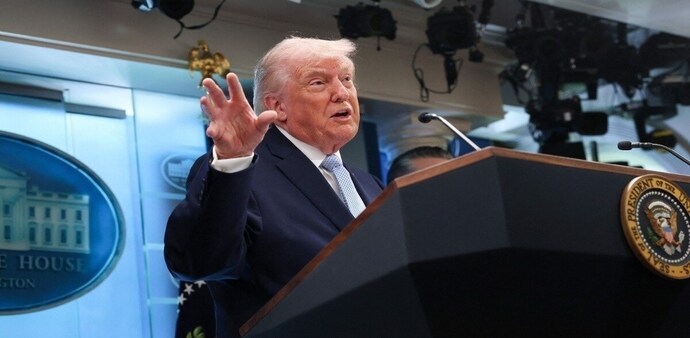
- Apr 27, 2026,
- Updated Apr 27, 2026 8:12 AM IST
US President Donald Trump said on Sunday that Iran could reach out directly to Washington if it wanted to negotiate an end to the war between the two countries. Trump's remarks came after he cancelled a planned visit by his representatives, Steve Witkoff and Jared Kushner, to Islamabad for talks with Iranian officials.
Speaking in an interview on Fox News, Trump said, "If they want to talk, they can come to us, or they can call us. You know, there is a telephone. We have nice, secure lines."
"They know what has to be in the agreement. It's very simple: they cannot have a nuclear weapon, otherwise there's no reason to meet," he added.
The cancellation followed Iranian Foreign Minister Abbas Araghchi's departure from Islamabad after meeting only Pakistani officials, though Araghchi has since returned to Pakistan despite the absence of US counterparts.
In a post on Truth Social on Saturday, Trump said, "I just cancelled the trip of my representatives" to Islamabad to meet the Iranians. He added, "Too much time wasted on travelling, too much work! Besides which, there is tremendous infighting and confusion within their 'leadership.' Nobody knows who is in charge, including them. Also, we have all the cards, they have none! If they want to talk, all they have to do is call!!!"
Meanwhile, Araghchi, in a post on X, described his Pakistan visit as "very fruitful". He wrote, he had a very fruitful visit to Pakistan, “whose good offices and brotherly efforts to bring back peace” they value. Pakistani Prime Minister Shehbaz Sharif too said in a statement, said he had "a most warm, cordial exchange of views on the current regional situation" with Araghchi.
Separately, Shehbaz spoke with Iranian President Masoud Pezeshkian on Saturday evening to discuss the evolving regional situation. According to the Prime Minister's Office, Shehbaz told the Iranian President that Pakistan was willing to serve as a "sincere and honest" facilitator for lasting peace in the region.
MUST READ | Iran war a 'gift to the world': Pete Hegseth says Strait of Hormuz blockade to continue
Even as Pakistan projected itself as a facilitator, an Iranian lawmaker publicly questioned Islamabad's suitability for that role. Ebrahim Rezaei, who represents Dashtestan and serves as spokesperson for Iran's National Security and Foreign Policy Commission, said on X that while Pakistan was a "good friend and neighbour", it was "not a suitable intermediary" and tended to align with US interests. He alleged that Islamabad avoids openly criticising Washington and does not highlight instances in which the US, according to him, did not fulfil commitments, including on Lebanon and blocked assets. "A mediator must be impartial," he said, "not always leaning to one side."
Rezaei's remarks came as Araghchi kept up a diplomatic push to sustain negotiations. On his second visit in three days to Islamabad, he held talks with Pakistan Army Chief Asim Munir on the conflict and possible ways forward. Iranian media reports said the discussions were extending beyond the nuclear issue and included proposals for a new legal framework for the Strait of Hormuz, compensation demands, guarantees against further military action, and the lifting of US maritime restrictions.
US President Donald Trump said on Sunday that Iran could reach out directly to Washington if it wanted to negotiate an end to the war between the two countries. Trump's remarks came after he cancelled a planned visit by his representatives, Steve Witkoff and Jared Kushner, to Islamabad for talks with Iranian officials.
Speaking in an interview on Fox News, Trump said, "If they want to talk, they can come to us, or they can call us. You know, there is a telephone. We have nice, secure lines."
"They know what has to be in the agreement. It's very simple: they cannot have a nuclear weapon, otherwise there's no reason to meet," he added.
The cancellation followed Iranian Foreign Minister Abbas Araghchi's departure from Islamabad after meeting only Pakistani officials, though Araghchi has since returned to Pakistan despite the absence of US counterparts.
In a post on Truth Social on Saturday, Trump said, "I just cancelled the trip of my representatives" to Islamabad to meet the Iranians. He added, "Too much time wasted on travelling, too much work! Besides which, there is tremendous infighting and confusion within their 'leadership.' Nobody knows who is in charge, including them. Also, we have all the cards, they have none! If they want to talk, all they have to do is call!!!"
Meanwhile, Araghchi, in a post on X, described his Pakistan visit as "very fruitful". He wrote, he had a very fruitful visit to Pakistan, “whose good offices and brotherly efforts to bring back peace” they value. Pakistani Prime Minister Shehbaz Sharif too said in a statement, said he had "a most warm, cordial exchange of views on the current regional situation" with Araghchi.
Separately, Shehbaz spoke with Iranian President Masoud Pezeshkian on Saturday evening to discuss the evolving regional situation. According to the Prime Minister's Office, Shehbaz told the Iranian President that Pakistan was willing to serve as a "sincere and honest" facilitator for lasting peace in the region.
MUST READ | Iran war a 'gift to the world': Pete Hegseth says Strait of Hormuz blockade to continue
Even as Pakistan projected itself as a facilitator, an Iranian lawmaker publicly questioned Islamabad's suitability for that role. Ebrahim Rezaei, who represents Dashtestan and serves as spokesperson for Iran's National Security and Foreign Policy Commission, said on X that while Pakistan was a "good friend and neighbour", it was "not a suitable intermediary" and tended to align with US interests. He alleged that Islamabad avoids openly criticising Washington and does not highlight instances in which the US, according to him, did not fulfil commitments, including on Lebanon and blocked assets. "A mediator must be impartial," he said, "not always leaning to one side."
Rezaei's remarks came as Araghchi kept up a diplomatic push to sustain negotiations. On his second visit in three days to Islamabad, he held talks with Pakistan Army Chief Asim Munir on the conflict and possible ways forward. Iranian media reports said the discussions were extending beyond the nuclear issue and included proposals for a new legal framework for the Strait of Hormuz, compensation demands, guarantees against further military action, and the lifting of US maritime restrictions.