
'Not a simple task': UK PM Starmer on reopening of Strait of Hormuz
The Strait of Hormuz is one of the world’s most important maritime chokepoints, linking the Persian Gulf to the Arabian Sea and serving as the main export route for oil producers in the Gulf.
- Mar 16, 2026,
- Updated Mar 16, 2026 6:14 PM IST
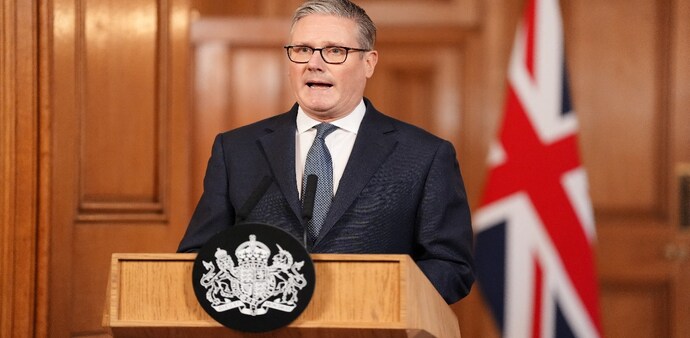
UK Prime Minister Keir Starmer said on Monday that Britain is working with its allies on a plan to reopen the Strait of Hormuz and restore freedom of navigation in the region, warning that stability in global energy markets depends on keeping the key waterway open.
Also read: First non-Iranian tanker crosses Strait of Hormuz with tracking signal on
Speaking at a press conference, Starmer said the recent US military operation had affected Iran’s military capability. "The US operation has ‘massively weakened’ the military capability of the ‘abhorrent regime in Iran’," he said.
However, the British PM added that the situation would ultimately require diplomacy. According to him, there will need to be a negotiated agreement after the conflict that limits Iran’s ability to rebuild its nuclear programme and ensures the safety of international shipping.
Starmer said reopening the Strait of Hormuz is critical to global trade and energy supplies.
The route must be reopened to “ensure stability in the markets,” he said, acknowledging that achieving this would not be easy.
“That is not a simple task,” Starmer said, adding that the UK is working with “all of our allies” to develop a “viable plan” to restore navigation through the strategic passage.
He also addressed questions about the possibility of deploying British troops as part of any security effort in the region. “Deciding whether to deploy UK troops is the toughest question for any prime minister,” Starmer said.
He said that if British forces are asked to operate in conflict zones, they must be assured that the mission is legally justified and carefully planned.
“If I'm going to send troops into harm's way, they deserve to know they can do so on a legal basis with a ‘properly thought out plan’,” he said.
Starmer added that his approach to leadership involves prioritising national interests even under pressure.
“I believe time will show that we have the right approach,” Starmer added.
Why the Strait of Hormuz matters
The Strait of Hormuz is one of the world’s most important maritime chokepoints, linking the Persian Gulf to the Arabian Sea and serving as the main export route for oil producers in the Gulf.
Countries such as Saudi Arabia, Iraq, Kuwait, Iran, the United Arab Emirates and Qatar ship most of their oil and gas through this narrow waterway.
Roughly one-fifth of the world’s oil consumption — more than 20 million barrels a day — moves through the strait, making it a vital artery for global energy markets.
Any disruption to shipping in the corridor can quickly push up oil prices and trigger economic ripple effects across energy-importing countries, particularly in Asia.
Recent tensions in West Asia have raised fears that the waterway could be blocked or disrupted, sending crude prices sharply higher and prompting governments to coordinate efforts to safeguard shipping.
UK Prime Minister Keir Starmer said on Monday that Britain is working with its allies on a plan to reopen the Strait of Hormuz and restore freedom of navigation in the region, warning that stability in global energy markets depends on keeping the key waterway open.
Also read: First non-Iranian tanker crosses Strait of Hormuz with tracking signal on
Speaking at a press conference, Starmer said the recent US military operation had affected Iran’s military capability. "The US operation has ‘massively weakened’ the military capability of the ‘abhorrent regime in Iran’," he said.
However, the British PM added that the situation would ultimately require diplomacy. According to him, there will need to be a negotiated agreement after the conflict that limits Iran’s ability to rebuild its nuclear programme and ensures the safety of international shipping.
Starmer said reopening the Strait of Hormuz is critical to global trade and energy supplies.
The route must be reopened to “ensure stability in the markets,” he said, acknowledging that achieving this would not be easy.
“That is not a simple task,” Starmer said, adding that the UK is working with “all of our allies” to develop a “viable plan” to restore navigation through the strategic passage.
He also addressed questions about the possibility of deploying British troops as part of any security effort in the region. “Deciding whether to deploy UK troops is the toughest question for any prime minister,” Starmer said.
He said that if British forces are asked to operate in conflict zones, they must be assured that the mission is legally justified and carefully planned.
“If I'm going to send troops into harm's way, they deserve to know they can do so on a legal basis with a ‘properly thought out plan’,” he said.
Starmer added that his approach to leadership involves prioritising national interests even under pressure.
“I believe time will show that we have the right approach,” Starmer added.
Why the Strait of Hormuz matters
The Strait of Hormuz is one of the world’s most important maritime chokepoints, linking the Persian Gulf to the Arabian Sea and serving as the main export route for oil producers in the Gulf.
Countries such as Saudi Arabia, Iraq, Kuwait, Iran, the United Arab Emirates and Qatar ship most of their oil and gas through this narrow waterway.
Roughly one-fifth of the world’s oil consumption — more than 20 million barrels a day — moves through the strait, making it a vital artery for global energy markets.
Any disruption to shipping in the corridor can quickly push up oil prices and trigger economic ripple effects across energy-importing countries, particularly in Asia.
Recent tensions in West Asia have raised fears that the waterway could be blocked or disrupted, sending crude prices sharply higher and prompting governments to coordinate efforts to safeguard shipping.