
'We would've won IN A LANDSLIDE if...': Donald Trump as Republicans continue to lose key turfs in US midterms
'We would've won IN A LANDSLIDE if...': Donald Trump as Republicans continue to lose key turfs in US midterms
His post on social media came as the Republicans continued to log massive losses, with the most notable being in South Carolina.
Business Today Desk
- Nov 4, 2026,
- Updated Nov 4, 2026 9:41 AM IST
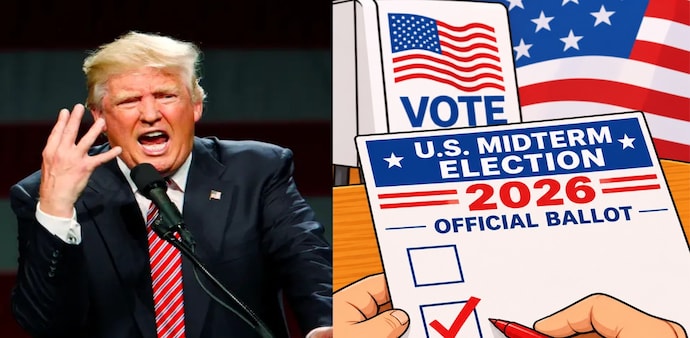
US President Donald Trump on Wednesday said that the Republicans would've logged a massive victory had the elections been fought on ballot paper. His post on social media came as the Republicans continued to log massive losses, with the most notable being in South Carolina.
In a post on Truth Social, the US President wrote, "I wasn’t on the Ballot and if I was, we would have won IN A LANDSLIDE! Thank you for your attention to this matter. President DONALD J. TRUMP."
Advertisement
He campaigned for many Republican candidates, urging voters at rallies to pretend as if he was on the ballot.
ALSO READ | US midterm elections: Democrats flip one of the four Senate seats they need to wrest control of the Congress
Democrats reverse Republican strongholds
The Democrats managed to reverse several Republican bastions - North Carolina, South Carolina, Texas, Pennsylvania, New Mexico.
In North Carolina, Democrat Roy Cooper flipped the seat as he defeated Republican Michael Whatley by securing 58.52% of the total votes. In South Carolina, Democrat Annie Andrews won against late Republican Senator Lindsey Graham's sister Darline Graham by a margin of more than 71,000 votes.
Advertisement
DON'T MISS | Huge setback to Trump: Republicans lose Lindsey Graham's Senate seat, Democrats win by huge margin
In Texas, Democrat Vicente Gonzalez defeated Republican Eric Flores by a margin of 30,855 votes. In Pennsylvania, Democrat Janelle Stelson won the election to the US House of Representatives, defeating Republican incumbent Scott Perry.
In New Mexico, Democrat Deb Haaland defeated Republican Greggory D. Hull, a former US interior secretary and member of Congress. While Haaland recorded a vote share of 56.6%, Greggory D. Hull managed to secure 43.4% of the total votes.
DO CHECKOUT | 'Won't be paying $4 billion a year to Israel': Donald Trump's big announcement on Election Day
Did the biggest setback come from Indian Americans?
Advertisement
The latest findings suggest in the Indian American Attitudes Survey (IAAS), conducted by the Carnegie Endowment for International Peace in partnership with YouGov, that Republican gains among Indian Americans in the 2024 presidential election have not translated into sustained congressional support. While 30 per cent backed Trump in the 2024 election, only 19 per cent now intend to vote for Republican House candidates.
Democratic support, meanwhile, has remained at 62 per cent. Among men aged 40 and above, support for Democrats rose from 53 per cent in the January 2026 survey to 68 per cent in October 2026. Republican support among this group fell from 32 to 16 per cent over the same period.
The October 2026 survey also found that 46 per cent of respondents identified as Democrats, compared with 62 per cent who said they intended to vote for Democratic candidates.
In the 2024 presidential election, 62 per cent of Indian Americans supported Kamala Harris, while 30 per cent backed Trump. By January 2026, support for Democrats had declined to 57 per cent, while support for Trump had risen to 25 per cent. The latest survey points to a reversal of that trend.
Read more!