
Maruti Suzuki launches India’s first flex-fuel car, ends chicken-and-egg dilemma
Large-scale adoption of flex-fuel vehicles will take time and effort from all stakeholders, says Maruti Suzuki MD & CEO Hisashi Takeuchi.
- Jun 4, 2026,
- Updated Jun 4, 2026 4:08 PM IST
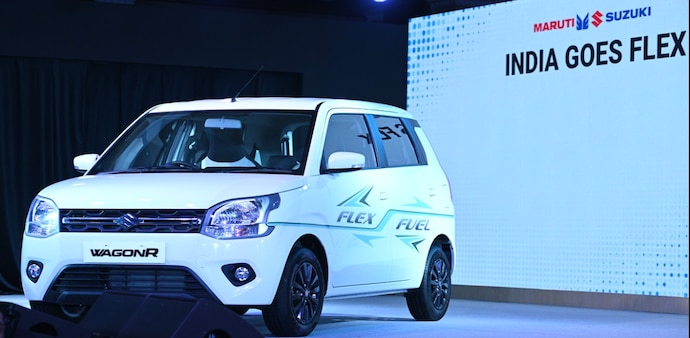
Maruti Suzuki India Ltd on Thursday launched the country’s first flex-fuel car with an E85 specification, a WagonR. However, the E85 fuel, a blend comprising 85% ethanol and 15% petrol, has yet to be available at petrol pumps.
“In the absence of an ecosystem, it is the responsibility of the market leader to take the first step and encourage others,” Hisashi Takeuchi, managing director and CEO, Maruti Suzuki, said at the launch.
Takeuchi, however, acknowledged that large-scale adoption of flex-fuel will take time and effort from all stakeholders. “An entire ecosystem needs to be developed – from fuel availability to more model launches, from customer awareness to fuel and vehicle pricing,” he said.
The company has yet to reveal the price of the car.
The flex-fuel version of the WagonR was launched by Union minister of road transport and highways Nitin Gadkari and Union minister of petroleum and natural gas Hardeep Singh Puri.
MUST READ | Maruti Suzuki WagonR flex-fuel launch on June 4: What to expect
Chicken-and-egg dilemma ends
The launch of the flex-fuel version of the Maruti Suzuki WagonR is significant because it comes even before E85 fuel has become commercially available in India. By introducing a flex-fuel passenger car ahead of fuel availability, Maruti Suzuki has effectively broken the long-standing "chicken-and-egg" dilemma over whether vehicles or fuel infrastructure should come first. The focus now shifts to building a nationwide supply ecosystem for flex-fuel. While the petroleum minister did not specify a timeline for the rollout of E85, he indicated that the fuel would be priced “substantially lower” than E20 petrol.
Maruti Suzuki’s WagonR flex-fuel launch brings flex-fuel technology to the mass market, ushering in a new chapter in India's energy transition, said Puri.
“In the beginning, we have about 200 dispensing station outlets in Delhi, NCR, and Mumbai, Pune, Natural, Corridor. These will expand to 500 by December this year, and approximately, God willing, to 5,000 outlets across major cities by end of next year,” he said.
India has over 30 crore two-wheelers and 37 lakh passenger vehicles on the road. “When flex fuel technology enters this segment at scale, the impact multiplies dramatically,” Puri added.
DON'T MISS | BT Explainer: What are flex-fuel cars and how they differ from EVs & hybrids?
E85 fuel price to determine success
Industry executives argue that E85 needs to be at least 30% cheaper than conventional petrol to make economic sense for consumers. The rationale is that ethanol contains roughly one-third less energy than petrol, meaning vehicles require a greater volume of fuel to travel the same distance.
Like any emerging automotive technology, flex-fuel vehicles will require supporting infrastructure. Similar to the ecosystem developed for compressed natural gas (CNG) vehicles over the past two decades and the expanding charging network for electric vehicles, fuel retail outlets will need modifications to dispense E85.
However, establishing E85 infrastructure is expected to be less complex and less capital-intensive than building networks for CNG or EV charging. The government could potentially repurpose existing dispensing systems used for high-octane fuels for E85 distribution. This is because regular petrol sold in India now has a Research Octane Number (RON) of 95, compared with RON 88 in earlier years. The shift to E20 blending has improved the fuel's octane rating and anti-knock characteristics, making the transition to E85 comparatively easier.
MUST READ | Here’s how many petrol pumps will offer E85 flex-fuel by 2026-end
Energy security
The Maruti Suzuki MD & CEO said achieving energy security with scale and speed is crucial. “Longterm dependence on imported crude oil cannot be an option. We need solutions that are cleaner, affordable, scalable, and based on India’s own strengths,” he said. “India has two national objectives: first, reduce dependence on imported crude oil. Second, reduce carbon emissions. Flex-fuel meets both,” Hisashi Takeuchi, managing director and CEO, Maruti Suzuki,” he added.
Maruti Suzuki India Ltd on Thursday launched the country’s first flex-fuel car with an E85 specification, a WagonR. However, the E85 fuel, a blend comprising 85% ethanol and 15% petrol, has yet to be available at petrol pumps.
“In the absence of an ecosystem, it is the responsibility of the market leader to take the first step and encourage others,” Hisashi Takeuchi, managing director and CEO, Maruti Suzuki, said at the launch.
Takeuchi, however, acknowledged that large-scale adoption of flex-fuel will take time and effort from all stakeholders. “An entire ecosystem needs to be developed – from fuel availability to more model launches, from customer awareness to fuel and vehicle pricing,” he said.
The company has yet to reveal the price of the car.
The flex-fuel version of the WagonR was launched by Union minister of road transport and highways Nitin Gadkari and Union minister of petroleum and natural gas Hardeep Singh Puri.
MUST READ | Maruti Suzuki WagonR flex-fuel launch on June 4: What to expect
Chicken-and-egg dilemma ends
The launch of the flex-fuel version of the Maruti Suzuki WagonR is significant because it comes even before E85 fuel has become commercially available in India. By introducing a flex-fuel passenger car ahead of fuel availability, Maruti Suzuki has effectively broken the long-standing "chicken-and-egg" dilemma over whether vehicles or fuel infrastructure should come first. The focus now shifts to building a nationwide supply ecosystem for flex-fuel. While the petroleum minister did not specify a timeline for the rollout of E85, he indicated that the fuel would be priced “substantially lower” than E20 petrol.
Maruti Suzuki’s WagonR flex-fuel launch brings flex-fuel technology to the mass market, ushering in a new chapter in India's energy transition, said Puri.
“In the beginning, we have about 200 dispensing station outlets in Delhi, NCR, and Mumbai, Pune, Natural, Corridor. These will expand to 500 by December this year, and approximately, God willing, to 5,000 outlets across major cities by end of next year,” he said.
India has over 30 crore two-wheelers and 37 lakh passenger vehicles on the road. “When flex fuel technology enters this segment at scale, the impact multiplies dramatically,” Puri added.
DON'T MISS | BT Explainer: What are flex-fuel cars and how they differ from EVs & hybrids?
E85 fuel price to determine success
Industry executives argue that E85 needs to be at least 30% cheaper than conventional petrol to make economic sense for consumers. The rationale is that ethanol contains roughly one-third less energy than petrol, meaning vehicles require a greater volume of fuel to travel the same distance.
Like any emerging automotive technology, flex-fuel vehicles will require supporting infrastructure. Similar to the ecosystem developed for compressed natural gas (CNG) vehicles over the past two decades and the expanding charging network for electric vehicles, fuel retail outlets will need modifications to dispense E85.
However, establishing E85 infrastructure is expected to be less complex and less capital-intensive than building networks for CNG or EV charging. The government could potentially repurpose existing dispensing systems used for high-octane fuels for E85 distribution. This is because regular petrol sold in India now has a Research Octane Number (RON) of 95, compared with RON 88 in earlier years. The shift to E20 blending has improved the fuel's octane rating and anti-knock characteristics, making the transition to E85 comparatively easier.
MUST READ | Here’s how many petrol pumps will offer E85 flex-fuel by 2026-end
Energy security
The Maruti Suzuki MD & CEO said achieving energy security with scale and speed is crucial. “Longterm dependence on imported crude oil cannot be an option. We need solutions that are cleaner, affordable, scalable, and based on India’s own strengths,” he said. “India has two national objectives: first, reduce dependence on imported crude oil. Second, reduce carbon emissions. Flex-fuel meets both,” Hisashi Takeuchi, managing director and CEO, Maruti Suzuki,” he added.