
India’s AI startups drive sector innovation, funding caps threaten growth
India startups are building state-of-the-art AI models for offering sector-based solutions to customers at scale.
- Oct 29, 2025,
- Updated Oct 29, 2025 9:44 PM IST
There are big players working on AI models at a large scale in the country, but also creating buzz are players in the startup ecosystem, who have lapped up the opportunity to provide sectoral solutions to customers through homegrown AI solutions.
Resilience AI, working in the space of natural disasters, is transforming disaster preparedness by helping enterprises, cities, and governments protect their climate-vulnerable assets. There has been tremendous investor interest that the company has generated over a period of time.
Samhita R, Co-founder and CEO, Resilience AI, says it’s a science-driven process which is used for solving some of the critical problems across sectors. The Resilience360™ AI/ML model has been trained over the last two years, spanning 750,000 structures in more than 25 real-time events for six types of disasters in more than 50 locations in the USA, Canada, Australia, Brazil, and India.
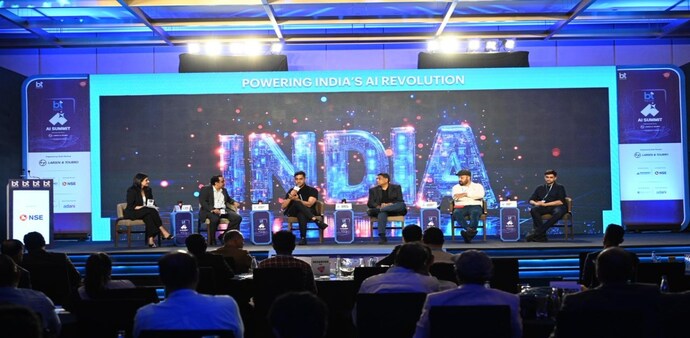
“There has been tremendous support from investors. I get two emails every month requesting a conversation for the product we have built. This shows investors are keen. It is simplifying and solving a real-world problem,” Samhita said, speaking at the Business Today AI Summit in Bengaluru.
Collaborations are the key to developing AI products for larger use, feel experts.
Prof. Ganesh Ramakrishnan, EVP & Principal Investigator, BharatGen, says they are working with IITs, IIMs and several other institutes for data collection to feed the model. BharatGen is a government-funded Multimodal Large Language Model project focused on creating efficient and inclusive AI in Indian languages.
“We are doing data collection from second-tier cities and libraries (for digitisation) that none of these big AI companies would. IBM recognises sovereign models, and they are building products on our models. Collaboration gives us domain-specific models in, let’s say, legal, healthcare and agriculture,” said Ramakrishnan.
On the need for a domestic skillset in AI, he says that there is a lot of potential in leveraging technological advancement anchored by our own people in the US. “We feel that probably there is a generation gap in what happens here and in Silicon Valley. Can our industries and government facilitate getting back professional talent?” he adds.
There has been work related to AI happening across sectors, and the auto industry is another key player where domestic startups are working on automation and driverless models.
We have all seen Tesla offering autonomous cars, but back in India, Gagandeep Reehal, Founder, Minus Zero, is building foundational AI models for autonomous driving. They are making autonomous driving smarter, scalable, and more accessible for emerging markets.
“How do you make foundational models which can ingest data, self-learning driving models that tackle real-world, unpredictable road conditions, the kind emerging markets like India struggle with? A technology that we can democratise for our auto OEMs,” said Reehal.
Reeju Datta, Co-founder, Cashfree, says the company is embedding AI into every layer of its payment stack. “I think the challenge is not integrating but getting results that could add value. A lot of effort is needed to get to results,” he added.
Cashfree is leveraging AI to drive efficiency in a compliance-heavy process like cross-border payments.
There are big players working on AI models at a large scale in the country, but also creating buzz are players in the startup ecosystem, who have lapped up the opportunity to provide sectoral solutions to customers through homegrown AI solutions.
Resilience AI, working in the space of natural disasters, is transforming disaster preparedness by helping enterprises, cities, and governments protect their climate-vulnerable assets. There has been tremendous investor interest that the company has generated over a period of time.
Samhita R, Co-founder and CEO, Resilience AI, says it’s a science-driven process which is used for solving some of the critical problems across sectors. The Resilience360™ AI/ML model has been trained over the last two years, spanning 750,000 structures in more than 25 real-time events for six types of disasters in more than 50 locations in the USA, Canada, Australia, Brazil, and India.
“There has been tremendous support from investors. I get two emails every month requesting a conversation for the product we have built. This shows investors are keen. It is simplifying and solving a real-world problem,” Samhita said, speaking at the Business Today AI Summit in Bengaluru.
Collaborations are the key to developing AI products for larger use, feel experts.
Prof. Ganesh Ramakrishnan, EVP & Principal Investigator, BharatGen, says they are working with IITs, IIMs and several other institutes for data collection to feed the model. BharatGen is a government-funded Multimodal Large Language Model project focused on creating efficient and inclusive AI in Indian languages.
“We are doing data collection from second-tier cities and libraries (for digitisation) that none of these big AI companies would. IBM recognises sovereign models, and they are building products on our models. Collaboration gives us domain-specific models in, let’s say, legal, healthcare and agriculture,” said Ramakrishnan.
On the need for a domestic skillset in AI, he says that there is a lot of potential in leveraging technological advancement anchored by our own people in the US. “We feel that probably there is a generation gap in what happens here and in Silicon Valley. Can our industries and government facilitate getting back professional talent?” he adds.
There has been work related to AI happening across sectors, and the auto industry is another key player where domestic startups are working on automation and driverless models.
We have all seen Tesla offering autonomous cars, but back in India, Gagandeep Reehal, Founder, Minus Zero, is building foundational AI models for autonomous driving. They are making autonomous driving smarter, scalable, and more accessible for emerging markets.
“How do you make foundational models which can ingest data, self-learning driving models that tackle real-world, unpredictable road conditions, the kind emerging markets like India struggle with? A technology that we can democratise for our auto OEMs,” said Reehal.
Reeju Datta, Co-founder, Cashfree, says the company is embedding AI into every layer of its payment stack. “I think the challenge is not integrating but getting results that could add value. A lot of effort is needed to get to results,” he added.
Cashfree is leveraging AI to drive efficiency in a compliance-heavy process like cross-border payments.