
'Vikram-1 will prove our commercial product': Skyroot Aerospace CEO Pawan Kumar Chandana as start-up gears up for lift-off
Skyroot Aerospace has the capacity to build one Vikram-1 a month, says co-founder and CEO Pawan Kumar Chandana.
- Jul 17, 2026,
- Updated Jul 17, 2026 9:03 PM IST
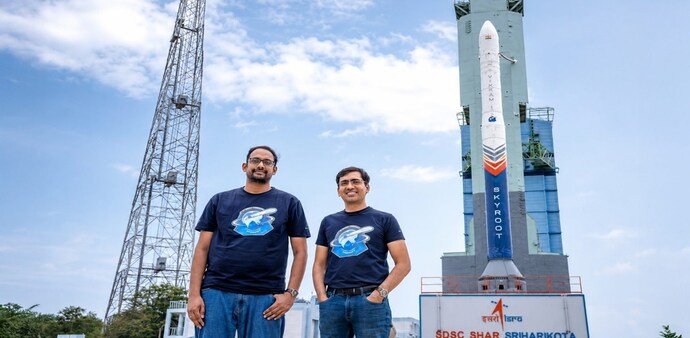
Skyroot Aerospace is gearing up for the maiden test flight of Vikram-1, an orbital-class rocket developed by a private player in India. A successful launch of Vikram-1 will demonstrate the start-up's commercial viability. The spacetech unicorn aims to gather valuable data from its first test flight mission ‘Aagaman’, which it says will be foundational to the startup’s aspirations of establishing launch cadence. Skyroot has the capacity to build one Vikram-1 a month.
Ahead of the lift-off of Vikram-1 on July 18, Business Today caught up with Pawan Kumar Chandana, the co-founder and CEO of Skyroot Aerospace.
Edited Excerpts:Q. Skyroot is set to launch Vikram-1. How big is this milestone for you?
It is the biggest step we have taken. In just over four years we have gone from Vikram-S, India's first private rocket, on a suborbital demonstration, to attempting orbital launch. That is a large leap. This is Vikram 1’s first test flight, a data-gathering mission. We will be getting real-flight data from every system, which no ground test can give us, and which feeds straight into the vehicles that follow. This will be significant for us and the national space ecosystem.
Q. When is the first commercial launch expected?
Our plan is to establish commercial readiness quickly, through a short series of test flights, and then build cadence. I would rather not put a hard date on the first fully commercial mission until we have flight data in hand, in this business the flight tells you the truth, and we let it set the timeline. What I can say is that the second vehicle is already in production, and between Skyroot’s 3 Hyderabad campuses we have the capacity to build one Vikram-1 a month.
Q. What would a successful Vikram-1 mission prove to customers and investors that Vikram-S could not?
Vikram-S validated the foundation. It proved our propulsion systems, our composite structures, and that a private Indian team could build and fly a rocket. Vikram-1 is a completely different challenge. It has multiple stages. It has to reach orbital velocity. It is heavier and far more complex. Successfully launching Vikram-1 means proving our actual commercial product. It shows that we can reliably take a customer's satellite and place it in the intended orbit. For customers, that changes us from a promising team into a launch provider they can trust and book. For investors, it de-risks our path to higher launch cadence and sustained revenue.
Q. You have often described launch services as a global business. Why do you expect overseas customers to form the bulk of Skyroot's demand?
The shortage of dedicated small satellite launch capacity is a global challenge. Today, the largest pools of funded satellite programmes are in the US, Japan, Europe and Southeast Asia.
At the same time, the market will diversify significantly. More countries will want sovereign satellite capabilities and independent access to space. That is a natural progression. Access to space will increasingly become a strategic necessity.
We expect about two-thirds of our demand to come from international markets. India's own demand is real and growing as the country builds its sovereign space capabilities. However, in the near term, the larger volume of demand will come from overseas, and India is well positioned to serve it.
India brings together several unique advantages. We have a trusted, decades-long track record in space. We have a cost-effective and largely indigenous supply chain. We are also a reliable partner for customers in both the West and the East. That combination is rare.
Q. What does India's emergence as a satellite broadband market mean for domestic launch providers?
It is one of the most important domestic tailwinds we have. India has made clear that it treats satellite connectivity as critical national infrastructure, and that pushes the country toward sovereign, India-controlled constellations rather than reliance on foreign networks. A sovereign constellation launched on a sovereign rocket is the logical outcome, and that is exactly the recurring domestic demand a provider like us is built to serve. As satellite constellations scale, it will create greater opportunities to the commercial case for domestic launch providers while supporting India’s ambition of building an end-to-end space ecosystem.
Q. Deep-tech companies often require patient capital. Has fundraising become easier now that private space has proven itself in India?
Materially, yes. When we started in 2018 there was no space policy and not a single Indian fund with a thesis for space tech; we were asking people to take a leap of faith on long R&D timelines. Today the sector has a track record, and that changes the conversation. This year we raised $60 million at a $1.1 billion pre-money valuation, with global and domestic investors backing us together. That said, deep tech still needs patient, conviction-led capital. It will never be as quick as consumer software. What has changed is that investors now understand the size of the prize.
Q. Is reusability essential to long-term competitiveness, or is there still room for expendable launch vehicles?
Both are true, for different jobs. For the dedicated small-satellite class we are serving today, at the cadence this segment needs, an expendable vehicle is the right and most economical answer. The numbers work. Reusability becomes essential as you move up in tonnage and volume, where recovering hardware materially changes cost per kilogram. That is precisely why our roadmap already includes a reusable launch vehicle further out, alongside the one-tonne-class Vikram-2. So it is not either/or. Expendable is right for now, reusability is where the scale game goes, and we are building for both.
Q. You left ISRO to build a private rocket company before the ecosystem really existed. Looking back, what was the biggest risk you underestimated?
That building the rocket was only half the job. A lot of work went into building everything around it, a supply chain that did not exist, a talent pool we had to train into rocket engineers, and the belief in the entire sector that we had to create before anyone would back one company in it. The engineering was hard, as we expected. Building the ecosystem around the engineering, in parallel, from scratch, was the part that took more out of us than we planned for.
Q. How big is the private orbital launch market? What kind of opportunities do you see?
The global satellite launch market is expected to rise from $12 billion to about $40 billion by 2035. But the number we should watch is demand. Independent forecasts point to roughly 16,900 small satellites needing to reach orbit between 2026 and 2035, and the dedicated launch supply to serve them simply does not exist yet. That gap is the opportunity. Dedicated small-sat launch, constellation replenishment, sovereign and strategic launch, and responsive access. Beyond launch itself, reliable access unlocks the entire downstream economy. India alone is targeting a $44 billion space economy by 2033. Reliable and repeatable launch services will be the backbone on which this economy will grow.
Q. How many launches per year does Skyroot need before the business becomes economically sustainable?
I would be cautious about a single magic number, because sustainability in this business is about consistent cadence, not one-off flights. A dedicated small-launch company works when it is flying regularly and predictably, that is what lets you spread fixed costs, hold customers, and price competitively. We have deliberately built capacity for about a vehicle a month across our two campuses, and our focus after these test flights is to build toward steady, repeatable cadence. Get the cadence right and the economics follow.
Q. Which part of the space value chain is India still weakest at?
India is genuinely strong at launch and increasingly at satellites and earth observation. The weaker links are two. One is the high-end component and electronics supply chain, space-grade semiconductors and certain specialised parts, where we still depend on imports. The other is the downstream layer, turning satellite data into large-scale commercial products and services, and building global go-to-market muscle. The upstream engineering talent is world-class. The components ecosystem and the commercial, applications end are where the country has the most room to grow.
Q. How important was the opening of ISRO facilities to private companies in Skyroot's journey?
It was foundational. We fly from a government-supported range with real capacity headroom, we have tested at national facilities, and we have drawn on six decades of institutional expertise through ISRO and IN-SPACe. The 2020 reforms and IN-SPACe gave the sector its architecture. Being able to build on it, as partners, is one of India's biggest structural advantages and a large part of why an Indian launch company can move as fast as we have.
Q. Are Indian space startups competing with ISRO or complementing it?
Complementing, clearly. Governments have played a major role in sustaining every successful private launch company. You can see this across advanced spacefaring nations. This is how the ecosystem works. The agency anchors and pushes the frontier of exploration, science and human spaceflight, and industry scales the volume of routine, commercial launch. ISRO transferring proven vehicles and technologies to industry is exactly that division of labour taking shape. We exist because ISRO built the foundation that makes a private launch industry possible.
Q. What percentage of Vikram's components are sourced domestically, and where are the biggest import dependencies?
Vikram-1 is about 90% indigenous, designed, built and assembled in India, from our carbon-composite structures to our 3D-printed engines. The remaining share is mostly specialised electronic components and a few raw materials where a qualified domestic source does not yet exist.
Skyroot Aerospace is gearing up for the maiden test flight of Vikram-1, an orbital-class rocket developed by a private player in India. A successful launch of Vikram-1 will demonstrate the start-up's commercial viability. The spacetech unicorn aims to gather valuable data from its first test flight mission ‘Aagaman’, which it says will be foundational to the startup’s aspirations of establishing launch cadence. Skyroot has the capacity to build one Vikram-1 a month.
Ahead of the lift-off of Vikram-1 on July 18, Business Today caught up with Pawan Kumar Chandana, the co-founder and CEO of Skyroot Aerospace.
Edited Excerpts:Q. Skyroot is set to launch Vikram-1. How big is this milestone for you?
It is the biggest step we have taken. In just over four years we have gone from Vikram-S, India's first private rocket, on a suborbital demonstration, to attempting orbital launch. That is a large leap. This is Vikram 1’s first test flight, a data-gathering mission. We will be getting real-flight data from every system, which no ground test can give us, and which feeds straight into the vehicles that follow. This will be significant for us and the national space ecosystem.
Q. When is the first commercial launch expected?
Our plan is to establish commercial readiness quickly, through a short series of test flights, and then build cadence. I would rather not put a hard date on the first fully commercial mission until we have flight data in hand, in this business the flight tells you the truth, and we let it set the timeline. What I can say is that the second vehicle is already in production, and between Skyroot’s 3 Hyderabad campuses we have the capacity to build one Vikram-1 a month.
Q. What would a successful Vikram-1 mission prove to customers and investors that Vikram-S could not?
Vikram-S validated the foundation. It proved our propulsion systems, our composite structures, and that a private Indian team could build and fly a rocket. Vikram-1 is a completely different challenge. It has multiple stages. It has to reach orbital velocity. It is heavier and far more complex. Successfully launching Vikram-1 means proving our actual commercial product. It shows that we can reliably take a customer's satellite and place it in the intended orbit. For customers, that changes us from a promising team into a launch provider they can trust and book. For investors, it de-risks our path to higher launch cadence and sustained revenue.
Q. You have often described launch services as a global business. Why do you expect overseas customers to form the bulk of Skyroot's demand?
The shortage of dedicated small satellite launch capacity is a global challenge. Today, the largest pools of funded satellite programmes are in the US, Japan, Europe and Southeast Asia.
At the same time, the market will diversify significantly. More countries will want sovereign satellite capabilities and independent access to space. That is a natural progression. Access to space will increasingly become a strategic necessity.
We expect about two-thirds of our demand to come from international markets. India's own demand is real and growing as the country builds its sovereign space capabilities. However, in the near term, the larger volume of demand will come from overseas, and India is well positioned to serve it.
India brings together several unique advantages. We have a trusted, decades-long track record in space. We have a cost-effective and largely indigenous supply chain. We are also a reliable partner for customers in both the West and the East. That combination is rare.
Q. What does India's emergence as a satellite broadband market mean for domestic launch providers?
It is one of the most important domestic tailwinds we have. India has made clear that it treats satellite connectivity as critical national infrastructure, and that pushes the country toward sovereign, India-controlled constellations rather than reliance on foreign networks. A sovereign constellation launched on a sovereign rocket is the logical outcome, and that is exactly the recurring domestic demand a provider like us is built to serve. As satellite constellations scale, it will create greater opportunities to the commercial case for domestic launch providers while supporting India’s ambition of building an end-to-end space ecosystem.
Q. Deep-tech companies often require patient capital. Has fundraising become easier now that private space has proven itself in India?
Materially, yes. When we started in 2018 there was no space policy and not a single Indian fund with a thesis for space tech; we were asking people to take a leap of faith on long R&D timelines. Today the sector has a track record, and that changes the conversation. This year we raised $60 million at a $1.1 billion pre-money valuation, with global and domestic investors backing us together. That said, deep tech still needs patient, conviction-led capital. It will never be as quick as consumer software. What has changed is that investors now understand the size of the prize.
Q. Is reusability essential to long-term competitiveness, or is there still room for expendable launch vehicles?
Both are true, for different jobs. For the dedicated small-satellite class we are serving today, at the cadence this segment needs, an expendable vehicle is the right and most economical answer. The numbers work. Reusability becomes essential as you move up in tonnage and volume, where recovering hardware materially changes cost per kilogram. That is precisely why our roadmap already includes a reusable launch vehicle further out, alongside the one-tonne-class Vikram-2. So it is not either/or. Expendable is right for now, reusability is where the scale game goes, and we are building for both.
Q. You left ISRO to build a private rocket company before the ecosystem really existed. Looking back, what was the biggest risk you underestimated?
That building the rocket was only half the job. A lot of work went into building everything around it, a supply chain that did not exist, a talent pool we had to train into rocket engineers, and the belief in the entire sector that we had to create before anyone would back one company in it. The engineering was hard, as we expected. Building the ecosystem around the engineering, in parallel, from scratch, was the part that took more out of us than we planned for.
Q. How big is the private orbital launch market? What kind of opportunities do you see?
The global satellite launch market is expected to rise from $12 billion to about $40 billion by 2035. But the number we should watch is demand. Independent forecasts point to roughly 16,900 small satellites needing to reach orbit between 2026 and 2035, and the dedicated launch supply to serve them simply does not exist yet. That gap is the opportunity. Dedicated small-sat launch, constellation replenishment, sovereign and strategic launch, and responsive access. Beyond launch itself, reliable access unlocks the entire downstream economy. India alone is targeting a $44 billion space economy by 2033. Reliable and repeatable launch services will be the backbone on which this economy will grow.
Q. How many launches per year does Skyroot need before the business becomes economically sustainable?
I would be cautious about a single magic number, because sustainability in this business is about consistent cadence, not one-off flights. A dedicated small-launch company works when it is flying regularly and predictably, that is what lets you spread fixed costs, hold customers, and price competitively. We have deliberately built capacity for about a vehicle a month across our two campuses, and our focus after these test flights is to build toward steady, repeatable cadence. Get the cadence right and the economics follow.
Q. Which part of the space value chain is India still weakest at?
India is genuinely strong at launch and increasingly at satellites and earth observation. The weaker links are two. One is the high-end component and electronics supply chain, space-grade semiconductors and certain specialised parts, where we still depend on imports. The other is the downstream layer, turning satellite data into large-scale commercial products and services, and building global go-to-market muscle. The upstream engineering talent is world-class. The components ecosystem and the commercial, applications end are where the country has the most room to grow.
Q. How important was the opening of ISRO facilities to private companies in Skyroot's journey?
It was foundational. We fly from a government-supported range with real capacity headroom, we have tested at national facilities, and we have drawn on six decades of institutional expertise through ISRO and IN-SPACe. The 2020 reforms and IN-SPACe gave the sector its architecture. Being able to build on it, as partners, is one of India's biggest structural advantages and a large part of why an Indian launch company can move as fast as we have.
Q. Are Indian space startups competing with ISRO or complementing it?
Complementing, clearly. Governments have played a major role in sustaining every successful private launch company. You can see this across advanced spacefaring nations. This is how the ecosystem works. The agency anchors and pushes the frontier of exploration, science and human spaceflight, and industry scales the volume of routine, commercial launch. ISRO transferring proven vehicles and technologies to industry is exactly that division of labour taking shape. We exist because ISRO built the foundation that makes a private launch industry possible.
Q. What percentage of Vikram's components are sourced domestically, and where are the biggest import dependencies?
Vikram-1 is about 90% indigenous, designed, built and assembled in India, from our carbon-composite structures to our 3D-printed engines. The remaining share is mostly specialised electronic components and a few raw materials where a qualified domestic source does not yet exist.