
Battle for Bengal: Only 3 parties ruled state since 1947. Will Kolkata see a new CM in 2026?
The contest is not just political — it is deeply tied to how successive Chief Ministers have shaped (and seen decline in) the state’s share of India’s GDP. The CM’s office in Kolkata has historically carried both political dominance and economic consequence.
- Apr 27, 2026,
- Updated Apr 27, 2026 8:00 PM IST
As the 2026 West Bengal Assembly elections unfold, the central question dominating political discourse is simple yet loaded: will Kolkata see a new Chief Minister, or will the incumbent retain her grip on power?
The contest is not just political — it is deeply tied to how successive Chief Ministers have shaped (and seen decline in) the state’s share of India’s GDP. The CM’s office in Kolkata has historically carried both political dominance and economic consequence.
Mamata Banerjee: Welfare-led growth, shrinking GDP share
The incumbent Chief Minister from the All India Trinamool Congress (TMC) has been in power since 2011 and remains the first woman CM of the state.
GDP share during tenure:
- Around 6.7% of India’s GDP in 2010-11 (when she took office)
- Declined to about 5.6% in 2023-24
Don't miss | No land, no car, no luxuries: Take a look at West Bengal CM Mamata Banerjee’s net worth
Economic pattern:
- Expansion in welfare schemes and consumption-led growth
- Services sector dominance (over half of GSDP)
- Growth often trailing the national average
Reading the trend: Despite stable governance and social spending, Bengal’s relative economic weight in India has continued to decline — reflecting structural issues like weak industrialisation and limited private investment.
Left Front era: Long rule, steady decline in economic share
The Communist Party of India (Marxist)-led Left Front governed for 34 years — the longest uninterrupted regime in any Indian state.
Jyoti Basu: The longest-serving CM. He remains India’s longest-serving Chief Minister (1977-2000).
Estimated GDP share trajectory during his era:
- Late 1970s-early 1980s: Roughly 8-9% of India’s GDP
- By the late 1990s: Closer to 7-8%
Economic model:
- Landmark land reforms and rural empowerment
- Strong agricultural growth in the 1980s
- Persistent industrial stagnation over time
Buddhadeb Bhattacharjee: Attempted industrial revival. He led the state from 2000 to 2011.
GDP share by end of tenure: Around 6.7% by 2010-11
Economic approach:
- Push for industrialisation (Singur, Nandigram)
- Efforts to attract private investment
- Political backlash over land acquisition slowed reforms
Reading the Left era: While rural inequality reduced and governance stabilised, Bengal’s relative economic importance steadily eroded, especially as other states surged post-liberalisation.
Must read | Why West Bengal’s share in India’s GDP has declined across political regimes
Congress era: When Bengal was an economic powerhouse
Before 1977, leaders like Bidhan Chandra Roy of the Indian National Congress oversaw a very different Bengal.
GDP share context:
- Around 10.5% of India’s GDP in 1960-61
- Among the top industrial contributors in the country
Economic profile:
- Strong industrial base centred around Kolkata
- Per capita income above the national average
Reading this phase: This period represents Bengal’s economic high point — before decades of relative decline set in.
2026: A leadership choice with economic consequences
- A TMC win would mean continuity under Mamata Banerjee and a welfare-led growth model.
- A BJP victory, with leaders like Suvendu Adhikari, could shift focus toward industrial expansion.
- A Left resurgence would revive debates around redistribution versus industrial policy.
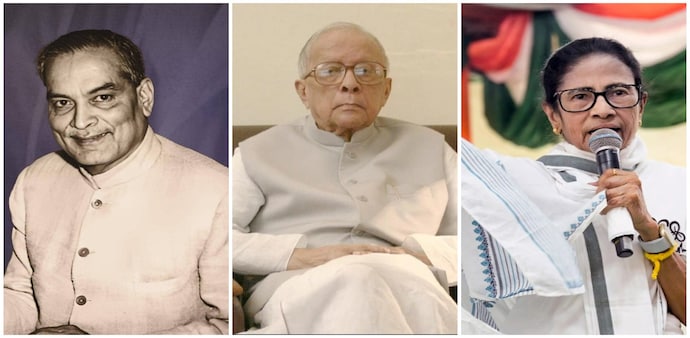
From Bidhan Chandra Roy to Jyoti Basu to Mamata Banerjee, West Bengal’s Chief Ministers have defined distinct political eras.
Yet one economic pattern persists: The state has grown in absolute terms, but its share in India’s GDP has steadily declined.
The 2026 verdict will not just decide who occupies the Chief Minister’s office — it may determine whether West Bengal can reverse a decades-long slide in its national economic standing.
As the 2026 West Bengal Assembly elections unfold, the central question dominating political discourse is simple yet loaded: will Kolkata see a new Chief Minister, or will the incumbent retain her grip on power?
The contest is not just political — it is deeply tied to how successive Chief Ministers have shaped (and seen decline in) the state’s share of India’s GDP. The CM’s office in Kolkata has historically carried both political dominance and economic consequence.
Mamata Banerjee: Welfare-led growth, shrinking GDP share
The incumbent Chief Minister from the All India Trinamool Congress (TMC) has been in power since 2011 and remains the first woman CM of the state.
GDP share during tenure:
- Around 6.7% of India’s GDP in 2010-11 (when she took office)
- Declined to about 5.6% in 2023-24
Don't miss | No land, no car, no luxuries: Take a look at West Bengal CM Mamata Banerjee’s net worth
Economic pattern:
- Expansion in welfare schemes and consumption-led growth
- Services sector dominance (over half of GSDP)
- Growth often trailing the national average
Reading the trend: Despite stable governance and social spending, Bengal’s relative economic weight in India has continued to decline — reflecting structural issues like weak industrialisation and limited private investment.
Left Front era: Long rule, steady decline in economic share
The Communist Party of India (Marxist)-led Left Front governed for 34 years — the longest uninterrupted regime in any Indian state.
Jyoti Basu: The longest-serving CM. He remains India’s longest-serving Chief Minister (1977-2000).
Estimated GDP share trajectory during his era:
- Late 1970s-early 1980s: Roughly 8-9% of India’s GDP
- By the late 1990s: Closer to 7-8%
Economic model:
- Landmark land reforms and rural empowerment
- Strong agricultural growth in the 1980s
- Persistent industrial stagnation over time
Buddhadeb Bhattacharjee: Attempted industrial revival. He led the state from 2000 to 2011.
GDP share by end of tenure: Around 6.7% by 2010-11
Economic approach:
- Push for industrialisation (Singur, Nandigram)
- Efforts to attract private investment
- Political backlash over land acquisition slowed reforms
Reading the Left era: While rural inequality reduced and governance stabilised, Bengal’s relative economic importance steadily eroded, especially as other states surged post-liberalisation.
Must read | Why West Bengal’s share in India’s GDP has declined across political regimes
Congress era: When Bengal was an economic powerhouse
Before 1977, leaders like Bidhan Chandra Roy of the Indian National Congress oversaw a very different Bengal.
GDP share context:
- Around 10.5% of India’s GDP in 1960-61
- Among the top industrial contributors in the country
Economic profile:
- Strong industrial base centred around Kolkata
- Per capita income above the national average
Reading this phase: This period represents Bengal’s economic high point — before decades of relative decline set in.
2026: A leadership choice with economic consequences
- A TMC win would mean continuity under Mamata Banerjee and a welfare-led growth model.
- A BJP victory, with leaders like Suvendu Adhikari, could shift focus toward industrial expansion.
- A Left resurgence would revive debates around redistribution versus industrial policy.
From Bidhan Chandra Roy to Jyoti Basu to Mamata Banerjee, West Bengal’s Chief Ministers have defined distinct political eras.
Yet one economic pattern persists: The state has grown in absolute terms, but its share in India’s GDP has steadily declined.
The 2026 verdict will not just decide who occupies the Chief Minister’s office — it may determine whether West Bengal can reverse a decades-long slide in its national economic standing.