












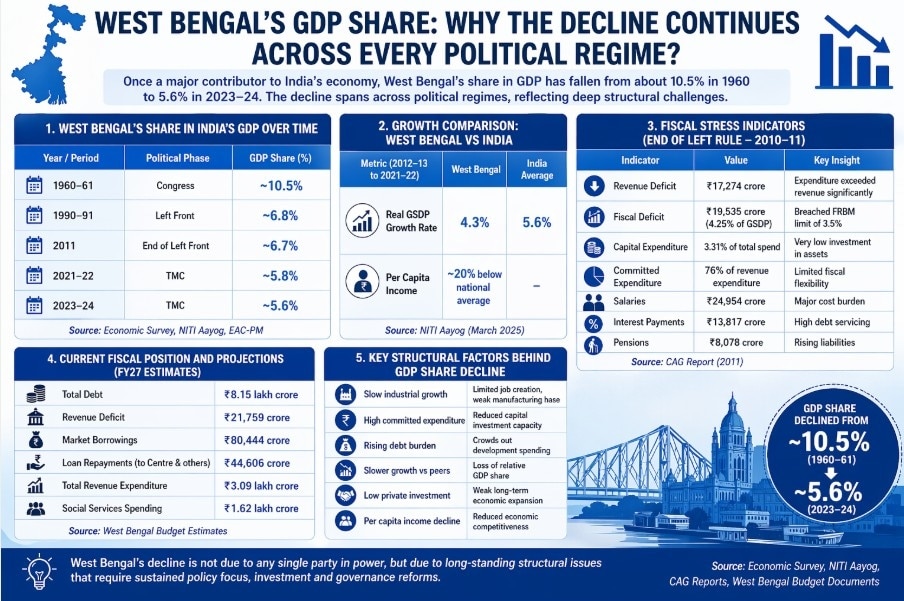



 Bengal’s GDP share decline is structural, driven by industrial slowdown, fiscal constraints, slower growth, and weak private investment—not any single party.
Bengal news: West Bengal’s economic trajectory presents a paradox: steady growth in absolute terms, yet a persistent decline in its share of India’s GDP across decades and governments. From contributing around 10.5% to India’s GDP in 1960, the state’s share has fallen to about 5.6% in 2023–24, according to recent estimates and policy reports. This long-term slide spans multiple political regimes — from Congress to the Left Front and now the Trinamool Congress (TMC) — suggesting structural, rather than purely political, causes.
At a headline level, the state’s economy is growing. The Economic Survey 2025 notes that West Bengal’s Net State Domestic Product (NSDP) reached ₹16.32 lakh crore in FY25, with growth improving to around 9%. However, this growth has not kept pace with faster-expanding states, resulting in a relative decline in national share. In essence, West Bengal is growing—but others are growing faster.

 Why Zerodha Fund House is bullish on life cycle funds
 Ex-IMF economist Surjit Bhalla backs 7.8% GDP number: 'No evidence of exaggeration'
 Air India sacks Phuket-Delhi pilot after psychoactive substance test comes back positive
 BT Explainer: Why Volkswagen Group plans to axe 12% of its workforce in India
 NSE IPO update: SEBI approval likely next week; Check expected dates of price band and listing
 #DemocraticNewsroom | '800 Million People On Subsidies': Siddharth Zarabi On India’s K-Shaped Economy
 #DemocraticNewsroom | India Inflation Data: Are Official Numbers Hiding The Real Economic Picture?
 GDP Real Or Fudged? Siddharth Zarabi Defends India’s Growth Numbers With Data
 Financial Planning For Couples: How To Build A Strong Financial Plan, Budget & Wealth Together
 “High Sugar, Salt, Fat”: FSSAI CEO On Proposed Red Warning Labels On Food Packs
 56% rally in TBZ stock: Upper circuit led to record high today; here's why
  Sensex, Nifty snap four sessions of losing streak; RIL, Tata Steel, Bajaj Finance boost sentiment
  Physicswallah shares jump 9% as Motilal Oswal sees 66% upside
 KEC International: At 52-week low, Geojit expects more downside in infra stockNSE IPO update: SEBI approval likely next week; Check expected dates of price band and listing
 US debt hits $40 trillion: Why India should worry about rising yields, rupee and capital flows now
 Axis Bank Scapia credit card goes live: Check lounge access, UPI rewards, forex benefits and fees
 From HUL to local jewellery brands: Bigg Boss creates a two-tier advertising ecosystem
 HbA1c of 6.4% is NOT 'almost normal': Why this borderline reading can be a warning sign
 China’s oil use drops sharply: Expert says EV shift is changing global energy demand


