
Delimitation Bill, 2026 a 'great deal' for Southern states, says BJP's Tejasvi Surya. Here's why
Parliament session: The bill was tabled in the Lok Sabha along with the Constitution (131st Amendment) Bill, 2026, by Union Law Minister Arjun Ram Meghwal, whereas Union Home Minister Amit Shah tabled the Union Territories Law (Amendment) Bill, 2026.
- Apr 16, 2026,
- Updated Apr 16, 2026 2:56 PM IST
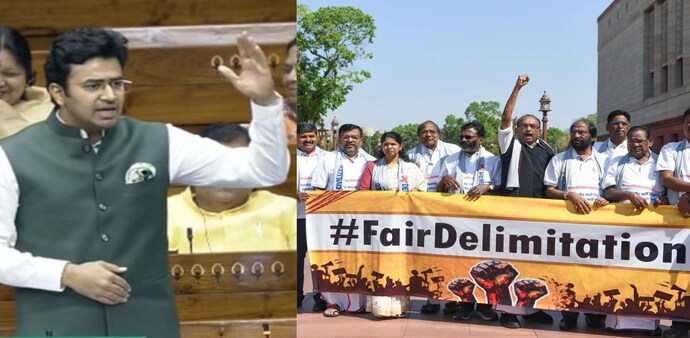
Parliament session latest: BJP MP Tejasvi Surya on Thursday said in the Parliament that the Delimitation Bill, 2026, tabled in the Parliament is a "great deal" for Southern states. The bill was tabled in the Lok Sabha along with the Constitution (131st Amendment) Bill, 2026, by Union Law Minister Arjun Ram Meghwal, whereas Union Home Minister Amit Shah tabled the Union Territories Law (Amendment) Bill, 2026.
He slammed the opposition for spreading misinformation among the South Indian states. Surya asserted that "the South could not have got a better deal than this" while responding to Congress MP Gaurav Gogoi.
Questioning the opposition, he said, “On what basis do you want this delimitation exercise to be conducted? Will the rich have more votes and the poor have none?”
Dismissing the opposition's arguments as politically motivated, the BJP MP asked, “If you take this argument further, Mukesh Ambani will have one lakh votes and someone like us will have only one vote. Is this the kind of logic the Congress wants to build?”
Is delimitation actually a 'great deal' for the South?
According to government sources, the southern states have nothing to lose as the 2011 Census would not be used to allocate Lok Sabha seats. Surya mentioned in a thread on X, "The five Southern states together gain 66 additional seats, while their collective share remains exactly 23.7 per cent. The arithmetic of government formation does not change."
Tamil Nadu's share in the Lok Sabha will increase from the current 39 seats to 59. The number of Lok Sabha seats for Andhra Pradesh will increase by 13 seats from 25 to 38.
Lok Sabha seats in Karnataka will rise from 28 to 42. While Kerala's share in the Lok Sabha will rise from 20 to 30 seats, Telangana's will go up from 17 to 26.
Surya said that the delimitation exercise will safeguard South's interests, specifically Tamil Nadu and Kerala.
"Without intervention, Tamil Nadu loses eight seats. Under this proposal, it gains 20. Kerala avoids losing a third of its representation and instead gains ten seats. Opposition to this model is, in effect, opposition to the South's interests demanding a smaller voice in the name of national adjustment."
On the Nari Shakti Vandana Adhiniyam, he said that out of Kerala's proposed 30 seats, 4 would be reserved for women. "Out of Kerala's expanded 30 seats, four would be reserved for women but Kerala now has 30 seats, not 12. The structural absorption of political displacement works in the South's favour. Women get their constitutionally mandated one-third. Southern states keep their voice."
Back in the Parliament, Surya said that delimitation is not a "backdoor exercise" but is being conducted in line with the existing constitutional provisions.
He mentioned that freezing Lok Sabha seats while implementing women's reservation would undermine Article 81's principle of "one person, one vote, one value."
He added that delimitation is a constitutional mandate under Articles 81 and 82, which require balancing the ratio between population and seats as well as redrawing territorial constituencies.
Surya rejected Telangana CM Revanth Reddy's argument of linking delimitation with GSDP, calling it unconstitutional. He mentioned that GSDP figures fluctuate and can't be a basis for seat allocation, and it would lead to changing constituencies constantly.
He termed the proposal as "ludicrous" and "laughable". He also explained how this would actually improve governance.
"Today, an MP in Karnataka represents nearly 25 lakh people. After expansion, that number drops to around 16 lakh. In Tamil Nadu, it falls from 19 lakh to about 13 lakh. Smaller constituencies mean more accountable representatives, greater responsiveness to local needs, and stronger democratic delivery. This is not just a numbers game, it is a democratic dividend for every citizen in every state," Surya wrote on X.
Meanwhile, former Odisha chief minister Naveen Patnaik backed the Women's Reservation and Delimitation Bills only if Odisha's rights remain fully protected. He urged current CM Mohan Charan Majhi to take up the issue strongly and called for a special Assembly session within 48 hours to pass a resolution to ensure that not even 0.001 per cent of the state's rights are compromised.
Parliament session latest: BJP MP Tejasvi Surya on Thursday said in the Parliament that the Delimitation Bill, 2026, tabled in the Parliament is a "great deal" for Southern states. The bill was tabled in the Lok Sabha along with the Constitution (131st Amendment) Bill, 2026, by Union Law Minister Arjun Ram Meghwal, whereas Union Home Minister Amit Shah tabled the Union Territories Law (Amendment) Bill, 2026.
He slammed the opposition for spreading misinformation among the South Indian states. Surya asserted that "the South could not have got a better deal than this" while responding to Congress MP Gaurav Gogoi.
Questioning the opposition, he said, “On what basis do you want this delimitation exercise to be conducted? Will the rich have more votes and the poor have none?”
Dismissing the opposition's arguments as politically motivated, the BJP MP asked, “If you take this argument further, Mukesh Ambani will have one lakh votes and someone like us will have only one vote. Is this the kind of logic the Congress wants to build?”
Is delimitation actually a 'great deal' for the South?
According to government sources, the southern states have nothing to lose as the 2011 Census would not be used to allocate Lok Sabha seats. Surya mentioned in a thread on X, "The five Southern states together gain 66 additional seats, while their collective share remains exactly 23.7 per cent. The arithmetic of government formation does not change."
Tamil Nadu's share in the Lok Sabha will increase from the current 39 seats to 59. The number of Lok Sabha seats for Andhra Pradesh will increase by 13 seats from 25 to 38.
Lok Sabha seats in Karnataka will rise from 28 to 42. While Kerala's share in the Lok Sabha will rise from 20 to 30 seats, Telangana's will go up from 17 to 26.
Surya said that the delimitation exercise will safeguard South's interests, specifically Tamil Nadu and Kerala.
"Without intervention, Tamil Nadu loses eight seats. Under this proposal, it gains 20. Kerala avoids losing a third of its representation and instead gains ten seats. Opposition to this model is, in effect, opposition to the South's interests demanding a smaller voice in the name of national adjustment."
On the Nari Shakti Vandana Adhiniyam, he said that out of Kerala's proposed 30 seats, 4 would be reserved for women. "Out of Kerala's expanded 30 seats, four would be reserved for women but Kerala now has 30 seats, not 12. The structural absorption of political displacement works in the South's favour. Women get their constitutionally mandated one-third. Southern states keep their voice."
Back in the Parliament, Surya said that delimitation is not a "backdoor exercise" but is being conducted in line with the existing constitutional provisions.
He mentioned that freezing Lok Sabha seats while implementing women's reservation would undermine Article 81's principle of "one person, one vote, one value."
He added that delimitation is a constitutional mandate under Articles 81 and 82, which require balancing the ratio between population and seats as well as redrawing territorial constituencies.
Surya rejected Telangana CM Revanth Reddy's argument of linking delimitation with GSDP, calling it unconstitutional. He mentioned that GSDP figures fluctuate and can't be a basis for seat allocation, and it would lead to changing constituencies constantly.
He termed the proposal as "ludicrous" and "laughable". He also explained how this would actually improve governance.
"Today, an MP in Karnataka represents nearly 25 lakh people. After expansion, that number drops to around 16 lakh. In Tamil Nadu, it falls from 19 lakh to about 13 lakh. Smaller constituencies mean more accountable representatives, greater responsiveness to local needs, and stronger democratic delivery. This is not just a numbers game, it is a democratic dividend for every citizen in every state," Surya wrote on X.
Meanwhile, former Odisha chief minister Naveen Patnaik backed the Women's Reservation and Delimitation Bills only if Odisha's rights remain fully protected. He urged current CM Mohan Charan Majhi to take up the issue strongly and called for a special Assembly session within 48 hours to pass a resolution to ensure that not even 0.001 per cent of the state's rights are compromised.