
Indian Army launches Bharat Rice for troops; signs MoU with FCI to strengthen military logistics
Under the new arrangement, Bharat Rice will be supplied directly to army supply depots rather than being collected by army depots from local FCI facilities
- Oct 12, 2026,
- Updated Oct 12, 2026 7:56 PM IST
The Indian Army on Monday launched ‘Bharat Rice’ for defence personnel, with supplies set to be delivered directly to Army Supply Depots, including those in Ladakh and the Northeast.
The initiative is aimed at improving the quality of rations and easing the transportation of food supplies to troops deployed in remote and difficult terrains.
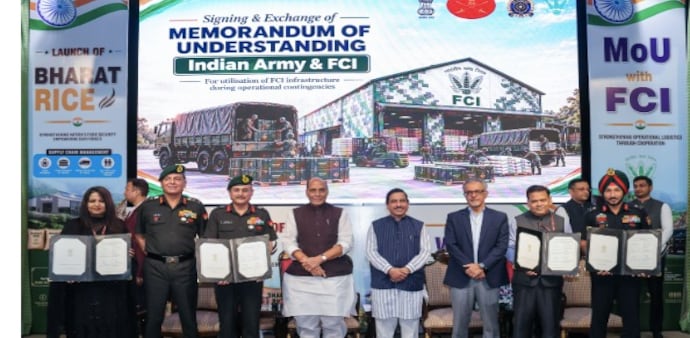
The launch, attended by Defence Minister Rajnath Singh and Consumer Affairs, Food and Public Distribution Minister Pralhad Joshi, also saw the signing of a memorandum of understanding (MoU) between the Indian Army and the Food Corporation of India (FCI) to use the latter’s infrastructure during operational contingencies.
Under the new arrangement, Bharat Rice will be supplied directly to Army Supply Depots rather than being collected by Army depots from local FCI facilities. The rice will be milled according to prescribed defence specifications and supplied through the National Agricultural Cooperative Marketing Federation of India Limited (NAFED) during the financial year 2026-27.
The rice will undergo quality-control checks and is expected to have minimal broken, damaged and discoloured grains, with no foreign matter or admixtures. It will be procured in 10-kg and 30-kg bags to facilitate handling and transportation, particularly at forward posts.
FCI infrastructure to support Army logistics
The MoU provides the Indian Army with a formal framework to use identified FCI warehouses, storage infrastructure, manpower and material-handling equipment during operational contingencies. The arrangement will remain valid for five years and can be extended by mutual consent.
Coordination will take place between the Army’s Supply and Transport elements and FCI’s regional and divisional offices, with the arrangements integrated into operational logistics plans.
The agreement is expected to facilitate additional storage, rapid mobilisation and forward positioning of rations, stores and equipment closer to operational areas. This is intended to strengthen the responsiveness and resilience of military logistics while making better use of existing national infrastructure.
Addressing the event, Singh said that logistics had become a critical component of modern warfare, with supply chains, storage capacity, transportation networks and timely replenishment playing an important role alongside weapons and technology.
He also referred to the lessons from Operation Sindoor, highlighting the need to build resilient logistics chains that can sustain military operations when warning times are short and contingencies arise at short notice.
“The strategic analysis of Operation Sindoor indicated that warning times could be extremely short in future conflicts,” Singh said, adding that the country needed to strengthen its logistics resilience to sustain operations.
Jai Jawan, Jai Kisan link
Singh described Bharat Rice as a link between farmers and soldiers, saying the initiative gave practical expression to the spirit of ‘Jai Jawan, Jai Kisan’.
He said soldiers’ operational readiness depended not only on weaponry but also on their physical health, mental balance, morale and stamina, particularly when serving in harsh conditions. Access to quality food, he added, was an integral part of soldiers’ welfare and national security.
The Defence Minister also highlighted the potential for civilian infrastructure to support military requirements. He cited the use of expressways for fighter aircraft operations and roads and bridges built by the Border Roads Organisation that also serve local residents.
Similarly, FCI’s warehouses and other facilities could become an integral part of the Army’s supply chain during contingencies, he said, describing the approach as one that would optimise resources and strengthen national resilience.
The initiative follows nearly 18 months of coordination among the Army, FCI, NAFED and the Department of Food and Public Distribution. The Army has also undertaken measures to improve ration quality and scales in recent years, including additional rations for Agniveer recruits and greater commonality in ration scales across the three services. The introduction of organic rations has also been proposed.
The event was attended by Chief of the Army Staff General Dhiraj Seth, Secretary of the Department of Food and Public Distribution Sanjeev Chopra, and Rabindra Kumar Agarwal, Chairman of FCI.
The Indian Army on Monday launched ‘Bharat Rice’ for defence personnel, with supplies set to be delivered directly to Army Supply Depots, including those in Ladakh and the Northeast.
The initiative is aimed at improving the quality of rations and easing the transportation of food supplies to troops deployed in remote and difficult terrains.
The launch, attended by Defence Minister Rajnath Singh and Consumer Affairs, Food and Public Distribution Minister Pralhad Joshi, also saw the signing of a memorandum of understanding (MoU) between the Indian Army and the Food Corporation of India (FCI) to use the latter’s infrastructure during operational contingencies.
Under the new arrangement, Bharat Rice will be supplied directly to Army Supply Depots rather than being collected by Army depots from local FCI facilities. The rice will be milled according to prescribed defence specifications and supplied through the National Agricultural Cooperative Marketing Federation of India Limited (NAFED) during the financial year 2026-27.
The rice will undergo quality-control checks and is expected to have minimal broken, damaged and discoloured grains, with no foreign matter or admixtures. It will be procured in 10-kg and 30-kg bags to facilitate handling and transportation, particularly at forward posts.
FCI infrastructure to support Army logistics
The MoU provides the Indian Army with a formal framework to use identified FCI warehouses, storage infrastructure, manpower and material-handling equipment during operational contingencies. The arrangement will remain valid for five years and can be extended by mutual consent.
Coordination will take place between the Army’s Supply and Transport elements and FCI’s regional and divisional offices, with the arrangements integrated into operational logistics plans.
The agreement is expected to facilitate additional storage, rapid mobilisation and forward positioning of rations, stores and equipment closer to operational areas. This is intended to strengthen the responsiveness and resilience of military logistics while making better use of existing national infrastructure.
Addressing the event, Singh said that logistics had become a critical component of modern warfare, with supply chains, storage capacity, transportation networks and timely replenishment playing an important role alongside weapons and technology.
He also referred to the lessons from Operation Sindoor, highlighting the need to build resilient logistics chains that can sustain military operations when warning times are short and contingencies arise at short notice.
“The strategic analysis of Operation Sindoor indicated that warning times could be extremely short in future conflicts,” Singh said, adding that the country needed to strengthen its logistics resilience to sustain operations.
Jai Jawan, Jai Kisan link
Singh described Bharat Rice as a link between farmers and soldiers, saying the initiative gave practical expression to the spirit of ‘Jai Jawan, Jai Kisan’.
He said soldiers’ operational readiness depended not only on weaponry but also on their physical health, mental balance, morale and stamina, particularly when serving in harsh conditions. Access to quality food, he added, was an integral part of soldiers’ welfare and national security.
The Defence Minister also highlighted the potential for civilian infrastructure to support military requirements. He cited the use of expressways for fighter aircraft operations and roads and bridges built by the Border Roads Organisation that also serve local residents.
Similarly, FCI’s warehouses and other facilities could become an integral part of the Army’s supply chain during contingencies, he said, describing the approach as one that would optimise resources and strengthen national resilience.
The initiative follows nearly 18 months of coordination among the Army, FCI, NAFED and the Department of Food and Public Distribution. The Army has also undertaken measures to improve ration quality and scales in recent years, including additional rations for Agniveer recruits and greater commonality in ration scales across the three services. The introduction of organic rations has also been proposed.
The event was attended by Chief of the Army Staff General Dhiraj Seth, Secretary of the Department of Food and Public Distribution Sanjeev Chopra, and Rabindra Kumar Agarwal, Chairman of FCI.