
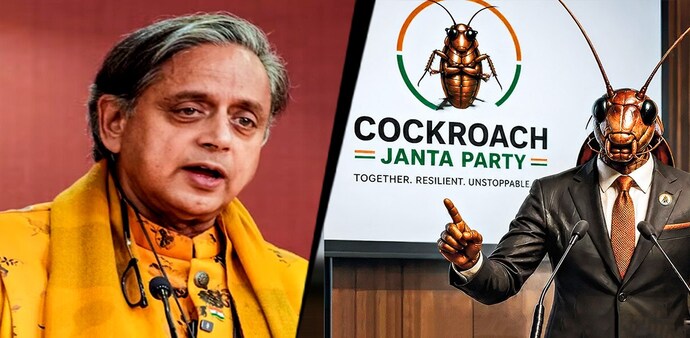
Instagram is your town square, not a ballot box: Shashi Tharoor writes to Gen Z who signed up for Cockroach Janta Party
Tharoor wrote that while the reasons why Gen Z Indians signed up for the CJP are valid, there is a danger in mistaking an outlet for one’s frustration as the solution to their problems.
- Jun 4, 2026,
- Updated Jun 4, 2026 10:55 AM IST
Rage can ignite a fire but it needs a steady hand to give shape to what one wants, said Shashi Tharoor, Congress MP from Thiruvananthapuram. In a column for The Indian Express, Tharoor advised Gen Z Indians on what to do now that they have formed a party and highlighted the flaws in our systems.
He said that while Abhijeet Dipke’s movement has captured the imagination of the Gen Zs who are frustrated by the inadequacies in India’s political system. “Instagram is your town square. But it is not a ballot box. To those of you feeling lost, angry, and disillusioned: your pain is seen, and your anger is heard,” he added.
Tharoor wrote that while the reasons why Gen Z Indians signed up for the CJP are valid, there is a danger in mistaking an outlet for one’s frustration as the solution to their problems. CJP’s emergence is a heartbreaking piece of political theatre, he said, one that captures the feeling of being treated as disposable by a system that appears unresponsive to the struggles of ordinary citizens.
He urged Gen Z to not stop only at venting and finding solidarity in the movement. “History shows us that while rage can ignite a fire, it requires a steady hand and a clear strategy to build a structure that endures. Instagram alone doesn’t do it,” he said, adding that the energy must be channeled into bending the system.
Tharoor advised Gen Z Indians on what they could do next:
Make the representatives accountable: He asked them to flood offices of the local MLAs and MPs, make use of the RTI (Right to Information) Act to demand transparency.
Leverage institutional pressure: Tharoor asked them to organise their dissent around specific, actionable demands. And since the media thrives on narratives, they would be bound to cover the demands, and force parliamentarians to act on it as well. “Don’t forget there’s a lot that still works well in India. Make it work for you,” he said.
Professionalise the advocacy: He asked them to engage with student unions, legal collectives, and policy advocacy groups who know how to draft petitions and fight cases in courts. Tharoor said that the most successful movements organised, drafted, lobbied and agitated.
Don’t forget the power of participation: Tharoor said that true change happens in the mundane processes of daily politics, where participation is necessary if one wants to ‘strip the “system” of its comfortable default inertia’.
Tharoor said that it is easy to feel that the game is rigged and to feel like giving up, but that Gen Zs are the ‘demographic majority in a nation that is still defining its identity’.
“Frustration is not an end in itself. You don’t need to be treated like cockroaches, and you don’t need to adopt the label as your permanent identity. Work with mainstream politicians of your choice, of all parties, to be the rebuilders of a system that respects the dignity of every student and every job-seeker,” he said.
Rage can ignite a fire but it needs a steady hand to give shape to what one wants, said Shashi Tharoor, Congress MP from Thiruvananthapuram. In a column for The Indian Express, Tharoor advised Gen Z Indians on what to do now that they have formed a party and highlighted the flaws in our systems.
He said that while Abhijeet Dipke’s movement has captured the imagination of the Gen Zs who are frustrated by the inadequacies in India’s political system. “Instagram is your town square. But it is not a ballot box. To those of you feeling lost, angry, and disillusioned: your pain is seen, and your anger is heard,” he added.
Tharoor wrote that while the reasons why Gen Z Indians signed up for the CJP are valid, there is a danger in mistaking an outlet for one’s frustration as the solution to their problems. CJP’s emergence is a heartbreaking piece of political theatre, he said, one that captures the feeling of being treated as disposable by a system that appears unresponsive to the struggles of ordinary citizens.
He urged Gen Z to not stop only at venting and finding solidarity in the movement. “History shows us that while rage can ignite a fire, it requires a steady hand and a clear strategy to build a structure that endures. Instagram alone doesn’t do it,” he said, adding that the energy must be channeled into bending the system.
Tharoor advised Gen Z Indians on what they could do next:
Make the representatives accountable: He asked them to flood offices of the local MLAs and MPs, make use of the RTI (Right to Information) Act to demand transparency.
Leverage institutional pressure: Tharoor asked them to organise their dissent around specific, actionable demands. And since the media thrives on narratives, they would be bound to cover the demands, and force parliamentarians to act on it as well. “Don’t forget there’s a lot that still works well in India. Make it work for you,” he said.
Professionalise the advocacy: He asked them to engage with student unions, legal collectives, and policy advocacy groups who know how to draft petitions and fight cases in courts. Tharoor said that the most successful movements organised, drafted, lobbied and agitated.
Don’t forget the power of participation: Tharoor said that true change happens in the mundane processes of daily politics, where participation is necessary if one wants to ‘strip the “system” of its comfortable default inertia’.
Tharoor said that it is easy to feel that the game is rigged and to feel like giving up, but that Gen Zs are the ‘demographic majority in a nation that is still defining its identity’.
“Frustration is not an end in itself. You don’t need to be treated like cockroaches, and you don’t need to adopt the label as your permanent identity. Work with mainstream politicians of your choice, of all parties, to be the rebuilders of a system that respects the dignity of every student and every job-seeker,” he said.