
'Never tagged robodog as Indian': Govt debunks Chinese media claim on robodog display at AI Summit
Responding to a post by the handle “China Pulse”, the Fact Check Unit clarified that the claim was false and that the minister had “nowhere stated” that the robot presented by Galgotias University was an Indian robot.
- Feb 18, 2026,
- Updated Feb 18, 2026 9:08 PM IST
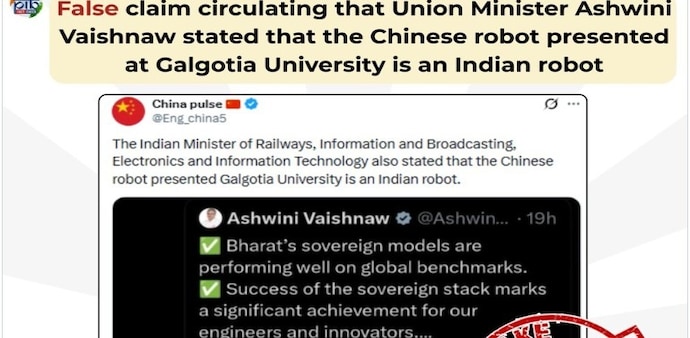
The government’s PIB Fact Check Unit has refuted a claim circulating on social media that Union Minister for Electronics and IT Ashwini Vaishnaw described a robot showcased at Galgotias University as an Indian-made product. Responding to a post by the handle “China Pulse”, the Fact Check Unit clarified that the claim was false and that the minister had “nowhere stated” that the robot presented by Galgotias University was an Indian robot.
The clarification comes amid a broader controversy involving Galgotias University, which has faced online scrutiny over allegations that it misrepresented a Chinese-made robotic dog as its own innovation during the India AI Impact Summit. The robot, displayed at the university’s stall, attracted significant attention from visitors and media, quickly becoming one of the most talked-about exhibits at the event.
Questions over the robot’s origin surfaced after a video from the summit went viral on social media. In the clip, a representative from Galgotias University is seen explaining the robot dog’s capabilities during a media interaction. Shortly after the video gained traction, social media users and technology observers identified the machine as the Unitree Go2 — a commercially available robotic dog manufactured by Chinese robotics firm Unitree and sold globally.
This led to allegations that the university was passing off imported technology as indigenous innovation. The issue escalated rapidly, triggering widespread online backlash and extensive media coverage, particularly given the summit’s focus on promoting India’s domestic AI and technology ecosystem.
In response, Galgotias University issued an official statement through its social media channels, strongly denying any attempt to mislead. The university clarified that it had never claimed to have built the robotic dog in-house. It stated that the device had been procured from Unitree, a Chinese manufacturer, and was being used strictly as a teaching and demonstration tool for students.
According to the university, the objective of showcasing the robot was to provide students with hands-on exposure to advanced robotics and AI systems currently available in the global market. The statement added that Galgotias University routinely acquires cutting-edge technologies from around the world to enable students to study, analyse, and challenge existing solutions, rather than to present them as original inventions developed on campus.
The university further emphasised that there was no intention to misrepresent the robot’s origin and that any interpretation suggesting otherwise was incorrect. It maintained that transparency around the source of the technology was always part of its internal academic use.
However, the controversy had tangible consequences. Following the intense online debate and scrutiny, summit organisers reportedly asked Galgotias University to vacate its stall at the India AI Impact Summit expo. The move came at a time when the use of foreign technology has become a sensitive issue at high-profile technology events, particularly those with government participation and a strong emphasis on indigenous innovation.
The government’s PIB Fact Check Unit has refuted a claim circulating on social media that Union Minister for Electronics and IT Ashwini Vaishnaw described a robot showcased at Galgotias University as an Indian-made product. Responding to a post by the handle “China Pulse”, the Fact Check Unit clarified that the claim was false and that the minister had “nowhere stated” that the robot presented by Galgotias University was an Indian robot.
The clarification comes amid a broader controversy involving Galgotias University, which has faced online scrutiny over allegations that it misrepresented a Chinese-made robotic dog as its own innovation during the India AI Impact Summit. The robot, displayed at the university’s stall, attracted significant attention from visitors and media, quickly becoming one of the most talked-about exhibits at the event.
Questions over the robot’s origin surfaced after a video from the summit went viral on social media. In the clip, a representative from Galgotias University is seen explaining the robot dog’s capabilities during a media interaction. Shortly after the video gained traction, social media users and technology observers identified the machine as the Unitree Go2 — a commercially available robotic dog manufactured by Chinese robotics firm Unitree and sold globally.
This led to allegations that the university was passing off imported technology as indigenous innovation. The issue escalated rapidly, triggering widespread online backlash and extensive media coverage, particularly given the summit’s focus on promoting India’s domestic AI and technology ecosystem.
In response, Galgotias University issued an official statement through its social media channels, strongly denying any attempt to mislead. The university clarified that it had never claimed to have built the robotic dog in-house. It stated that the device had been procured from Unitree, a Chinese manufacturer, and was being used strictly as a teaching and demonstration tool for students.
According to the university, the objective of showcasing the robot was to provide students with hands-on exposure to advanced robotics and AI systems currently available in the global market. The statement added that Galgotias University routinely acquires cutting-edge technologies from around the world to enable students to study, analyse, and challenge existing solutions, rather than to present them as original inventions developed on campus.
The university further emphasised that there was no intention to misrepresent the robot’s origin and that any interpretation suggesting otherwise was incorrect. It maintained that transparency around the source of the technology was always part of its internal academic use.
However, the controversy had tangible consequences. Following the intense online debate and scrutiny, summit organisers reportedly asked Galgotias University to vacate its stall at the India AI Impact Summit expo. The move came at a time when the use of foreign technology has become a sensitive issue at high-profile technology events, particularly those with government participation and a strong emphasis on indigenous innovation.