
Six in 10 Indians face heat stress, but only 10% have AC access: McKinsey flags growing climate risk
Six in ten Indians face heat stress, but only 10% have access to air-conditioning, a McKinsey report reveals. With climate adaptation costs potentially reaching 3% of GDP, India faces a widening gap between rising temperatures and affordable protection.
- Nov 3, 2026,
- Updated Nov 3, 2026 8:30 PM IST
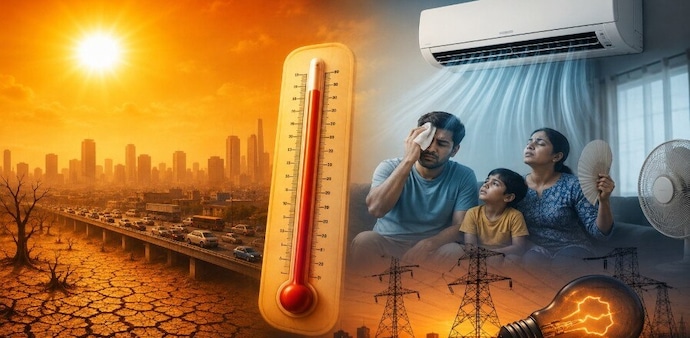
Nearly 60% of India's population lives in areas already experiencing heat stress, yet air-conditioning coverage remains at just 10%, highlighting a significant gap in the country's ability to protect households from rising temperatures. A new McKinsey Global Institute (MGI) report warns that India faces substantial financial and infrastructure challenges in adapting to extreme weather, even as the economic benefits of climate protection increasingly outweigh its costs.
The November 2026 report, Advancing Adaptation: Breaking Barriers to a Trillion-Dollar Opportunity, examines the investments required to protect populations against heat, drought, flooding and wildfires.
How does India compare with other countries?
McKinsey's findings reveal sharp differences in heat exposure and access to cooling across countries.
Around 60% of India's population and 30% of Nigeria's population live in areas experiencing heat stress. However, air-conditioning coverage stands at approximately 10% in India and just 3% in Nigeria.
In contrast, only about 4% of the US population currently faces heat stress, while air-conditioning coverage exceeds 90%.
The comparison underscores how developing economies face greater climate exposure despite having fewer resources to protect vulnerable households.
MUST READ: India hits climate target 5 years early, targets 500 GW green capacity: PM Modi
Why is heat stress becoming an economic concern?
Heat stress is not merely a household comfort issue. Prolonged exposure can affect health, reduce labour productivity and disrupt economic activity.
Workers in agriculture, construction and other outdoor occupations face particular challenges because their jobs often involve extended exposure to high temperatures.
McKinsey estimates that protecting populations against heat stress could require approximately $568 billion annually worldwide under a scenario involving 2°C warming.
Air-conditioning alone could account for 38% of total global adaptation costs, making active cooling one of the largest investment categories.
Other measures include urban trees, reflective roofs, passive building cooling and temporary cooling shelters.
ALSO READ: Your mutual fund investments face climate risk. Find out why
How much could India need to spend?
According to McKinsey, providing developed-economy standards of climate protection under a 2°C warming scenario could cost India an estimated 2–3% of GDP.
By comparison, the corresponding requirement for higher-income regions, including North America and the EU-30, is estimated at just 0.3–0.5% of GDP.
However, the challenge extends beyond the overall investment requirement.
The report estimates that less than 20% of India's adaptation investment needs are currently deployment-ready, meaning most potential projects face significant demand, affordability or financing barriers.
In wealthier regions, more than half of adaptation requirements could be deployment-ready.
DO READ: Super El Niño death map: 8,57,000 heat-related deaths projected worldwide. Where India stands?
Why is climate protection investment lagging?
McKinsey identifies limited household resources, competing spending priorities, weak financing mechanisms and implementation challenges as major obstacles.
Globally, spending on 20 established adaptation measures stands at approximately $190 billion annually, against $540 billion needed to provide developed-economy protection standards under current climate conditions.
The report estimates that adaptation measures generate benefits worth roughly three times their costs on average, through avoided damage, health impacts and productivity losses.
For India, the findings highlight the importance of affordable cooling technologies, resilient buildings and better financing mechanisms.
As temperatures rise, expanding access to effective cooling and heat protection could become increasingly important for household welfare, workforce productivity and economic resilience.