
'You can't succeed without New Delhi': Ex-US diplomat warns Trump on de-risking from China
The former diplomat said nothing fundamental has changed about "either of our country's strategic interests vis-a-vis China."
- Aug 20, 2025,
- Updated Aug 20, 2025 5:06 PM IST
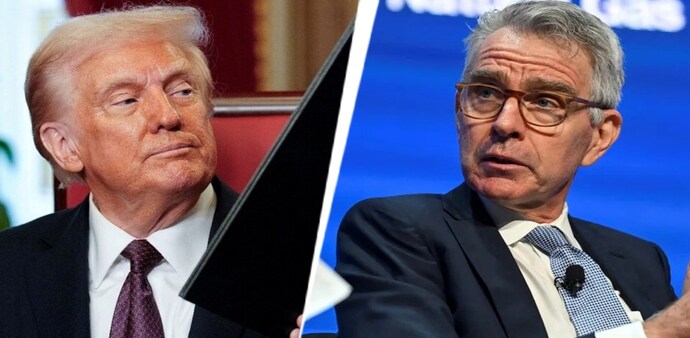
Former US diplomat Geoffrey Pyatt has warned that the Trump administration's strategy to reduce dependency on China cannot succeed without a strong and confident partnership with India.
"For the United States, the Trump administration's overarching strategic goal is to reduce our dependency on China, to de-risk our dependency on key strategic imports from China. You can't have success in that strategy without a strong and confident relationship between Delhi and Washington," Pyatt told NDTV in an interview on Tuesday.
His remarks come amid rising tensions between India and the US following the imposition of a 50% tariff on Indian exports linked to its Russian oil trade.
Pyatt acknowledged the toll this has taken on bilateral trust. "There's been significant damage done to the underlying foundation of trust that has enabled us to make progress in this relationship through multiple governments from multiple political parties in both Delhi and Washington. That needs to be resolved as quickly as possible."
The former diplomat also said that nothing fundamental has changed about "either of our country's strategic interests vis-a-vis China." It's going to be a complicated relationship for decades to come because of China's alternative vision of how the international system should be organised, he added.
On China's growing economic and strategic leverage, Pyatt emphasised the need for both nations - India and the US - to insulate themselves from supply risks. "We have to continue the work that began in the Biden administration, so that both India and the United States do not find themselves again in the future in a situation where China is able to cut off supplies in a manner that endangers both our civilian economy sectors."
He stressed that the rare earths challenge is not only economic, but strategic. "You talked about all the areas where rare earth materials have technology applications, but you left out one critical category, which is defense...advanced fighter jets, advanced sensors...That's why the Trump administration has put a major focus on diversifying our supply chains. And frankly, this is yet another illustration of how the strategic interests of India and the United States converge.”
Asked about the friction over India's continued defense and energy ties with Russia, Pyatt framed the relationship as a Cold War hangover. "I view the Russia-India defense relationship as largely a legacy - a hangover, if you will - of the Cold War days. There is no comparison whatsoever between the kind of technology offering and the partnership that’s emerging between US defense contractors working in India...and what Russia offers with legacy Soviet technology."
Pyatt acknowledged India's insistence on strategic autonomy but argued that deeper defense cooperation with the US remains in New Delhi's interest. "The best way for India to strengthen its own security and its defense capabilities is exactly what we’ve been doing over the past several decades."
Former US diplomat Geoffrey Pyatt has warned that the Trump administration's strategy to reduce dependency on China cannot succeed without a strong and confident partnership with India.
"For the United States, the Trump administration's overarching strategic goal is to reduce our dependency on China, to de-risk our dependency on key strategic imports from China. You can't have success in that strategy without a strong and confident relationship between Delhi and Washington," Pyatt told NDTV in an interview on Tuesday.
His remarks come amid rising tensions between India and the US following the imposition of a 50% tariff on Indian exports linked to its Russian oil trade.
Pyatt acknowledged the toll this has taken on bilateral trust. "There's been significant damage done to the underlying foundation of trust that has enabled us to make progress in this relationship through multiple governments from multiple political parties in both Delhi and Washington. That needs to be resolved as quickly as possible."
The former diplomat also said that nothing fundamental has changed about "either of our country's strategic interests vis-a-vis China." It's going to be a complicated relationship for decades to come because of China's alternative vision of how the international system should be organised, he added.
On China's growing economic and strategic leverage, Pyatt emphasised the need for both nations - India and the US - to insulate themselves from supply risks. "We have to continue the work that began in the Biden administration, so that both India and the United States do not find themselves again in the future in a situation where China is able to cut off supplies in a manner that endangers both our civilian economy sectors."
He stressed that the rare earths challenge is not only economic, but strategic. "You talked about all the areas where rare earth materials have technology applications, but you left out one critical category, which is defense...advanced fighter jets, advanced sensors...That's why the Trump administration has put a major focus on diversifying our supply chains. And frankly, this is yet another illustration of how the strategic interests of India and the United States converge.”
Asked about the friction over India's continued defense and energy ties with Russia, Pyatt framed the relationship as a Cold War hangover. "I view the Russia-India defense relationship as largely a legacy - a hangover, if you will - of the Cold War days. There is no comparison whatsoever between the kind of technology offering and the partnership that’s emerging between US defense contractors working in India...and what Russia offers with legacy Soviet technology."
Pyatt acknowledged India's insistence on strategic autonomy but argued that deeper defense cooperation with the US remains in New Delhi's interest. "The best way for India to strengthen its own security and its defense capabilities is exactly what we’ve been doing over the past several decades."