
'A bigger shift than the internet': Adani CFO to Uday Kotak on Anthropic's $1.5 trillion valuation
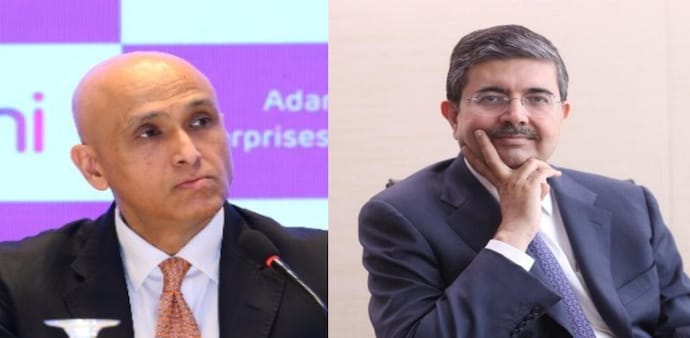
Responding to banker Uday Kotak's observations on Anthropic's valuation and the relative valuations of Indian companies, Singh said in a social media post that traditional businesses and frontier AI companies operate in fundamentally different economic categories.
- Nov 19, 2026,
- Updated Nov 19, 2026 3:38 PM IST
Adani Group Chief Financial Officer Jugeshinder Singh on Thursday defended the $1.5 trillion valuation of artificial intelligence company Anthropic, arguing that comparing its market value with India's top 10 corporates reflects a misunderstanding of how AI is reshaping the global economy.
Responding to banker Uday Kotak's observations on Anthropic's valuation and the relative valuations of Indian companies, Singh said in a social media post that traditional businesses and frontier AI companies operate in fundamentally different economic categories.
ALSO READ | Anthropic IPO: AI firm prices shares at $83, set to challenge SpaceX's $1.77 trillion record
What did Jugeshinder Singh say?
"Comparing Anthropic’s $1.5T valuation to India’s top 10 corporates as 'undervaluation' vs. 'catching up' is a textbook category error in asset pricing," Singh said in a social media post.
He argued that traditional blue-chip companies in sectors such as banking, energy and consumer staples are linked to the growth of the human economy, with their expansion constrained by demographics, credit penetration, physical consumption and human working hours.
In contrast, Singh described Anthropic as a "call option on synthetic GDP", arguing that frontier AI models are not merely software-as-a-service tools but the "infrastructure of intelligence" powering a parallel digital workforce.
"Cognitive labor is decoupling from human population growth," he said, adding that AI systems could operate around the clock and scale at the marginal cost of computing.
DON'T MISS | From $20 mn homes to $800K boats: Anthropic’s record IPO is igniting a Bay Area luxury boom
Adani's 'cobotic workforce' model
The model combines human creativity with autonomous AI agents and robotics across the group's utilities, ports and other operations. He said the group is also upskilling more than 11,000 professionals annually to prepare for what he called a hybrid industrial paradigm.
AI boom compared with the internet revolution
Drawing parallels with the internet boom of the late 1990s, Singh argued that investors and traditional financial institutions could be underestimating the scale of the AI-led economic transformation.
He cited the early internet era, when global e-commerce was around $150 billion and internet penetration stood at just 5%, or approximately 277 million users. Despite the dotcom crash in 2000, which saw the Nasdaq fall 78%, the internet economy expanded dramatically over the following two decades.
By 2020, internet users had crossed 4.5 billion, representing 57% of the global population, while annual e-commerce exceeded $4.2 trillion, Singh noted.
He said traditional investors had mistaken the dotcom crash as evidence that the internet growth thesis was flawed, rather than recognising it as a market correction preceding a broader economic transformation.
Adani's $100 billion AI infrastructure roadmap
Singh also pointed to the Adani Group's investment ambitions in the AI infrastructure space, citing its roadmap of more than $100 billion (around ₹10 lakh crore) for what he called the "Infrastructure of Intelligence".
The roadmap involves building capabilities across the physical and digital infrastructure stack, spanning ports, power, metals and processors. It also includes gigawatt-scale renewable energy, electricity transmission infrastructure and hyperscale liquid-cooled AI data centres, with capacity targeted to scale towards 5 GW.
"Because intelligence is written in code, but it runs on electrons and sovereign infrastructure," Singh said.
He maintained that India's traditional blue-chip companies should not be viewed as lagging behind AI companies, as they generate returns from the physical economy while investments in energy and computing infrastructure support the emergence of a parallel synthetic economy.
Concluding his argument, Singh described artificial intelligence as a transformation potentially much larger than previous technological shifts. "Scientifically, AI is a bigger shift, akin to development of scientific method in 16th century thus an order of magnitude a greater opportunity," he said.