
BT BIG STORY: Tata Sons restructuring: What it means for the listing and governance
Were all the Tata trustees on board—and were they consulted? Questions over disclosure add another layer to the dispute
- Oct 2, 2026,
- Updated Oct 2, 2026 6:00 AM IST
On the evening of September 28, Tata Trusts, the largest shareholder in Tata Sons with a 66% stake, issued a statement that added another intriguing—and perhaps complicated—layer to an already contentious issue: the listing of Tata Sons, the conglomerate’s holding company, which owns stakes in several group companies.
The hitch is that Tata Sons falls within the upper-layer NBFC category, which covers systemically important financial institutions with assets exceeding Rs 1 lakh crore. The statement proposes merging Tata Electronics Systems and Tata Consulting Engineers—both unlisted group companies—with Tata Sons. It said that, as of March 31, 2026, the amalgamated entity had operating revenue of Rs 1.05 lakh crore, with income from financial assets accounting for 64.3%. This would keep it outside the NBFC ambit because it would not meet the threshold for classification as a core investment company, under which financial assets must account for at least 90% of aggregate assets. On the face of it, the proposal seemed sound—at least until the next round in this long-running battle.
Read More: Tata Sons reorganisation is a fresh twist in a long tale
Tackling multiple issues
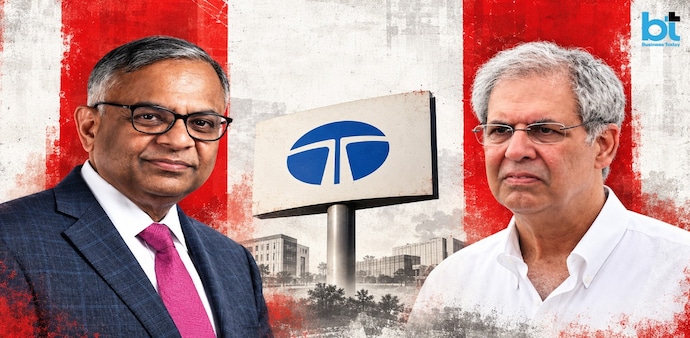
The bitter succession battle at Tata Sons centres on two individuals: N. Chandrasekaran, its Chairman, and Noel Tata, Chairman of Tata Trusts. Chandrasekaran was reappointed Chairman for a third term by the Tata Sons board, a decision approved by every member except Noel Tata, one of the trusts’ representatives on the board. The other representative is Venu Srinivasan, Chairman Emeritus of TVS Motor Company.
The two have taken conflicting positions on Chandrasekaran’s reappointment—which will require shareholder approval at Tata Sons’ AGM—and on the listing of Tata Sons. Srinivasan, who previously opposed the listing, now supports it. Their lack of unanimity has escalated into a broader dispute over the functioning of Tata Trusts. More on that shortly.
Eminent lawyer Homi Ranina views the proposed merger of Tata Electronics Systems and Tata Consulting Engineers with Tata Sons as a positive move. “It will make Tata Sons a larger entity and one that is more robust,” he says.
In Case You Missed It: BT Big Story: Is 66% = zero? The Tata Sons question on everyone’s minds
From a legal perspective, Swapnil Kothari, senior corporate lawyer and Managing Partner at S. Kothari & Co., believes the proposed restructuring could remove the regulatory constraint. “Hopefully, the RBI can be persuaded to not compel the listing of Tata Sons,” he says.
Ranina says the RBI has asked Tata Sons only to comply with guidelines issued under Section 45 JA of the Reserve Bank of India Act. “It needs to be understood that there is no obligation to list Tata Sons,” he maintains. He notes that the regulation allows the RBI to frame policy and issue directions to all or any non-banking financial companies in four areas: income recognition, accounting standards, provisioning for bad and doubtful debts, and capital adequacy based on risk weights.
“Other restrictions relate to the limit up to which loans and advances can be made or monies that can be invested in shares or securities of another company,” he adds.
Must Read: Tata Sons AGM: Why holding the board meeting is critical amid the boardroom tussle
The next steps
Meanwhile, the Sir Ratan Tata Trust (SRTT) has been unable to convene its board. In May, Maharashtra Charity Commissioner Amogh Kaloti issued an order preventing SRTT from holding meetings or passing resolutions. The intervention followed complaints about the composition of the trust’s board. Under the rules, permanent or lifetime trustees cannot constitute more than one-fourth of the board; the complaints alleged that they accounted for half.
“The Charity Commissioner, sooner than later, should clear any impediments so as to ensure the convening of the AGM as an inordinately postponed meeting tends to affect the smooth functioning of yearly issues besides impacting the day-to-day affairs as well. Unless the Charity Commissioner has cogent reasons to not allow the Sir Ratan Tata Trusts to meet, it cannot prolong the agony,” says Kothari.
A key question, according to group insiders, is whether the trustees knew about the restructuring proposal. Given the differences between Srinivasan and Noel Tata, they say it would have been difficult for
Srinivasan to support any move intended to avoid listing Tata Sons. Less than two days after the proposal was announced, he reportedly wrote to the Charity Commissioner, alleging serious governance lapses at Sir Dorabji Tata Trust (SDTT). He also questioned Noel Tata’s permanent status as a perpetual trustee and the appointment of Tata’s son, Neville.
“Why this was not brought up earlier and whether it forms the minutes of various board meeting needs to be looked into. Disclosure of critical information on a timely basis is critical and if it’s not been done, there is cause for concern,” says one official.
On the restructuring itself, Kothari maintains that the proposal would have required majority approval, if not unanimity, among the Tata Trusts members. “Failing which the proposal itself would be deemed invalid should Tata Sons want to argue against such a proposal and seek to examine the Minutes of Tata Trusts pertaining to the issue.”
In Kothari’s view, the uncertainty surrounding the AGM must end, and a way must be found to hold it. “Plus, challenging the integrity of SDTT by its trustees can perhaps be blunted to a certain extent. If the two main trusts of this iconic behemoth are ducking periodic googlies, whether deliberate or legitimate, it does not bode well for the whole group as it shakes investor confidence and slowly but surely erodes its blue-chip status,” says Kothari.
In a more recent development, another trustee, former Defence Secretary Vijay Singh, also demanded an inquiry into the trust’s governance. A separate media report said Srinivasan and Singh were surprised to learn of the proposal and had not been consulted.
Getting back to Tata Sons’ possible listing, Ranina says RBI has only asked the holding company to comply with the guidelines in conformity with Section 45 JA of the Reserve Bank of India Act. It needs to be understood that there is no obligation to list Tata Sons,” he explains.
The regulation under Section 45 JA outlines four items on which the RBI may determine the policy and give directions to all or any of the non-banking financial companies—income recognition, accounting standards, making of proper provision for bad and doubtful debts, capital adequacy based on risk weights. “Other restrictions relate to the limit up to which loans and advances can be made or monies that can be invested in shares or securities of another company,” he adds.
How matters unfold from here—particularly around the Tata Sons AGM—is anybody’s guess. Ranina says that other options can be explored. “The company can approach the Bombay High Court and seek a direction to hold the AGM. As things stand, we must quickly get to a position of unanimity as far as possible on this issue to ensure everyone’s interests are safeguarded,” he says.
On the evening of September 28, Tata Trusts, the largest shareholder in Tata Sons with a 66% stake, issued a statement that added another intriguing—and perhaps complicated—layer to an already contentious issue: the listing of Tata Sons, the conglomerate’s holding company, which owns stakes in several group companies.
The hitch is that Tata Sons falls within the upper-layer NBFC category, which covers systemically important financial institutions with assets exceeding Rs 1 lakh crore. The statement proposes merging Tata Electronics Systems and Tata Consulting Engineers—both unlisted group companies—with Tata Sons. It said that, as of March 31, 2026, the amalgamated entity had operating revenue of Rs 1.05 lakh crore, with income from financial assets accounting for 64.3%. This would keep it outside the NBFC ambit because it would not meet the threshold for classification as a core investment company, under which financial assets must account for at least 90% of aggregate assets. On the face of it, the proposal seemed sound—at least until the next round in this long-running battle.
Read More: Tata Sons reorganisation is a fresh twist in a long tale
Tackling multiple issues
The bitter succession battle at Tata Sons centres on two individuals: N. Chandrasekaran, its Chairman, and Noel Tata, Chairman of Tata Trusts. Chandrasekaran was reappointed Chairman for a third term by the Tata Sons board, a decision approved by every member except Noel Tata, one of the trusts’ representatives on the board. The other representative is Venu Srinivasan, Chairman Emeritus of TVS Motor Company.
The two have taken conflicting positions on Chandrasekaran’s reappointment—which will require shareholder approval at Tata Sons’ AGM—and on the listing of Tata Sons. Srinivasan, who previously opposed the listing, now supports it. Their lack of unanimity has escalated into a broader dispute over the functioning of Tata Trusts. More on that shortly.
Eminent lawyer Homi Ranina views the proposed merger of Tata Electronics Systems and Tata Consulting Engineers with Tata Sons as a positive move. “It will make Tata Sons a larger entity and one that is more robust,” he says.
In Case You Missed It: BT Big Story: Is 66% = zero? The Tata Sons question on everyone’s minds
From a legal perspective, Swapnil Kothari, senior corporate lawyer and Managing Partner at S. Kothari & Co., believes the proposed restructuring could remove the regulatory constraint. “Hopefully, the RBI can be persuaded to not compel the listing of Tata Sons,” he says.
Ranina says the RBI has asked Tata Sons only to comply with guidelines issued under Section 45 JA of the Reserve Bank of India Act. “It needs to be understood that there is no obligation to list Tata Sons,” he maintains. He notes that the regulation allows the RBI to frame policy and issue directions to all or any non-banking financial companies in four areas: income recognition, accounting standards, provisioning for bad and doubtful debts, and capital adequacy based on risk weights.
“Other restrictions relate to the limit up to which loans and advances can be made or monies that can be invested in shares or securities of another company,” he adds.
Must Read: Tata Sons AGM: Why holding the board meeting is critical amid the boardroom tussle
The next steps
Meanwhile, the Sir Ratan Tata Trust (SRTT) has been unable to convene its board. In May, Maharashtra Charity Commissioner Amogh Kaloti issued an order preventing SRTT from holding meetings or passing resolutions. The intervention followed complaints about the composition of the trust’s board. Under the rules, permanent or lifetime trustees cannot constitute more than one-fourth of the board; the complaints alleged that they accounted for half.
“The Charity Commissioner, sooner than later, should clear any impediments so as to ensure the convening of the AGM as an inordinately postponed meeting tends to affect the smooth functioning of yearly issues besides impacting the day-to-day affairs as well. Unless the Charity Commissioner has cogent reasons to not allow the Sir Ratan Tata Trusts to meet, it cannot prolong the agony,” says Kothari.
A key question, according to group insiders, is whether the trustees knew about the restructuring proposal. Given the differences between Srinivasan and Noel Tata, they say it would have been difficult for
Srinivasan to support any move intended to avoid listing Tata Sons. Less than two days after the proposal was announced, he reportedly wrote to the Charity Commissioner, alleging serious governance lapses at Sir Dorabji Tata Trust (SDTT). He also questioned Noel Tata’s permanent status as a perpetual trustee and the appointment of Tata’s son, Neville.
“Why this was not brought up earlier and whether it forms the minutes of various board meeting needs to be looked into. Disclosure of critical information on a timely basis is critical and if it’s not been done, there is cause for concern,” says one official.
On the restructuring itself, Kothari maintains that the proposal would have required majority approval, if not unanimity, among the Tata Trusts members. “Failing which the proposal itself would be deemed invalid should Tata Sons want to argue against such a proposal and seek to examine the Minutes of Tata Trusts pertaining to the issue.”
In Kothari’s view, the uncertainty surrounding the AGM must end, and a way must be found to hold it. “Plus, challenging the integrity of SDTT by its trustees can perhaps be blunted to a certain extent. If the two main trusts of this iconic behemoth are ducking periodic googlies, whether deliberate or legitimate, it does not bode well for the whole group as it shakes investor confidence and slowly but surely erodes its blue-chip status,” says Kothari.
In a more recent development, another trustee, former Defence Secretary Vijay Singh, also demanded an inquiry into the trust’s governance. A separate media report said Srinivasan and Singh were surprised to learn of the proposal and had not been consulted.
Getting back to Tata Sons’ possible listing, Ranina says RBI has only asked the holding company to comply with the guidelines in conformity with Section 45 JA of the Reserve Bank of India Act. It needs to be understood that there is no obligation to list Tata Sons,” he explains.
The regulation under Section 45 JA outlines four items on which the RBI may determine the policy and give directions to all or any of the non-banking financial companies—income recognition, accounting standards, making of proper provision for bad and doubtful debts, capital adequacy based on risk weights. “Other restrictions relate to the limit up to which loans and advances can be made or monies that can be invested in shares or securities of another company,” he adds.
How matters unfold from here—particularly around the Tata Sons AGM—is anybody’s guess. Ranina says that other options can be explored. “The company can approach the Bombay High Court and seek a direction to hold the AGM. As things stand, we must quickly get to a position of unanimity as far as possible on this issue to ensure everyone’s interests are safeguarded,” he says.