“As a fundamental canon of corporate jurisprudence, the board manages a company, whereas the company manages the shareholders,” says Swapnil Kothari, senior corporate lawyer and Managing Partner, S. Kothari & Co.
The distinction may appear straightforward ordinarily, but Tata Sons is no ordinary company. Its ownership structure is unlike that of a conventional promoter-led business, with Tata Trusts holding 66% and the board comprising directors who do not themselves own any shares in the company.
“Corporate law requires the shareholders of Tata Sons to approve the reappointment a shareholder meeting – an annual general meeting (AGM) or extraordinary general meeting (EGM) – which means Tata Trusts will have a say in the approval,” says Shriram Subramanian, Founder and Managing Director of InGovern Research Services, a corporate governance advisory firm.
MUST READ: Who controls Tata Sons? Why Tata Trusts’ 66% stake does not tell the whole story
The issue has now moved beyond a disagreement over succession. India’s Finance Minister has weighed in, as have lawyers, corporate-governance advisers and others tracking the Tata Group.
“This tug-of-war between the two camps—and very soon most likely to be a part of a court docket—could form an annoying precedent for any large shareholder who can be sidelined by a board majority,” says Kothari. The two sides have brought in the best legal minds: Abhishek Manu Singhvi (for Tata Trusts) and Harish Salve (Tata Sons).
“It is a complete mess now and one is seeing a lot of uncertainty,” says eminent lawyer Homi Ranina. “In August, Chandrasekaran said he was not offering himself for reappointment. Now, it is a completely different story, and the fact is nothing has changed. Noel Tata opposed his reappointment then and is opposing it now.”
It is an unusual corporate-governance confrontation, and one that could have implications beyond the Tata Group.
In a report dated September 18, corporate governance advisory firm Institutional Investor Advisory Services (IiAS) says, “The mutiny of the board against the controlling shareholder is possibly a first, and not the right precedent for corporate India. Will corporate India now have a set of independent directors making decisions that the promoter does not agree with?”
A board member of a prominent promoter-led company, speaking on condition of anonymity, says the episode has already prompted discussion in other companies about whether shareholder interests are not being taken seriously. “The conversation is around how the board needs to get more assertive,” this person says.
ALSO READ: Tata Sons to be split into smaller entities instead of listing? Here’s what we know
What led to the battle
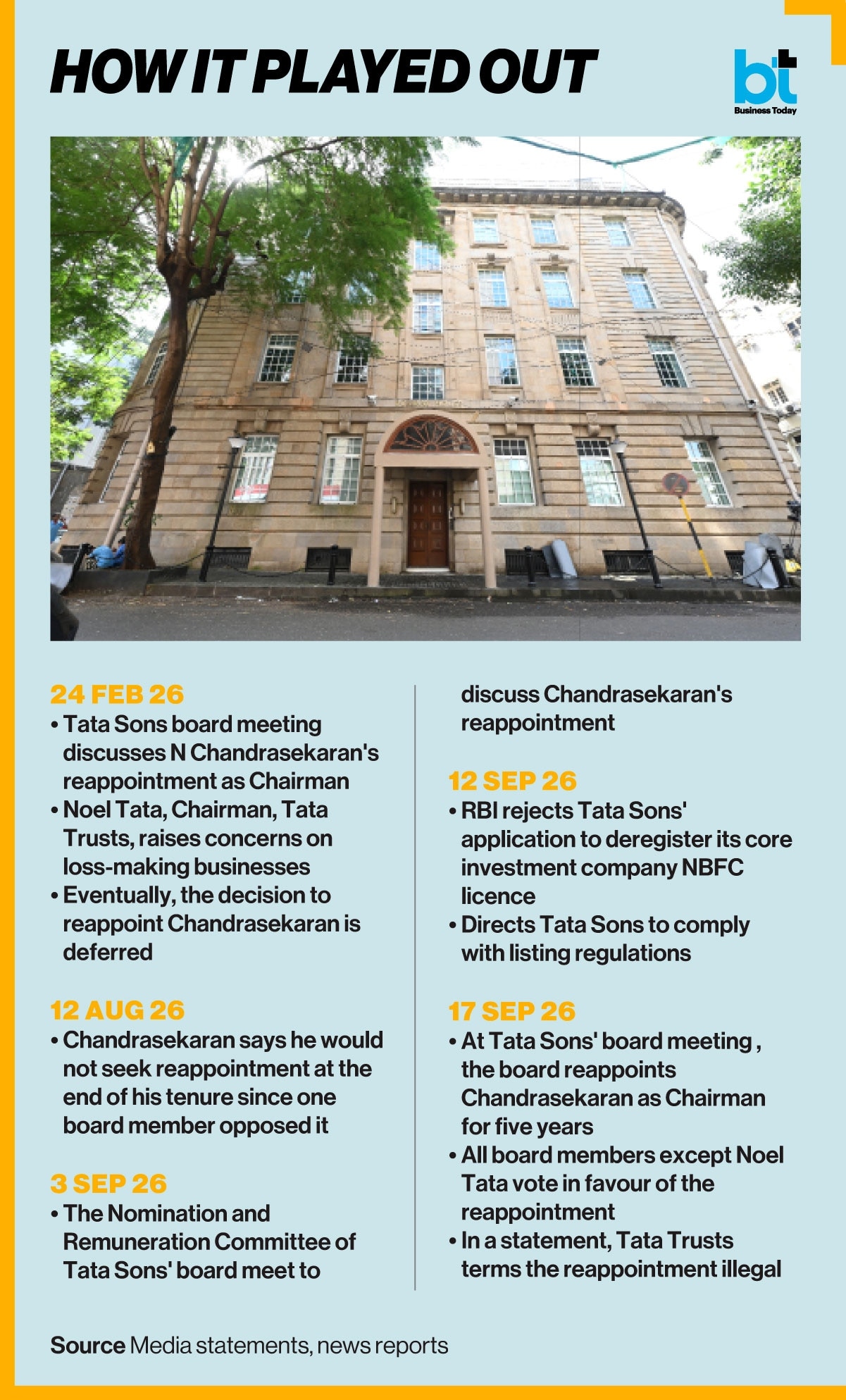
The immediate flashpoint is Chandrasekaran's reappointment. In August, he said he would step down at the end of his term on February 20, after Noel Tata had opposed a third term for him. Tata’s opposition was based on his reservations over some of the group’s investments in new businesses under Chandrasekaran, and with some businesses – most notably Air India and Tata Digital – deep in the red. Following Chandrasekaran’s communication, a search committee was subsequently set up to find his successor.
Then, on September 17, the Tata Sons board changed the script. Four board members approved Chandrasekaran's reappointment for another five years, while Noel Tata dissented. After the decision was taken in Chandrasekaran’s favour, Tata vehemently opposed it and termed it illegal.
The board may have made its choice, but the matter does not end there. Under Indian corporate law, Chandrasekaran's reappointment requires broader approval at a shareholder meeting. That gives Tata Trusts, with its 66% stake, the power to accept or reject the board’s decision.
“Corporate law requires the shareholders of Tata Sons to approve the reappointment at a shareholder meeting—an annual general meeting (AGM) or extraordinary general meeting (EGM)—which means Tata Trusts will have a say in the approval,” says Subramanian of InGovern.
And that is what makes the Tata Sons battle so significant. The board has acted, the controlling shareholder has opposed it, and the shareholder vote is the next crucial test. The question is where the balance of power lies between the two.
What’s at stake?
Tata Sons is the unlisted holding company of the salt-to-aviation conglomerate; 66% of its shares are held by Tata Trusts, of which two entities – Sir Dorabji Tata Trust (SDTT) and Sir Ratan Tata Trust (SRTT) – account for 52%. In turn, Tata Sons holds stakes in multiple Tata Group companies and, hence, earns dividend income that goes to Tata Trusts.
This May, the Maharashtra Charity Commissioner, Amogh Kaloti, issued an order blocking SRTT from convening board meetings or passing resolutions. The intervention followed complaints over the composition of the trust’s board. Under the rules, permanent or lifetime trustees cannot account for more than one-fourth of the total number of trustees, while the complaints stated that lifetime trustees were at half the board.
DO READ: SP Group seeks funds for Rs 3,500 crore debt payment amid Tata Sons IPO uncertainty: Report
“The functioning has been crippled because of (SRTT’s) inability to convene a meeting. The bigger problem lies in the Tata Trusts’ nominees board being divided on key issues like Chandrasekaran’s reappointment and Tata Sons’ listing,” Subramanian says.
On September 11, the Reserve Bank of India asked Tata Sons to get itself listed after an application to be exempted from the core investment company category was rejected.
The two Tata Trust nominees on Tata Sons’ board – Noel Tata and Venu Srinivasan, TVS Motor Company’s Chairman Emeritus – are on opposite sides of the fence when it comes to key issues like Chandrasekaran’s reappointment and the listing of Tata Sons.
“If they were in alignment, the decision pertaining to the reappointment may not have been proposed,” says Sanjay Kallapur, Professor (Accounting) at the Indian School of Business.
Kallapur further points to the role of independent directors. “They have a fiduciary responsibility to the corporation they represent,” he says. In the US, for instance, independent directors are encouraged to own shares of the companies whose boards they sit on. The rationale for this is to get them to think like shareholders and have the company’s best interests in mind.
The flip side, as Subramanian points out, is that independent directors are typically decided on factors like profile, competence and familiarity with promoters. “For a long time, independent directors have not been truly independent and that is a concern. They are professionals and are chosen to give an unbiased and fair opinion on key issues,” he says.
MUST WATCH: EXCLUSIVE: Abhishek Manu Singhvi Defends Tata Trusts’ Veto Rights; Explains The Boardroom Battle
Power struggles
Succession battles is not a new phenomenon in the Tata Group. In the early 1990s, after the passing of JRD Tata, Ratan Tata had to contend with the satraps – Russi Mody, Ajit Kerkar and Darbari Seth – before he could consolidate his position.
Likewise, Cyrus Mistry (the scion of the Shapoorji Pallonji Group that owns 18.4% in Tata Sons), after becoming Chairman in 2012 was ousted in 2016 at a Tata Sons’ board meeting. It led to Ratan Tata taking charge as interim Chairman before Chandrasekaran assumed charge in February 2017.
“It was really during Cyrus Mistry’s ouster that one realised how skewed Tata Sons’ articles of association was towards Tata Trusts,” points out Sharmila Gopinath, an independent corporate governance consultant. That alone is an indication of how much power lies with Tata Trusts.
In the current battle, media reports indicate that Srinivasan defied Tata Trusts, which had restrained him from voting on Tata Sons’ listing.
“By voting contrary to what the trusts want, Venu Srinivasan is acting as any other director on the board of Tata Sons and not as a nominee of Tata Trusts,” says Subramanian. “There is a complete breakdown of corporate governance since there is no alignment between Tata Sons’ board and its largest shareholder. In addition to that, the two nominees of Tata Trusts are voting contrary to each other.”
Given Chandrasekaran’s term ends next February, there is still time for the Tata Sons’ shareholders to convene. And although Tata Sons’ listing is important, Subramanian emphasises that even after that, Tata Trusts will continue to be the major shareholder.
DO READ: Tata Trusts vs Tata Sons: Abhishek Singhvi says shareholder rights cannot be ‘nullified’
What now
Why the Tata Sons’ board decided to reappoint Chandrasekaran is not clear, especially when it must pass muster with its shareholders. Kothari says the approval of another five-year term of Chandrasekaran does not automatically mean that it will be confirmed in the AGM.
“Public perception and investor faith are sine qua non (a necessary condition without which nothing is possible) and it would be oxymoronic for anyone to believe that someone who has resigned will recalibrate himself to work with the same dedication and commitment only because his term has been extended,” says Kothari.
One of the big issues is when the Tata Sons’ AGM will take place. If one goes strictly by the law, it should be held in end November or early December (basically 15 months after the last one). “Unless the Charity Commissioner relents or the High Court passes a favourable order assuming an application or petition is filed soon, this limbo shall linger,” maintains Kothari.
In the midst of all this, there is investor apprehension given the uncertainty on the entire issue. Kallapur expresses concern on how the current dispute between Tata Sons and its biggest shareholder has not been good for the image of the conglomerate. “The Tata Group has a reputation of being trust builders and it is one earned over time. That has now taken a hit,” he says.
ALSO READ: Sharad Pawar backs Tata Trusts: 'Weakening the Trusts weakens institutions'
The legal question may ultimately determine how much power the board has. But the immediate test will come when Tata Sons’ largest shareholder gets its chance to vote.
According to Ranina, there is no ambiguity on the issue that unanimity is needed for the reappointment of Chandrasekaran as Tata Sons’ Chairman. “That was the case when Tata Sons proposed N. Chandrasekaran’s name. What we are seeing is merely a decision of Tata Sons’ board and Tata Trusts, with a 66% shareholding, needing to clear it. On the face of it, that is looking unlikely,” he says.
















 Tata Sons’ structure is unusual, with Tata Trusts holding 66% and its board owning no shares.
 Bangladesh turns to India for wheat as Black Sea disruption pushes up prices
 Morgan Stanley accidentally leaks 100-plus deal pipeline, including India IPOs: Report
 Sebi may ease margin requirements for longer-tenure F&O products
 India boosts LPG production as festive demand rises and Gulf supplies remain uncertain
 No petrol, diesel price hike proposal yet; govt may support OMCs if crude stays high
 India Growth Outlook Gets Major Boost: S&P, Fitch, ADB Raise FY27 Forecasts; OECD Upgrades 2026 View
 A-One Steels IPO Explained: Key Details, Growth Strategy & Future Outlook | Management Live
 Market Commentary: Nifty Outlook, Stocks & Market Strategy | Deven Choksey
 Ignore Large Caps? Why Investors Are Chasing High P/E Mid Cap Stocks Now
 30 IPOs In A Month: Deven Choksey On IPO Flipping And Secondary Market Liquidity
 RBI to conduct OMO sale of Rs 25,000 crore in government bonds on September 28
 NSE shares: Deven Choksey lists reasons for long-term investment; calls stock 'shock absorber' in volatile markets
 Crude oil prices fall for sixth session; PL Capital explains what could happen next
 Mazagon Dock, GRSE shares: Does short-term bounce signal trend reversal? Analyst decodes
 Apple Pay India launch: After 90+ markets, is India finally next? What you can expect
 BT Big Story: Is 66% = zero? The Tata Sons question on everyone’s minds
  Diwali car rush: New models from Honda, Volvo, Tata and more could arrive soon
 RBI repo rate hike on or off? S&P sees 5.5%, Fitch projects 5.75% in 2027
 From Gulf to US: How the Iran war is redrawing India’s LPG import map


