
Germany’s Festo turns to India for global R&D, opens first GCC in Bengaluru
Marking 40 years in India, Germany’s Festo has launched its first Global Capability Centre in Bengaluru, aiming to scale to 600 roles and power global R&D, AI and digital automation.
- Feb 18, 2026,
- Updated Feb 18, 2026 4:17 PM IST
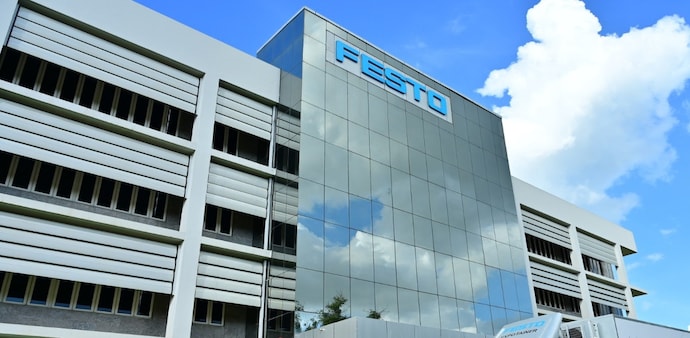
As global manufacturers recalibrate supply chains and technology bets, Germany’s automation major Festo is sharpening its India play. Marking 40 years of incorporated presence in the country, the €3.5-billion family-owned firm has inaugurated a 71,000 sq. ft. Global Capability Centre (GCC) in Bengaluru with plans to scale the workforce to over 600. The company has over 1,000 people employed across its India operations.
The new centre, which has already onboarded 100-plus engineers over the past year, will anchor advanced engineering, software development, AI/ML, data analytics, product security and global process optimisation for Festo’s worldwide operations. According to Ravi Sastry, Festo’s MD for India, Festo will be hiring and upskilling fresh talent from the campus placement route.
The timing is significant. The recently concluded India–EU trade agreement negotiations and India’s pact with the European Free Trade Association (EFTA) have buoyed European boardrooms. Festo’s management, which was present during high-level India–EU engagements earlier this year, sees both sentiment and structural tailwinds. “India is the natural partner for the EU. Whatever the final contours of the trade deal, the free flow of goods, services and people will help both sides,” said Sastry.
For Festo, which competes globally in pneumatic, electric and digital automation systems, India is no longer just a sales outpost. Over four decades, the company has built a presence spanning production, R&D and technical education, serving over 25,000 customers across automotive, electronics, food processing and pharmaceuticals. Its Hosur plant in Tamil Nadu already runs substantially on solar power, underscoring its sustainability push.
The GCC is central to another transition, Sastry adds from being perceived as a pneumatic hardware player to a software-led automation company. The centre will work on predictive and prescriptive analytics, autonomous systems and product security, areas increasingly critical as factories adopt Industry 4.0 frameworks.
Automotive remains its largest segment, with deployments across leading OEMs, while semiconductor equipment is an emerging focus as India builds out fabrication capacity.
While the stated target is 600-plus roles implying roughly 2.5x growth the company says value creation, not headcount alone, will be the metric.
As global manufacturers recalibrate supply chains and technology bets, Germany’s automation major Festo is sharpening its India play. Marking 40 years of incorporated presence in the country, the €3.5-billion family-owned firm has inaugurated a 71,000 sq. ft. Global Capability Centre (GCC) in Bengaluru with plans to scale the workforce to over 600. The company has over 1,000 people employed across its India operations.
The new centre, which has already onboarded 100-plus engineers over the past year, will anchor advanced engineering, software development, AI/ML, data analytics, product security and global process optimisation for Festo’s worldwide operations. According to Ravi Sastry, Festo’s MD for India, Festo will be hiring and upskilling fresh talent from the campus placement route.
The timing is significant. The recently concluded India–EU trade agreement negotiations and India’s pact with the European Free Trade Association (EFTA) have buoyed European boardrooms. Festo’s management, which was present during high-level India–EU engagements earlier this year, sees both sentiment and structural tailwinds. “India is the natural partner for the EU. Whatever the final contours of the trade deal, the free flow of goods, services and people will help both sides,” said Sastry.
For Festo, which competes globally in pneumatic, electric and digital automation systems, India is no longer just a sales outpost. Over four decades, the company has built a presence spanning production, R&D and technical education, serving over 25,000 customers across automotive, electronics, food processing and pharmaceuticals. Its Hosur plant in Tamil Nadu already runs substantially on solar power, underscoring its sustainability push.
The GCC is central to another transition, Sastry adds from being perceived as a pneumatic hardware player to a software-led automation company. The centre will work on predictive and prescriptive analytics, autonomous systems and product security, areas increasingly critical as factories adopt Industry 4.0 frameworks.
Automotive remains its largest segment, with deployments across leading OEMs, while semiconductor equipment is an emerging focus as India builds out fabrication capacity.
While the stated target is 600-plus roles implying roughly 2.5x growth the company says value creation, not headcount alone, will be the metric.