
Maruti Suzuki eVitara price starts at Rs 10.99 lakh without battery
e-Vitara's production capacity will remain constrained until July, says Maruti Suzuki's Partho Banerjee.
- Feb 17, 2026,
- Updated Feb 17, 2026 8:05 PM IST
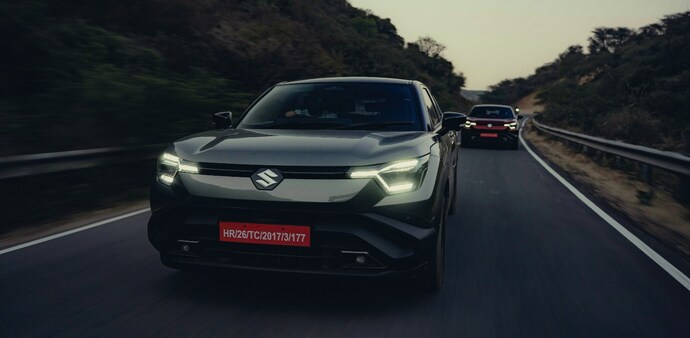
Maruti Suzuki India Ltd on Tuesday announced the battery-as-a-service price for its maiden electric car, the e-Vitara, at Rs 10.99 lakh (ex-showroom). To be clear, the battery is not included in this price. The company has yet to reveal the battery-inclusive prices.
India’s biggest carmaker is offering battery rental at Rs 3.99 per kilometre. “Today when a customer buys a product. He has got fuel cost and the cost of acquisition. We need to understand when we buy an ICE (internal-combustion engine) vehicle, we incur a cost for running it as well,” Partho Banerjee, Senior Executive Officer, Marketing and Sales at Maruti Suzuki told Business Today.
The e-Vitara is currently manufactured at the company’s Hansalpur plant in Gujarat. Banerjee said the production capacity for the EV will remain constrained until July.
“We have a line in Gujarat which has a capacity of 1 lakh units. But we have to cater to the demand of other OEMs (Toyota) and export market needs and in the same line we are producing the Fronx, which has a huge waiting period. We are trying to balance between domestic market and exports. That problem will be there till the month of July. After July, we are going to expand the line capacity,” said Banerjee.
The e-Vitara comes with two battery pack options: a 49-kWh pack for the base variant and a 61-kWh pack for the higher trim. The carmaker claims a range of 543 kilometres on a single charge for the top trim.
Maruti Suzuki said has set up 2,000 EV charging points exclusively for its customers. “We have set up 1,500 EV-enabled workshops across 1100 cities,” said Banejree.
Maruti Suzuki’s entry to the EV race comes at a time when the penetration of electric vehicles has gone down following the Goods and Services Tax (GST) reduction on internal-combustion engine (ICE) cars.
“After the introduction of GST 2.0, the penetration of EVs is going down. The EV industry is not keeping pace with the auto industry,” Banerjee said. “By 2030, the car industry will be around 5.5-6 million vehicles per annum. And the EV penetration forecast earlier was around 13-15%. But that was before GST 2.0. We need to reassess the market to arrive at the penetration levels in 2030,” he explained.
The penetration of electric vehicles will grow only when people consider it their primary car, as per Banerjee. “About 99% of customers who buy an EV use it as a secondary car. It’s not the primary car,” he said. Range anxiety, inadequate public charging infrastructure and lack of residual value are among the key concerns of EV buyers.
To address the resale value barrier, Banerjee said Maruti Suzuki is offering its EV with a battery-as-a-service option.
Maruti Suzuki India Ltd on Tuesday announced the battery-as-a-service price for its maiden electric car, the e-Vitara, at Rs 10.99 lakh (ex-showroom). To be clear, the battery is not included in this price. The company has yet to reveal the battery-inclusive prices.
India’s biggest carmaker is offering battery rental at Rs 3.99 per kilometre. “Today when a customer buys a product. He has got fuel cost and the cost of acquisition. We need to understand when we buy an ICE (internal-combustion engine) vehicle, we incur a cost for running it as well,” Partho Banerjee, Senior Executive Officer, Marketing and Sales at Maruti Suzuki told Business Today.
The e-Vitara is currently manufactured at the company’s Hansalpur plant in Gujarat. Banerjee said the production capacity for the EV will remain constrained until July.
“We have a line in Gujarat which has a capacity of 1 lakh units. But we have to cater to the demand of other OEMs (Toyota) and export market needs and in the same line we are producing the Fronx, which has a huge waiting period. We are trying to balance between domestic market and exports. That problem will be there till the month of July. After July, we are going to expand the line capacity,” said Banerjee.
The e-Vitara comes with two battery pack options: a 49-kWh pack for the base variant and a 61-kWh pack for the higher trim. The carmaker claims a range of 543 kilometres on a single charge for the top trim.
Maruti Suzuki said has set up 2,000 EV charging points exclusively for its customers. “We have set up 1,500 EV-enabled workshops across 1100 cities,” said Banejree.
Maruti Suzuki’s entry to the EV race comes at a time when the penetration of electric vehicles has gone down following the Goods and Services Tax (GST) reduction on internal-combustion engine (ICE) cars.
“After the introduction of GST 2.0, the penetration of EVs is going down. The EV industry is not keeping pace with the auto industry,” Banerjee said. “By 2030, the car industry will be around 5.5-6 million vehicles per annum. And the EV penetration forecast earlier was around 13-15%. But that was before GST 2.0. We need to reassess the market to arrive at the penetration levels in 2030,” he explained.
The penetration of electric vehicles will grow only when people consider it their primary car, as per Banerjee. “About 99% of customers who buy an EV use it as a secondary car. It’s not the primary car,” he said. Range anxiety, inadequate public charging infrastructure and lack of residual value are among the key concerns of EV buyers.
To address the resale value barrier, Banerjee said Maruti Suzuki is offering its EV with a battery-as-a-service option.