
Nandan Nilekani’s next big projects: Infosys’ AI leap and taking digital public infrastructure global
At the Infosys level, Nilekani is focused on ensuring the successful integration of AI. Furthermore, he expressed his interest in taking digital public infrastructure worldwide, emphasizing the importance of more countries adopting this approach for their future.
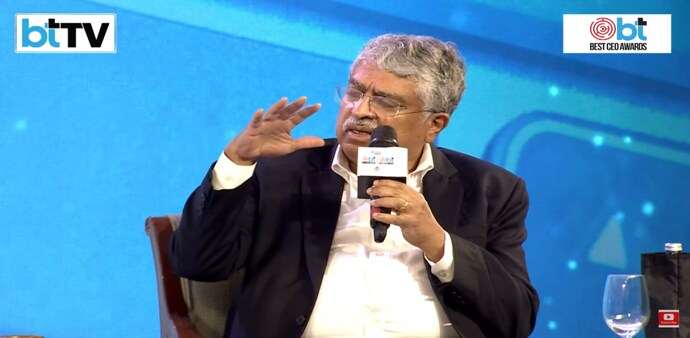
- May 12, 2023,
- Updated May 12, 2023 11:59 AM IST
Artificial Intelligence and Machine Learning have lately become the talk of the town, with companies across the world trying to get on the AI bandwagon. Indian technocrat Nandan Nilekani is no different. In a recent interview with Morgan Stanley, the co-founder of Infosys and former Chairman of the Unique Identification Authority of India (UIDAI), shared his thoughts on artificial intelligence (AI) and his plans to promote digital public infrastructure globally.
When asked about his next big project, Nilekani stated, "I don't think like that. You know, I just think about doing new things. I'm deeply looking at how AI will change the industry. It's a structural paradigm shift." At the Infosys level, Nilekani is focused on ensuring the successful integration of AI. Furthermore, he expressed his interest in taking digital public infrastructure worldwide, emphasizing the importance of more countries adopting this approach for their future.
Regarding the relationship between AI and India Stack, Nilekani believes the two are complementary, saying, "India Stack is infrastructure. There are many AI use cases." He highlighted the potential of AI to amplify human capabilities and provide services to a larger population. For example, AI could address the shortage of teachers and doctors in India, ensuring that quality education and medical treatment reach more people.
Nilekani also discussed the significance of AI for Indian languages, explaining, "For 22 Indian languages, they're going to create the complete open capability to translate speech to speech, speech to text, text to speech, all that. And suddenly, every Indian will be able to talk or write or read in their language to somebody else who's in another language."
In light of India's success with its digital public infrastructure, the interview explored whether other countries might be considering similar initiatives. Nilekani acknowledged that there is a growing understanding of digital public infrastructure's value globally. However, he noted that the challenges lie in strategically implementing it over a five-to-ten-year period and ensuring the interoperability of the building blocks. "That's the hard part," he said.
Also Read: TCS, Infosys, Wipro: Are huge bench sizes dragging down Indian IT majors? - BusinessToday
Also Read: TCS, Infosys, HCLTech: Hirings drop up to 78% in FY23 at major IT companies - BusinessToday
Artificial Intelligence and Machine Learning have lately become the talk of the town, with companies across the world trying to get on the AI bandwagon. Indian technocrat Nandan Nilekani is no different. In a recent interview with Morgan Stanley, the co-founder of Infosys and former Chairman of the Unique Identification Authority of India (UIDAI), shared his thoughts on artificial intelligence (AI) and his plans to promote digital public infrastructure globally.
When asked about his next big project, Nilekani stated, "I don't think like that. You know, I just think about doing new things. I'm deeply looking at how AI will change the industry. It's a structural paradigm shift." At the Infosys level, Nilekani is focused on ensuring the successful integration of AI. Furthermore, he expressed his interest in taking digital public infrastructure worldwide, emphasizing the importance of more countries adopting this approach for their future.
Regarding the relationship between AI and India Stack, Nilekani believes the two are complementary, saying, "India Stack is infrastructure. There are many AI use cases." He highlighted the potential of AI to amplify human capabilities and provide services to a larger population. For example, AI could address the shortage of teachers and doctors in India, ensuring that quality education and medical treatment reach more people.
Nilekani also discussed the significance of AI for Indian languages, explaining, "For 22 Indian languages, they're going to create the complete open capability to translate speech to speech, speech to text, text to speech, all that. And suddenly, every Indian will be able to talk or write or read in their language to somebody else who's in another language."
In light of India's success with its digital public infrastructure, the interview explored whether other countries might be considering similar initiatives. Nilekani acknowledged that there is a growing understanding of digital public infrastructure's value globally. However, he noted that the challenges lie in strategically implementing it over a five-to-ten-year period and ensuring the interoperability of the building blocks. "That's the hard part," he said.
Also Read: TCS, Infosys, Wipro: Are huge bench sizes dragging down Indian IT majors? - BusinessToday
Also Read: TCS, Infosys, HCLTech: Hirings drop up to 78% in FY23 at major IT companies - BusinessToday