
West Asia war ‘precarious’ for Indian auto industry: SIAM’s Shailesh Chandra
There could be more price hikes, says Chandra.
- Apr 14, 2026,
- Updated Apr 14, 2026 7:18 PM IST
The ongoing war in West Asia has created a precarious situation for the Indian auto industry which uses gases like LPG, according to the Society of Indian Automobile Manufacturers (SIAM).
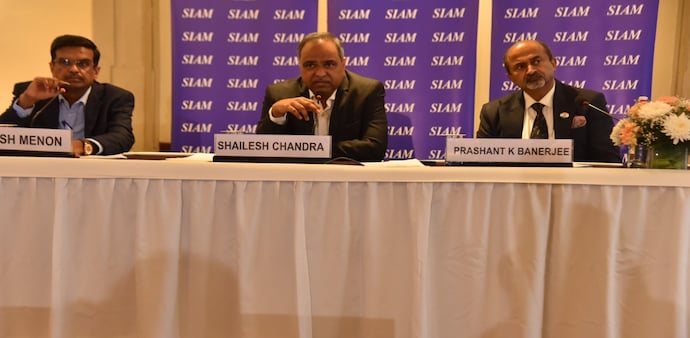
Even though the industry has not seen much impact because growth has been strong in March, the situation is “precarious,” Shailesh Chandra, president of SIAM, told reporters in New Delhi.
April will be a litmus test for India’s automobile supply chain. In March, there was stress in supply. As the CEO of Tata Motors Passenger Vehicles, I was reviewing the inventory situation every three days. These reviews have become more intense in April,” Chandra explained, adding that inventories in the auto industry are “tightly controlled.”
One good thing, according to Chandra, is that a lot of auto companies have shifted to PNG in manufacturing.
“People who are dependent on LPG have shifted to bulk connections, and all consumptions have been looked at so more efficient ways of consuming these gasses,” he adds.
On the outlook on production, Chandra, says, “If you ask me the visibility of for one week, I can say one week we should not be disrupted to that extent.”
The SIAM president, however, said underlying costs have escalated as companies are doing air freights if there are some supply disruptions.
“So far, industry has been able to manage the supplies, but you have to watch how things pan out,” he added.
Price Hikes on the Horizon
The SIAM president cautioned about more price hikes due to the war and the subsequent commodity cost increases. “There might be potential cost increases that you will start seeing for vehicles. To what extent OEMs will be able to absorb the commodity prices, and to what extent commodity prices will increase will be clear in the next few weeks, or say, four weeks to five weeks,” says Chandra.
Once that is clear, only then demand outlook for FY27 can be determined, he explained. “And if the fuel prices also significantly increase, and if the West Asia crisis also prolongs, then there can be an issue,” he says.
“But broadly, if you see still the GDP is expected to grow by 6.5% to 7%, we clearly see that passenger vehicle growth mimics the growth of what you see in the GDP growth,” says Chandra.
The ongoing war in West Asia has created a precarious situation for the Indian auto industry which uses gases like LPG, according to the Society of Indian Automobile Manufacturers (SIAM).
Even though the industry has not seen much impact because growth has been strong in March, the situation is “precarious,” Shailesh Chandra, president of SIAM, told reporters in New Delhi.
April will be a litmus test for India’s automobile supply chain. In March, there was stress in supply. As the CEO of Tata Motors Passenger Vehicles, I was reviewing the inventory situation every three days. These reviews have become more intense in April,” Chandra explained, adding that inventories in the auto industry are “tightly controlled.”
One good thing, according to Chandra, is that a lot of auto companies have shifted to PNG in manufacturing.
“People who are dependent on LPG have shifted to bulk connections, and all consumptions have been looked at so more efficient ways of consuming these gasses,” he adds.
On the outlook on production, Chandra, says, “If you ask me the visibility of for one week, I can say one week we should not be disrupted to that extent.”
The SIAM president, however, said underlying costs have escalated as companies are doing air freights if there are some supply disruptions.
“So far, industry has been able to manage the supplies, but you have to watch how things pan out,” he added.
Price Hikes on the Horizon
The SIAM president cautioned about more price hikes due to the war and the subsequent commodity cost increases. “There might be potential cost increases that you will start seeing for vehicles. To what extent OEMs will be able to absorb the commodity prices, and to what extent commodity prices will increase will be clear in the next few weeks, or say, four weeks to five weeks,” says Chandra.
Once that is clear, only then demand outlook for FY27 can be determined, he explained. “And if the fuel prices also significantly increase, and if the West Asia crisis also prolongs, then there can be an issue,” he says.
“But broadly, if you see still the GDP is expected to grow by 6.5% to 7%, we clearly see that passenger vehicle growth mimics the growth of what you see in the GDP growth,” says Chandra.