
BT BIG STORY: The next big agri export story may not be written in grains of basmati or boxes of spices alone
BT BIG STORY: The next big agri export story may not be written in grains of basmati or boxes of spices alone
With a $100-billion target in sight, India is looking beyond traditional agricultural exports such as rice, spices and marine products to diversify its export basket. As new free trade agreements open markets, could non-traditional agri products become India’s next big export opportunity?
Surabhi
- Nov 17, 2026,
- Updated Nov 17, 2026 6:00 AM IST
Basmati rice, tea, and spices. Soon, the definition of Indian food in global kitchens could change. India is now trying to diversify into a range of new food products—from new sources to new markets—as part of an export diversification strategy in the face of the US tariffs last year, the West Asia war this year as well as the opening of new markets through the several trade pacts being signed.
Advertisement
Consider this: The Agricultural and Processed Food Products Export Development Authority (APEDA) has, in this fiscal year, flagged off over 45 new food items.
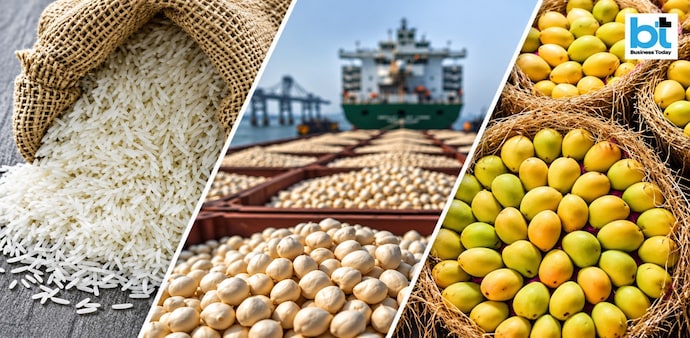
These include a variety of mangoes such as Jardalu and Malda from Bihar, Amrapali from Jharkhand, and Fazli from West Bengal. Several other fresh fruits such as cherries and plums from Himachal Pradesh are being exported to Oman, kiwis from Arunachal to Dubai as well as processed foods like organic cold-pressed oils, millets, pulses, flours and A2 ghee from Madhya Pradesh, and tapioca chips from Kerala to the UK and also GI-tagged products such as Gulbarga tur dal (split pigeon pea) from Karnataka to the Maldives. In fact, India’s food export basket today has expanded to close to 500 products from just about 280 a decade ago.
Advertisement
Challenges and Opportunities
The West Asia war has thrown up new challenges for Indian agri exports. While logistical and freight disruptions have hit exports and raised costs for exports to markets like the UK, West Asia has also been a traditional market for Indian food items as well as fresh produce.
India’s agri exports have increased by 63.8% to $52.55 billion in FY26 from $32.08 billion in FY15. Rice, marine products, meat as well as spices continue to be key export items. Official data shows that while exports of products like rice, dairy, and meat products have remained robust in the first six months of the fiscal year, exports of key produce like fruits and vegetables have declined. Overall, agri exports have increased to $27.88 billion between April and October 2026 from 25.89 billion a year ago.
Advertisement
Latest commerce ministry data shows that basmati rice exports grew 25% between April and October 2026 to $1.6 billion with top destinations including Iran, Saudi Arabia and the US; exports of other food items have also risen sharply. For instance, exports of frozen potatoes grew 21% year on year to $179 million between April and September 2026 with top markets including the Philippines, Saudi Arabia and Malaysia while that of yellow dent corn grew 1,156% to $123 million with key destinations including Bangladesh, Vietnam and the Philippines.
Don't Miss | BT BIG STORY: The Rupee bounces back, but the ₹100 threat isn't gone yet
“The overall export figures have been strong, but the West Asia conflict has created challenges for our exports given that this region is a top destination for us,” says Abhishek Dev, Chairman, APEDA. In an interaction with BT, he says that of the overall APEDA basket, about 30-35% of exports are for West Asia markets. About 60-70% of basmati exports as well as 80-90% of banana exports also go to West Asia. “Currently, there is growth in almost all segments except in fresh products,” he says.
APEDA, which functions under the Ministry of Commerce and Industry, is mandated with the promotion and export of about 17 product categories including fruits and vegetables, meat, poultry, dairy, confectionary items, alcoholic and non-alcoholic beverages, basmati rice, floriculture as well as cereals.
Advertisement
In October 2026, exports of fruits and vegetables grew 1.84% to $0.29 billion on a year-on-year basis. However, between April and October 2026, exports declined by 8.04% to $1.98 billion from $2.15 billion a year ago.
Sopan Kanchan, President, Grape Growers Association of India as well as of the Confederation of Indian Horticulture, says that the war has increased logistics and other risk-related costs, which has affected the returns of farmers. “In any consignment, the cost of grapes is about 20% to 30% while the loaded risk charges are around 80% to 70% of the total cost,” he explains.
What is also intriguing is that while India is amongst the largest agri producers in the world, it was the ninth largest agri exporter in 2025 as per the WTO World Trade Statistics 2025; its share is just 2.25% in global agri exports compared to 37.46% of the EU and 7.65% of the US.
While part of this is because of the large domestic market that also determines the government’s export policies and curbs, there remains huge potential for increasing agri exports, including those of processed and value-added food products. The Economic Survey 2025-26 pointed out that while India is the world’s second largest agricultural producer by value, WTO Trade Statistics show only a marginal increase in the country’s share in global agricultural exports to 2.4% in 2024 from 1.1% in 2000. It also set out a target of $100 billion for agri exports over the next four years by 2030.
Advertisement
In Case You Missed It | BT BIG STORY | More sales, less profit: FMCG's margin trap
The focus on trade pacts has also created a renewed vigour to boost such exports, given access to large markets such as those of the UK and the EU, and value-added food items are a growing opportunity for Indian exporters and farmers.
Agneshwar Sen, Trade Policy Leader, EY India, sums up these opportunities for India and notes that the potential for growth of India’s agri exports is considerable across several traditional and newer products such as millets, which are gaining ground as a healthier dietary choice. “India’s framework of free trade agreements offer agri exporters significant new market access. They ease both tariff and non-tariff barriers,” he says.
The UK free trade agreement that was recently operationalised gives duty-free access on over 95% agri tariff lines and Indian exports are seen to rise by over 30% in the next three years. For instance, in agriculture, India exports $36.63 billion globally, while the UK imports $37.52 billion, but imports just $811 million worth from India, revealing room for growth in high-value agri products. In processed food products, India exports $14.07 billion globally, but it accounts for just $309.5 million of the UK imports worth $ 50.68 billion.
Advertisement
Coming to the EU, the trade pact, that is likely to be operationalised soon, gives preferential market access for India’s agricultural products like tea, coffee, spices, grapes, gherkins and cucumbers, dried onion, fresh vegetables and fruits as well as for processed food products.
“There’s a huge opportunity for Indian agri exports with these pacts, especially in the value-added segment,” says Ajay Sahai, Director General & CEO, Federation of Indian Export Organisations (FIEO). He says recent efforts at diversification of food exports have shown an extremely good response from foreign markets. Goods like makhanas (foxnuts) have seen strong global acceptance and demand. Interest has been generated in several products from the Northeast, such as speciality coffee as well as black rice from Uttar Pradesh.
Officials, in fact, point out that makhana exports have been such a success story, especially in health-conscious markets like the US, EU, West Asia, and South-East Asia, that the humble product from Bihar was given a separate HS Code for exports in July 2025. Indian Makhana exports grew nearly 4X from 6,700 MT in 2020 to 25,130 MT in 2024, registering a 39% CAGR in the period, official data shows.
Apart from this, there’s also growing appreciation for India’s organic food items and GI-tagged produce, but it’s still early days. Low production is a challenge. There’s also an export market for alcoholic beverages but much of it is taken up by domestic demand.
For farmers too, there is scope for higher income through exports. On average, they can get as much as 30% higher realisation than what they get in the domestic market.
Rahul Sahu, CEO of a Farmer Producer Organisation (FPO) in Gumla district in Jharkhand, who helped export a variety of mangoes this year through APEDA to a variety of destinations including Dubai and London, says farmers earned Rs 70 to 75 per kg for mangoes that were exported as against just Rs 20 to Rs 25 kg in the local markets. “We are trying to send ragi also for export now. For next season for mango exports, we are already planning 100 acres of orchards,” he says.
Efforts underway
In terms of government intervention, the commerce ministry and APEDA are in talks with several countries, including Singapore and Russia, to market Indian agri goods.
Russia is turning into a new market for India with a lot of demand for bananas, potatoes, and groundnuts. Dev of APEDA says there is a roughly $1-billion market for bananas in Russia but getting the logistics right is key as well as meeting their quality norms. “A trial shipment of bananas will soon be sent to Russia by sea to assess the time and logistics,” he explains.
APEDA is also working with state governments to identify food crops for export and key regions for export-oriented produce. At present, India exports just 1-1.5% of its fresh produce but the government is now looking at an intermediate target of increasing it to 5%. Similarly, it is looking to increase the export of value added and processed foods from about 24% of overall agri exports to 40% over the years.
There is also work underway on improved logistics and availability of containers and ships with discussions underway with the Ministry of Shipping and CONCOR.
It is also planning to expand the BHARATI (Bharat’s Hub for Agritech, Resilience, Advancement and Incubation for Export Enablement) initiative launched last year to help accelerate export opportunities for 100 agri-food and agri-tech start-ups to 100 FPOs this year for a higher level of export readiness.
But it’s not such an easy path. For one, there are strict quality and safety norms for agri-produce in most countries that mandate limits on pesticide usage. This has, in the past, led to the rejection of several Indian consignments of goods, including rice, peanuts, spices, and mangoes by countries like Japan, the US and the EU. This summer, Japan stopped imports of Indian mangoes due to deficiencies in fumigation.
Sen of EY India also notes that favourable policy and legal framework are only part of the equation; Indian produce must also meet the quality standards these markets demand.
“This means ensuring traceability and product identification, and complying with maximum residue limits (MRLs) and sanitary and phytosanitary (SPS) requirements to avoid shipment rejections,” he says, adding that equally important are effective marketing and presentation of the produce. “Achieving India’s potential will require sustained, ground-level support for farmers and producers,” he further underlines.
On this front, work is underway in terms of handholding of farmers and exporters to ensure pesticides and chemicals are used as per limits. Officials say that in 2026, the number of rejections is reducing. Kanchan says that for grape exports, farmers remain vigilant in meeting the standards set by importers.
“There are also labs to test pesticide residues,” he says. Sahu also stresses that their mango consignments did not face any rejections. Coming to meat and animal products, the EU has listed 123 Indian fishery establishments between September 2025 and July 2026.
Sahai of FIEO points out to the new generation of agri-tech farmers who are more conscious of quality parameters for both domestic consumers as well as international markets. He also calls for the need for a brand promotion strategy.
The next big Indian export story may not be written in grains of basmati or boxes of spices alone. It could well be found in a packet of makhana, a crate of mangoes or a bottle of cold-pressed oil. The aspiration is to find India on the global plate.
Read more!