How quickly things can change. As of November 11, 2026, the rupee is one of the best-performing currencies in Asia, having staged a strong turnaround. It closed at around 93.69 against the greenback on November 11, up around 0.2% from 93.93 on November 9. The currency has now gained more than 3.3% since its record low of 96.96 on May 20 and is at its strongest level since April.
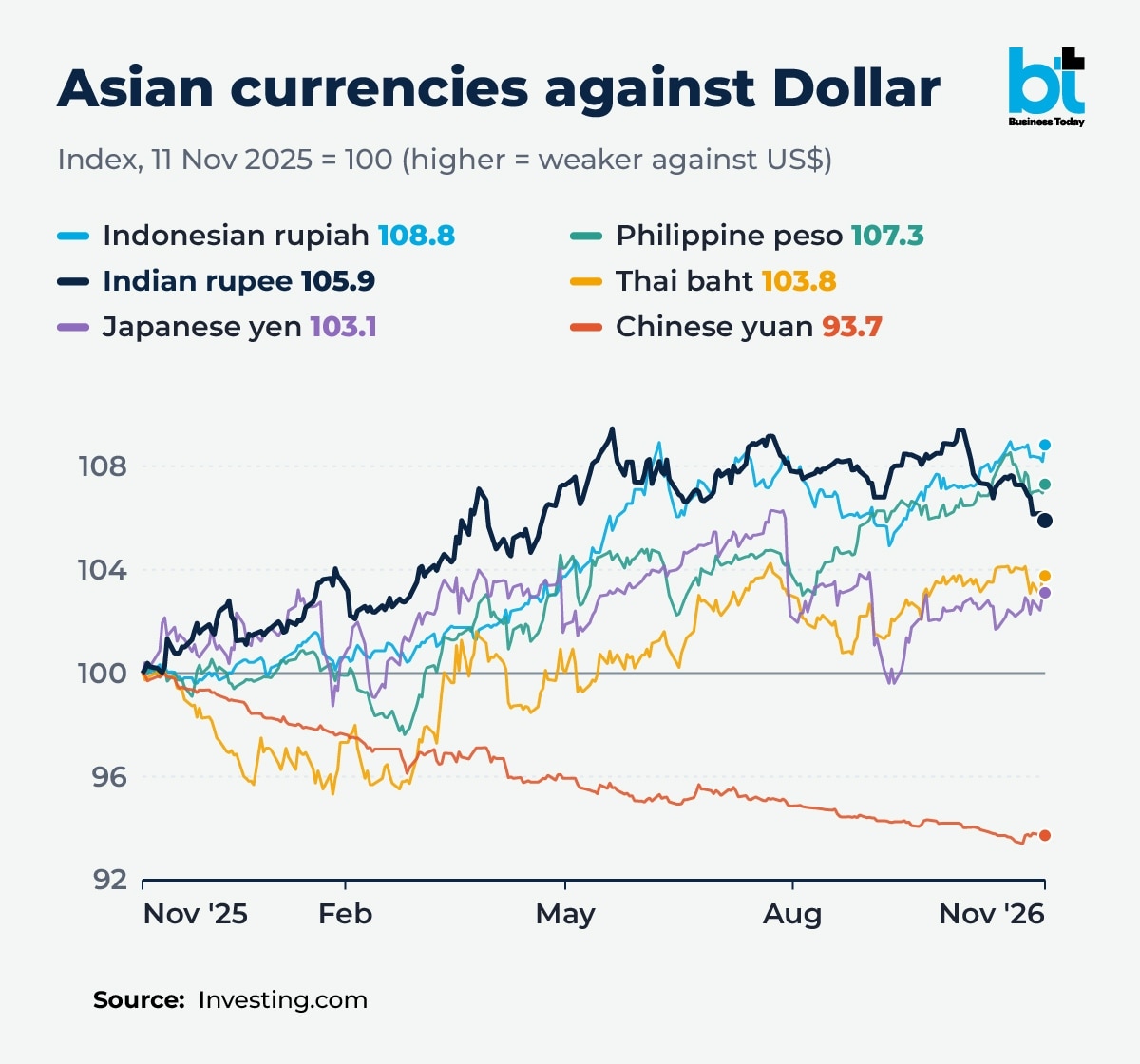
The rupee is up close to 1% so far in the current financial year, behind only the South Korean won and the Chinese renminbi in Asia. Many other regional currencies have continued to depreciate, with the Indonesian rupiah down around 6%. The Philippine peso, the Taiwanese dollar and the Thai baht have also weakened against the dollar.
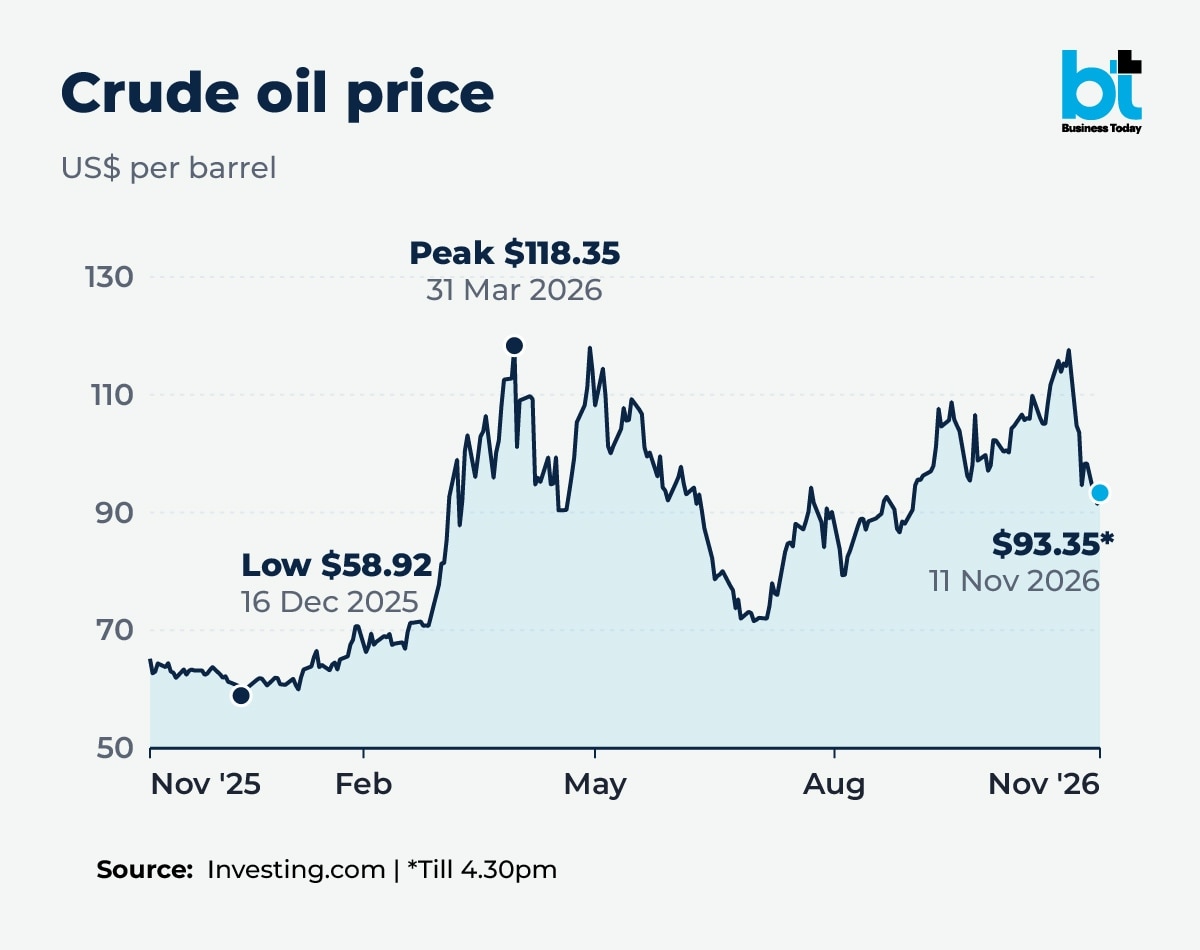
Cooling crude oil prices have eased the pressure on the rupee considerably in recent weeks. Because India imports much of its crude oil, any fall in prices lowers the import bill and, in turn, eases the pressure on the government’s finances.
On Tuesday, November 10, Brent crude briefly slipped below $90 per barrel, its lowest in almost two months, on hopes of a de-escalation of the conflict between the US and Iran. Prices rose on Wednesday to around $92 per barrel, still much lower than the October average of $124.
Foreign inflows power the rally
Beyond crude oil, however, a bigger driver for the rupee has been the sudden surge in foreign investor inflows into the equity market. As of November 11, foreign portfolio investors (FPIs) had pumped in around $6.4 billion during the month, said to be their biggest monthly purchase since September 2024.
MUST READ: Crude down 24%, FPIs invest ₹53,739 crore: GTRI explains what's driving rupee recovery
The inflows have significantly eclipsed the $3.6 billion they withdrew in October, although, from January 1 to November 11, FPIs remain net sellers to the tune of $24.98 billion, according to NSDL data. The renewed interest has driven the Sensex and the NSE Nifty50 up 10% since the end of October 2026.
“The renewed FPI interest has been driven by attractive valuations, resilient earnings growth, and India's relative appeal amid a global rotation away from AI-driven investment themes,” said Manoj Purohit, partner and leader, financial services tax, tax and regulatory services, BDO India.
Purohit noted that expectations of capital market tax reforms have further supported sentiment. These include potential long-term capital gains relief for offshore investors, rationalisation of the securities transaction tax, and simplification of capital gains taxation.
Over the past 12-18 months, FIIs chased attractive AI-related ideas from the US to Korea and Taiwan. With India lacking major AI-related themes, and surging oil prices raising balance-of-payments concerns, FIIs turned their backs on the country. Now, however, the AI trade seems to be reversing, especially after the Democrats made massive gains in the US mid-term elections, and India appears to be benefiting.
“More fragmented AI regulation and slower expansion in the US can bring back some lost savings to India,” noted Tanay Dalal, SVP – business and economic research at Axis Bank.
When FIIs sell Indian stocks and invest the money elsewhere, dollar demand rises, putting pressure on the rupee. Conversely, when they invest in the Indian market again, the rupee gets a lift. If the flows are sustained, the rupee could gain further support.
“Given India’s healthy macroeconomic fundamentals, strong corporate earnings, a meaningful correction in valuations from their 2024 peak levels, and robust domestic liquidity, any moderation in the global AI trade could encourage a stronger and more sustained revival in FII interest in relatively underperforming emerging markets such as India,” said Deven Mistry of Motilal Oswal Financial Services.
ALSO READ: Brent crude falls to lowest level since August; will markets extend recovery?
The Reserve Bank of India (RBI) took multiple measures this year to stabilise the rupee. It opened a special concessional swap window for banks to raise foreign currency non-resident (FCNR(B)) deposits, which brought in about $133 billion. In June, the government and the RBI took measures to increase FPI participation in government securities (G-Secs).
In October 2026, the RBI also opened a special window to meet the entire daily foreign exchange requirements of the three public sector oil marketing companies.
The Global Trade Research Institute (GTRI) expects the currency to settle around 92-93 against the US dollar over the coming months if favourable conditions persist.
ALSO READ: Trump loses, rupee gains: How US midterm elections triggered a turnaround in India's currency
Can the gains last?
However, some analysts still expect the rupee’s trajectory to remain downward, particularly in the medium term.
“Forex adequacy is still low. Rebuilding this is likely to keep the rupee weaker than fair,” said Dalal of Axis Bank. He pointed out that about $200 billion in RBI short positions are in the one-year-plus maturity range. Dalal is therefore sticking to his view, targeting the rupee at 100 to the dollar by June 2027.
In a short forward dollar contract, the central bank commits to sell dollars at a future date at a predetermined rate.
A recent IDFC First Bank economics research report also noted that the RBI’s net short dollar position could limit rupee appreciation, as the central bank would need to accumulate dollars to meet its commitments when the contracts mature.
UBS also expects the rupee to depreciate. It sees the currency at 96 to the dollar by the end of the current financial year in March 2027 and at 100 by the end of FY2028. “RBI faces a difficult trade-off between supporting the rupee, containing inflation and sustaining growth,” it said.
Inflation in India has been rising in recent months because of the conflict in West Asia and rising input costs. Deficient rains in many parts of the country are expected to add to inflationary pressures, as food prices are seen rising in the coming months.
Against this backdrop, the RBI is expected to raise interest rates further. It raised the repo rate by 25 basis points in October, and a similar hike is expected at the Monetary Policy Committee meeting in December.
ALSO READ: Gold falls 21% globally but only 15% in India: How the rupee protected investors
UBS expects cumulative rate hikes of 75 bps, while many other economists have in recent weeks pencilled in a further 50-75 bps increase in the coming months.
Higher-than-expected inflation in the US in October has also built a case for the Federal Reserve to raise interest rates when it meets next month.
To be clear, crude oil, FII flows and interest rates will all have a bearing on the rupee in the months ahead.












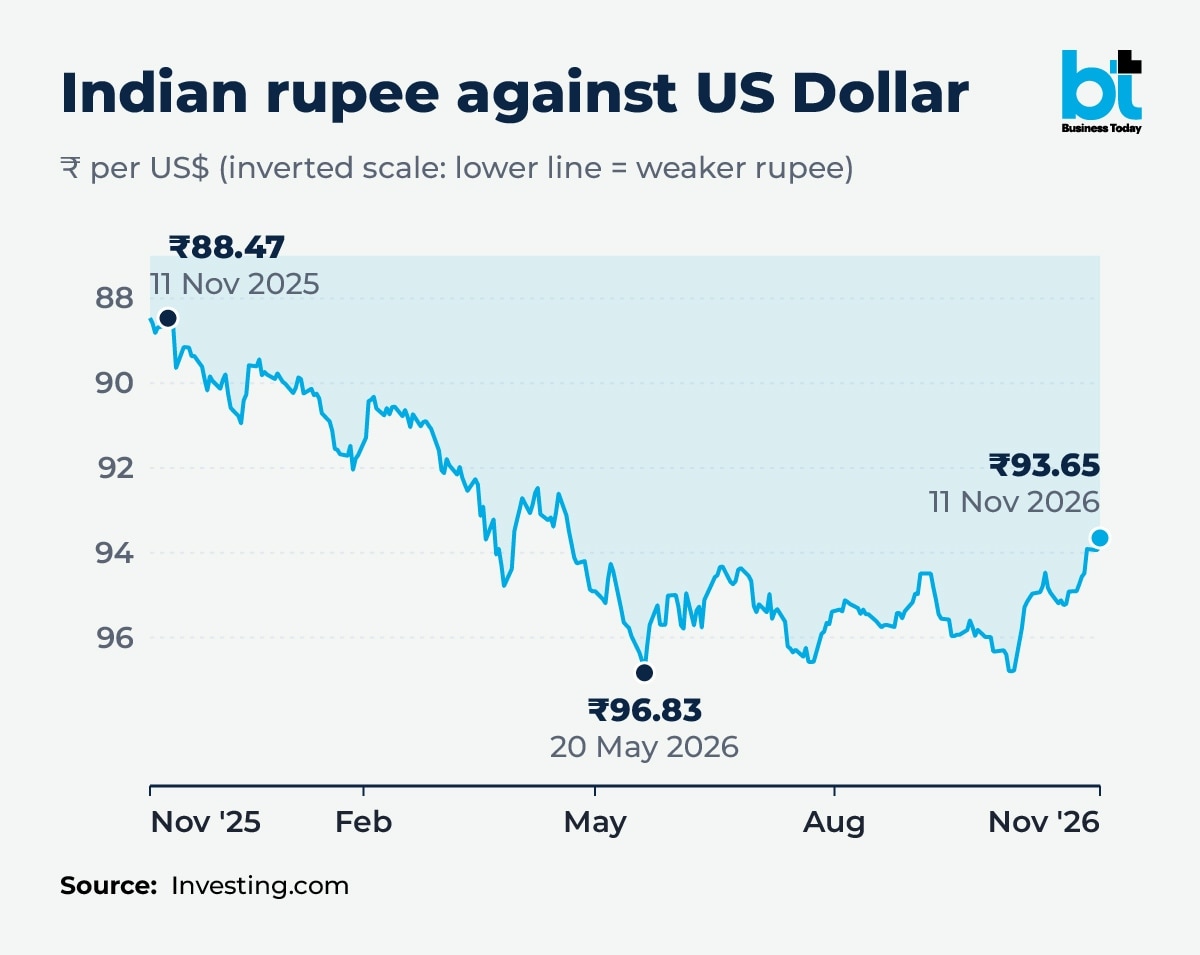



 The rupee is up close to 1% so far in the current financial year, behind only the South Korean won and the Chinese renminbi in Asia.

 Nvidia shares get 60% target cut! What should Indian stock investors know
 Noel Tata steps down as Tata Investment Chairman after 16 years; Bahram Vakil to take over
 Will October inflation breach 6%? What it means for interest rates, EMIs and GDP growth
 India overhauls visa rules: Tourist Visa renamed, 70% fewer form fields, new categories for foreigners
 'RBI may struggle to meet 4% inflation target': Economist flags fastest money, credit growth since 2012-13
 India's Jobless Rate Falls to 5.1%, But Why Is Urban Youth Unemployment Rising to 18.9%?
 Budget 2027: Industry Seeks LTCG Tax Abolition, STCG Cut To 10%, Lower STT Rates
 LIVE Daily Calls: Ask Your STOCK MARKET TODAY QUERIES | Market Update LIVE | Share Market News Today
 U.P. SIR Row: Yogi’s 1.27 Crore Hindu Voter Claim Gives Opposition Fresh Ammunition
 Big Challenge For Vijay Govt: 11 Diwali Murders Put Tamil Nadu Law & Order In Focus

 Cochin Shipyard shares tumble 7%: Weak Q2 earnings overshadow Rs 500 crore MoD order
 Sensex jumps 773 points, Nifty tops 25,250; profit booking trims gains
 Mutual fund SIP inflows slip marginally to Rs 32,160 crore in October; equity inflows fall 14%
 TVS Motor expands global portfolio with Callisto 110 launch in Istanbul
 Rupee at 92 or 100 per dollar? GTRI and Axis Bank differ on how long India's currency rally can last
 Financial Horoscope Today, November 12, 2026: Pisces Will See Their Plans Succeed, Know the Fate of Other Signs
 Land buying plunges 56% in 2026: Why developers are slowing expansion after 3 years of growth
 India–EU FTA's €119 billion trade promise: Could Europe's fiscal troubles threaten Indian exporters?
 Lahore AQI hits 263: Pakistan blames India's Diwali fireworks for toxic air