
Did you know India’s cash demand is strong despite the digital payment boom?
Did you know India’s cash demand is strong despite the digital payment boom?
The growth of UPI has been particularly striking. According to the NPCI, UPI processed 23.6 billion transactions worth ₹29.9 lakh crore in May 2026
Ujjwal Thakur
- Aug 25, 2026,
- Updated Aug 25, 2026 4:18 PM IST
According to Reserve Bank of India (RBI) data, currency in circulation rose to a five-year high of ₹43.02 lakh crore in May 2026, up 12% from ₹38.35 lakh crore a year earlier. The increase came even as digital payments, particularly UPI, became an increasingly important mode of transaction. Meanwhile, digital payments recorded ₹272 lakh crore in value in May 2026, up 11% from ₹246 lakh crore a year earlier.
Advertisement
"That combination makes future demand harder to predict, which complicates our planning for production and distribution capacity," RBI Deputy Governor Shirish Chandra Murmu said.
The continued use of cash also means the central bank needs banknotes to last longer. "We are exploring ways to extend the life of banknotes, including surface coatings on the substrate, and polymer notes for lower denominations," Murmu said.
DON'T MISS | The Rs 606 problem: What happens when India puts a price on UPI
Murmu noted that cash usage remains significant in rural and semi-urban areas, among low-income groups, older populations and small businesses, despite the rapid expansion of digital payment infrastructure.
Advertisement
The growth of UPI has been particularly striking. According to the National Payments Corporation of India (NPCI), UPI processed 23.6 billion transactions worth ₹29.9 lakh crore in May 2026.
MUST READ | 10 years of UPI: Transaction value surges 4,000-fold to reach ₹314 lakh crore
PhonePe, Google Pay dominate UPI payments
While UPI has emerged as the backbone of India’s digital-payment ecosystem, its usage is heavily concentrated among a few applications. NPCI data for May shows that PhonePe was the largest UPI app by transaction value, processing transactions worth about ₹14.67 lakh crore. Google Pay followed with ₹10.03 lakh crore, while Paytm ranked third at ₹1.99 lakh crore.
Advertisement
CRED and Navi rounded out the top five by transaction value, processing ₹61,002 crore and ₹43,602 crore, respectively.
Together, PhonePe and Google Pay accounted for around 82.6% of UPI transaction value in May. Their dominance, however, has begun to ease in terms of transaction volume, according to NPCI data.
DO CHECKOUT | BT EXPLAINER | Banks or PhonePe, Patym and Google Pay — Who stands to benefit the most from UPI MDR?
The difference between transaction volume and value is also notable for some smaller players. CRED, for instance, accounted for only about 0.7% of UPI transaction volume in May, but its share of transaction value was around 2%, indicating a relatively higher average transaction size.
The cash paradox
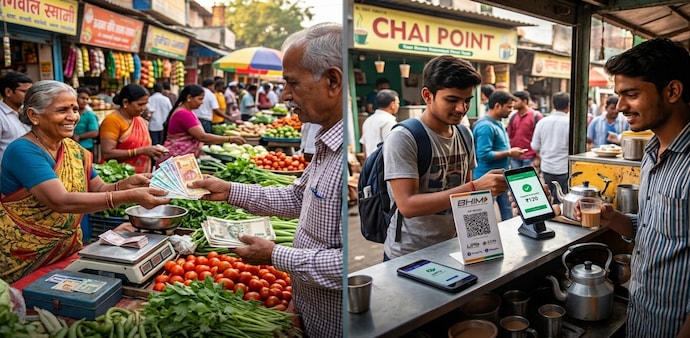
India’s payments landscape is therefore evolving in two directions at once. Digital payments are taking an increasing share of individual transactions, while physical currency remains an important part of the economy.
The central bank must continue to maintain sufficient production and distribution capacity while accounting for changes in economic growth, inflation, interest rates, payment behaviour and the preferences of different sections of the population.
Advertisement
According to Murmu, cash continues to be a crucial form of payment in India, so ensuring trust in physical currency—through clean notes, secure logistics, and a dependable currency framework—is vital for upholding confidence in the monetary system.
According to Reserve Bank of India (RBI) data, currency in circulation rose to a five-year high of ₹43.02 lakh crore in May 2026, up 12% from ₹38.35 lakh crore a year earlier. The increase came even as digital payments, particularly UPI, became an increasingly important mode of transaction. Meanwhile, digital payments recorded ₹272 lakh crore in value in May 2026, up 11% from ₹246 lakh crore a year earlier.
Advertisement
"That combination makes future demand harder to predict, which complicates our planning for production and distribution capacity," RBI Deputy Governor Shirish Chandra Murmu said.
The continued use of cash also means the central bank needs banknotes to last longer. "We are exploring ways to extend the life of banknotes, including surface coatings on the substrate, and polymer notes for lower denominations," Murmu said.
DON'T MISS | The Rs 606 problem: What happens when India puts a price on UPI
Murmu noted that cash usage remains significant in rural and semi-urban areas, among low-income groups, older populations and small businesses, despite the rapid expansion of digital payment infrastructure.
Advertisement
The growth of UPI has been particularly striking. According to the National Payments Corporation of India (NPCI), UPI processed 23.6 billion transactions worth ₹29.9 lakh crore in May 2026.
MUST READ | 10 years of UPI: Transaction value surges 4,000-fold to reach ₹314 lakh crore
PhonePe, Google Pay dominate UPI payments
While UPI has emerged as the backbone of India’s digital-payment ecosystem, its usage is heavily concentrated among a few applications. NPCI data for May shows that PhonePe was the largest UPI app by transaction value, processing transactions worth about ₹14.67 lakh crore. Google Pay followed with ₹10.03 lakh crore, while Paytm ranked third at ₹1.99 lakh crore.
Advertisement
CRED and Navi rounded out the top five by transaction value, processing ₹61,002 crore and ₹43,602 crore, respectively.
Together, PhonePe and Google Pay accounted for around 82.6% of UPI transaction value in May. Their dominance, however, has begun to ease in terms of transaction volume, according to NPCI data.
DO CHECKOUT | BT EXPLAINER | Banks or PhonePe, Patym and Google Pay — Who stands to benefit the most from UPI MDR?
The difference between transaction volume and value is also notable for some smaller players. CRED, for instance, accounted for only about 0.7% of UPI transaction volume in May, but its share of transaction value was around 2%, indicating a relatively higher average transaction size.
The cash paradox
India’s payments landscape is therefore evolving in two directions at once. Digital payments are taking an increasing share of individual transactions, while physical currency remains an important part of the economy.
The central bank must continue to maintain sufficient production and distribution capacity while accounting for changes in economic growth, inflation, interest rates, payment behaviour and the preferences of different sections of the population.
Advertisement
According to Murmu, cash continues to be a crucial form of payment in India, so ensuring trust in physical currency—through clean notes, secure logistics, and a dependable currency framework—is vital for upholding confidence in the monetary system.
Read more!