WHAT DID PARLIAMENT DO?
It removed a ban.
Since 2020, the law had forbidden anyone from charging a shop for taking UPI payments. The Centre has now removed that protection.
That does not create a fee. It makes one possible. The Finance Minister's office called the change "an enabling provision" that "does not impose any tax or transaction charge on UPI users".
What might follow is an MDR, or merchant discount rate: the small cut a shop already pays its bank every time you swipe a card. On UPI, that cut has always been zero.
WILL IT COME OUT OF MY POCKET?
No. Nothing on the table charges the customer.
The fee would sit with shops, and only large ones, on payments above Rs 2,000. Reports put it between 0.3 and 0.5 per cent. But no minister has said that aloud, and no document carries a figure. Rates, limits, and timings are still being settled — inside the National Payments Corporation of India office.
https://www.npci.org.in/what-we-do/upi/upi-ecosystem-statistics
In how small an Indian payment is.
The average UPI payment to a shop in July 2026 was Rs 606 — a grocery run, a phone bill, or a pair of school shoes. Put a 0.3 per cent fee on a payment that size, and it yields Rs 1.82. That is then shared between the shop's bank, the app you paid with, and NPCI itself.
India made 14.97 billion ( https://www.npci.org.in/what-we-do/upi/upi-ecosystem-statistics ) of them that month. Two in every three UPI payments now go to a shop rather than a person.
WHICH SHOPS WOULD ACTUALLY PAY?
Very few, and that is deliberate.
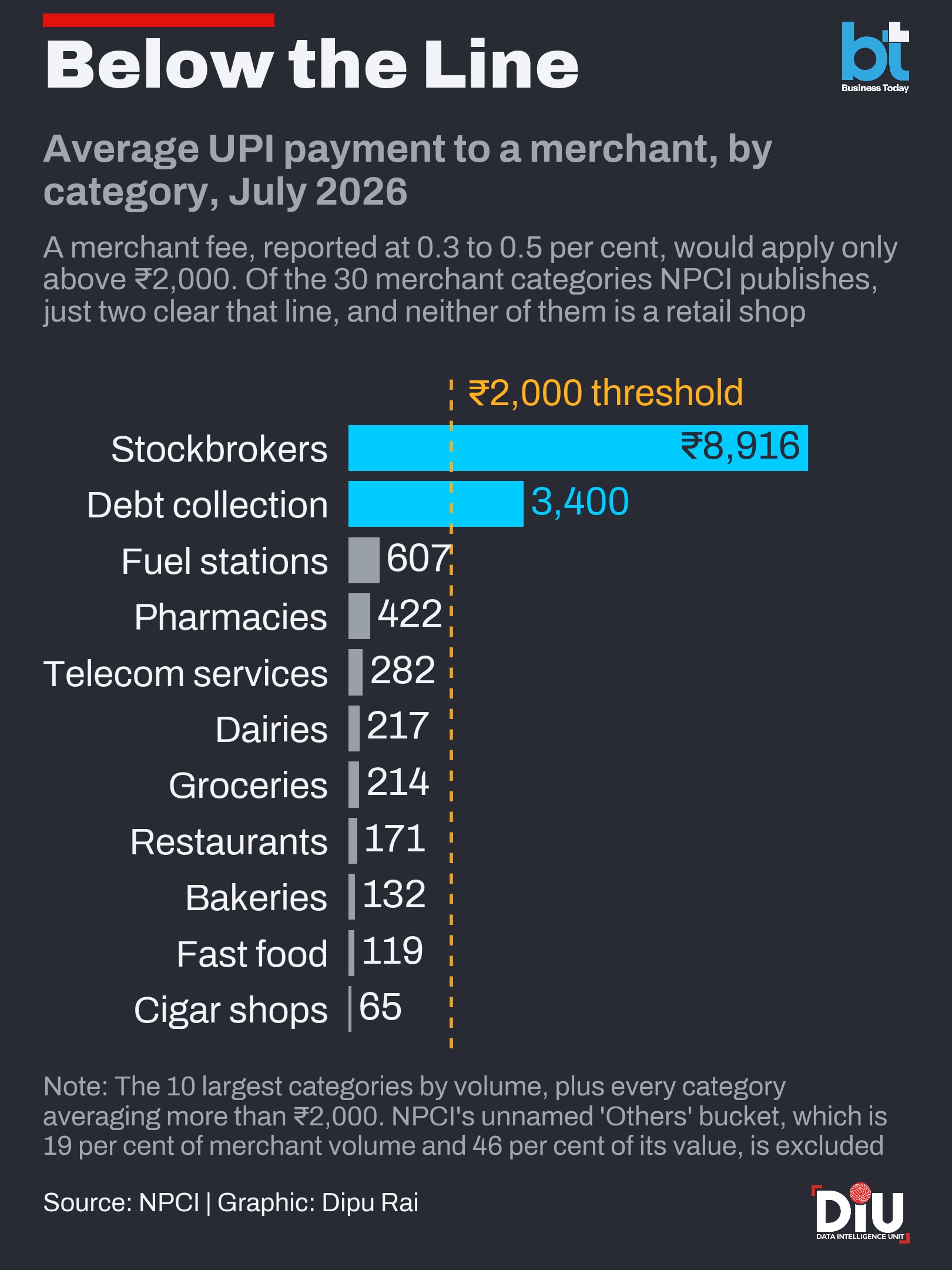
The NPCI sorts merchant payments into 30 trade categories. Only two average more than Rs 2,000: stockbrokers, at Rs 8,916, and debt collection agencies, at Rs 3,400. Neither is a shop in any ordinary sense.
The categories that carry the crowds sit nowhere near the line. Groceries average Rs 214, restaurants Rs 171, bakeries Rs 132, fast food Rs 119.
A Rs 2,000 threshold protects the corner shop, which is the intention. It also means the fee sails over almost everything India buys. One caution: nearly half the merchant money sits in a bucket NPCI labels only "Others" and never breaks down.
HOW MUCH MONEY IS REALLY IN THIS?
Less than the noise suggests.
Shops took Rs 98.08 lakh crore over UPI in the year to July 2026. A flat 0.3 per cent on all of it would raise about Rs 29,400 crore. But it will not be flat and will not touch everything, so the real figure is a fraction of that.
The trouble is structural. India's average instant payment is $21 the lowest among economies the Bank for International Settlements compares. Japan's is $3,380, Mexico's $2,566. The nearest are Sweden at $49 and Argentina at $73.
A percentage fee earns well on big payments. India does not make big payments.
IS UPI REALLY BIGGER THAN VISA?
It depends what you count, and the answer flips.
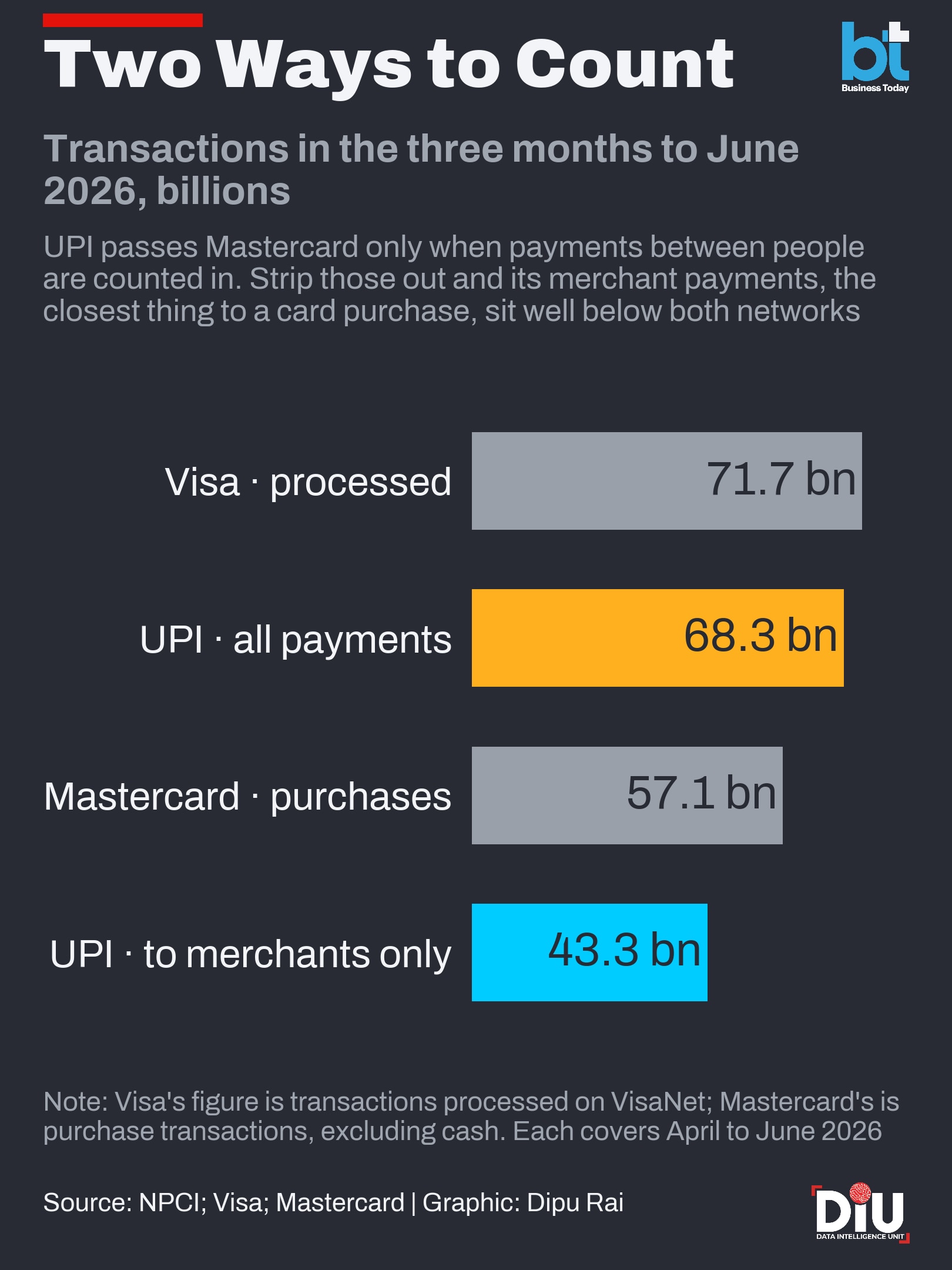
Between April and June, UPI carried 68.26 billion payments, Visa 71.7 billion, and Mastercard 57.10 billion card purchases.
But UPI's count includes money you send your friend, your domestic help, or your landlord. No card network does that. Strip it out and UPI's shop payments come to 43.26 billion, below Mastercard.
HAS ANY COUNTRY CHARGED FOR A SYSTEM LIKE THIS?
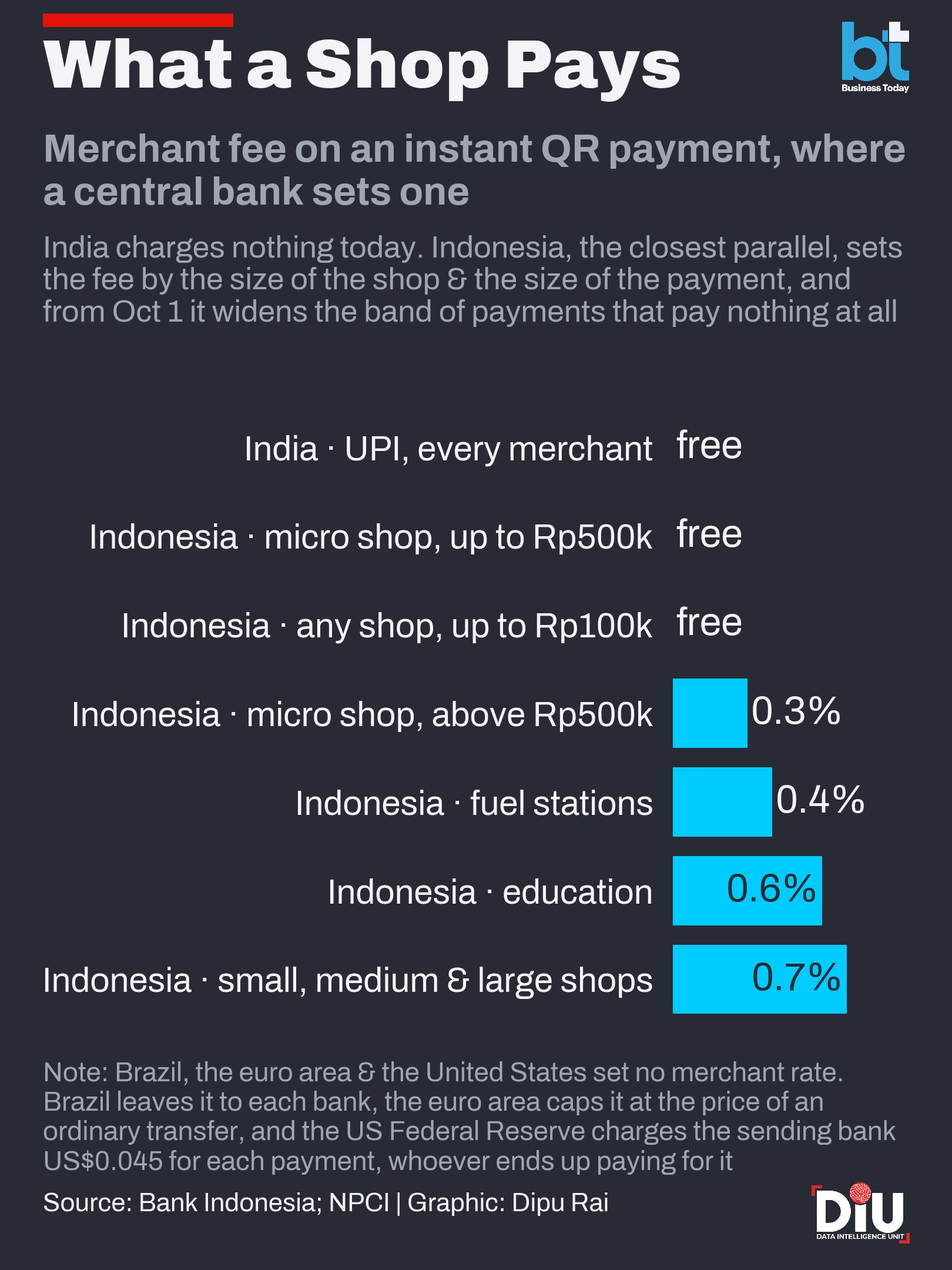
Indonesia is the closest thing to a test. The QRIS is its national QR-code system, built for the same street-corner economy as UPI. It does charge, and its central bank fixes the rate rather than leaving it to banks. A tiny shop pays nothing up to Rp 500,000 (about Rs 2,700), and then 0.3 per cent. Bigger shops pay 0.7 per cent, petrol pumps 0.4 per cent, and schools 0.6 per cent. Shops are barred from passing any of it to the customer.
Brazil took another route with Pix, its central bank's instant-payment system and the closest cousin UPI has. People are not charged there; companies are, and each bank sets its own price.
The euro area caps instead: an instant transfer cannot cost more than an ordinary one. America charges the bank rather than the shop about 4.5 cents per payment on FedNow, the Federal Reserve's own instant system.
And Indonesia is walking it back. On August 17, its central bank announced that from October 1, no shop pays anything up to Rp 100,000, about Rs 540. The country India would be copying is shrinking its fee, not raising it.
WHY HAS WASHINGTON JOINED THE ARGUMENT?Because two American apps carry the traffic.
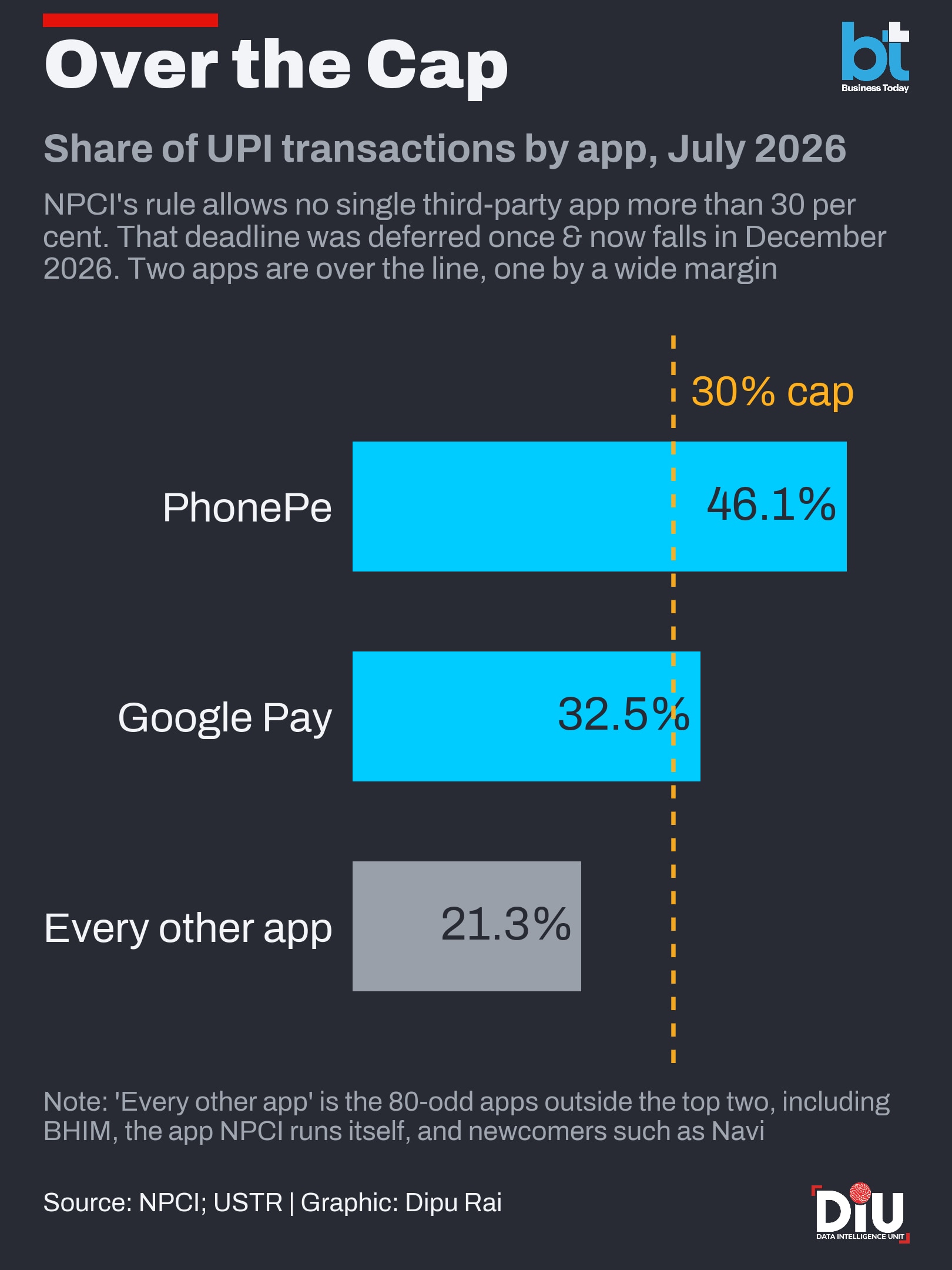
PhonePe handles 46.2 per cent of UPI payments. Google Pay handles another 32.5 per cent. That’s nearly four in five between them.
The US Trade Representative's 2026 trade report says American firms cannot compete fairly within UPI against RuPay, India's homegrown card network. It noted that those two apps crossed 80 per cent of all UPI payments by the end of last year. A domestic pricing question has become a diplomatic one.
WHAT IS WORTH WATCHING NOW?
December, more than the fee.
The NPCI's own rule says no single app may hold more than 30 per cent of UPI payments. That deadline has already slipped and now falls in December 2026. Both PhonePe and Google Pay are over the line.
The fee is still a proposal. The cap is a date. And the Rs 606 payment sits under both, too small to pay for much at all.













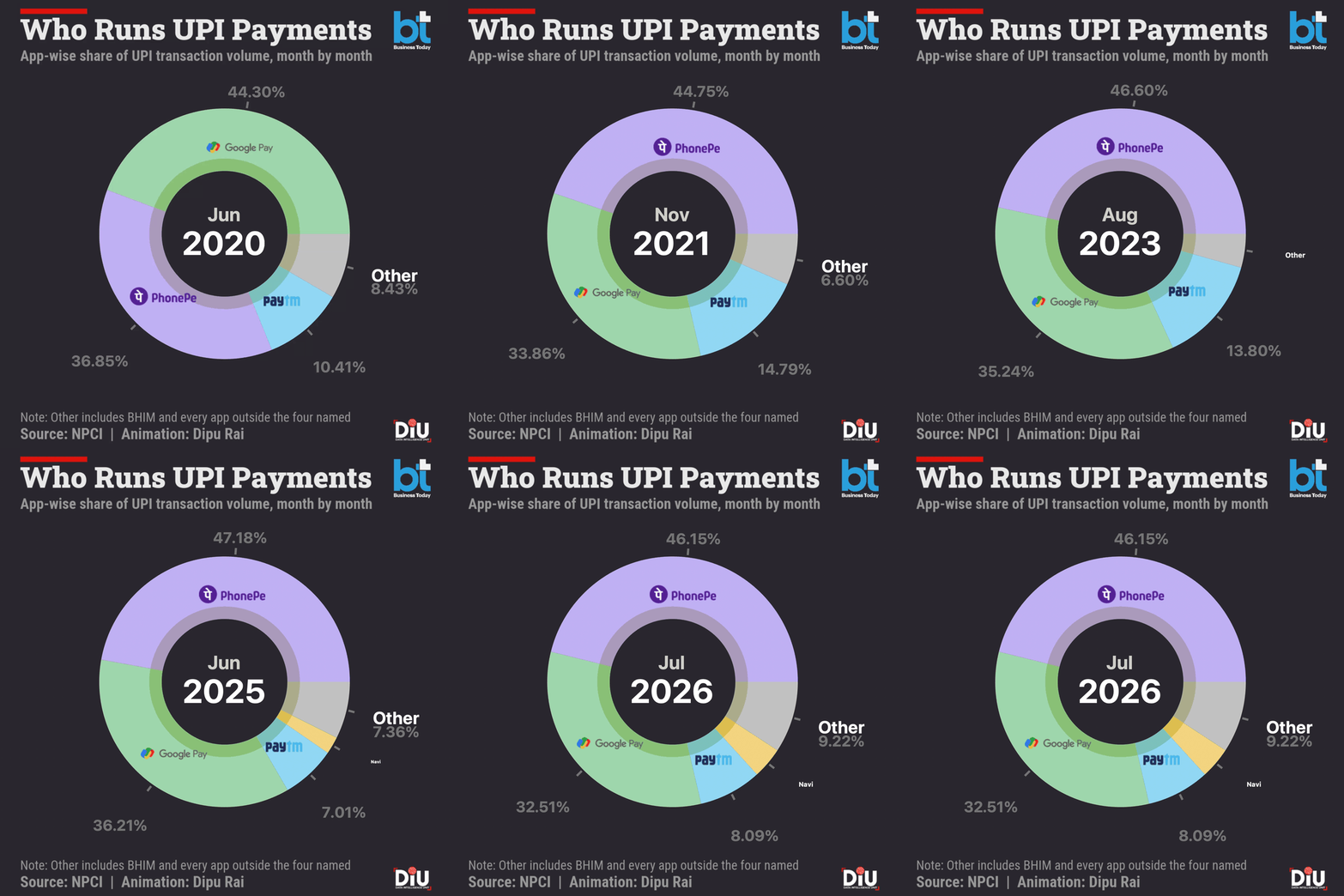


 PhonePe handles 46.2 per cent of UPI payments, while Google Pay handles another 32.5 per cent. That’s nearly four in five between them.
  Tata Motors, Ather, M&M, Ashok Leyland: Emkay Global sees up to 58% upside in select auto stocks
 NSE IPO subscribed 3.8x on Day 3 amid strong QIB demand; key details
 Biocon’s breast cancer biosimilar gets a positive EMA opinion; closer to launching therapy in EU
 ‘It was inappropriate…’: IIT-B apologises for earlier statement, says Director has not resigned
 Apple layoffs: iPhone maker begins fresh job cuts, second round in two months
 Takeda, Dr. Reddy’spartner To Bring QDENGA Dengue Vaccine To India; Launch Expected In H1 2027
 Would You Really Upgrade Your iPhone Just For THIS? | The iPhone 18 Pro Debate
 IPO Rush Drains Secondary Market Liquidity; Ajay Bagga On Primary Market & NSE IPO
 Dr. Reddy's Sees Dengue Vaccine Opportunity As QDENGA Launch Nears
 From Noida To Lucknow: Food Safety Raids Uncover Rodents, Rotten Food And Hygiene Violations
 Protean eGov shares zoom 20% to hit upper circuit; here's what's happening
 AMFI rejig: IRFC, Vedanta shares may move to midcap list, SBI Funds' largecap entry likely
 Wipro shares fall 55% from record high, deliver negative returns for up to five years; looking to exit?
 Multibagger stock to buy: This recent debutant is up 140% in two months; analyst sees more upside
 Apple’s $250 million Siri settlement: Check if your iPhone qualifies and how to claim
 Professors were doing their job: Ex-Rajya Sabha MP questions caste discrimination angle in IIT Bombay row
 Citroën owner Stellantis take full control of Tamil Nadu plant