
Iran-Israel conflict puts India’s LNG imports, exports at risk; govt to explore Norway & US if Crisis persists: Sources
Sources told Business Today that LNG imports are the biggest concern for policymakers, as gas is critical for city gas, power, fertilisers, and cooking fuel. The government is exploring supplies from Norway and the US, but longer routes make logistics costlier and more complex.
- Mar 10, 2026,
- Updated Mar 10, 2026 4:18 PM IST
The ongoing conflict in West Asia has raised fresh concerns over India’s energy security and export trade, with government sources warning that disruptions in liquified natural gas (LNG) supplies and shipping routes through the Strait of Hormuz could create significant economic stress if the crisis continues.
According to government officials, India’s dependence on the Strait of Hormuz for energy supplies makes the situation particularly sensitive, as nearly 69% of India’s LNG imports pass through the narrow shipping corridor, which has become a potential flashpoint amid the Iran-Israel-US conflict.
Sources told Business Today that LNG imports are currently the biggest concern for policymakers, as natural gas is widely used in city gas distribution, power generation, fertiliser production, and cooking gas supplies.
Officials said the government is evaluating alternative sourcing options, including shipments from Norway and the United States, but longer distances make logistics more expensive and complicated. “We may explore longer-term LNG shipping routes if the crisis persists. Russian oil supply is providing temporary relief on the crude side, but gas imports remain a key risk,” a government source said.
Export trade also under pressure
Apart from energy imports, India’s exports to the Gulf region are also facing uncertainty. Government sources said that nearly $40–50 billion worth of exports to the Gulf Cooperation Council (GCC) countries could be affected if tensions escalate or shipping delays increase.
The sectors most exposed to the West Asia crisis include petroleum products, precious metals, gems and jewellery, along with food products, processed foods, textiles, and apparel, which rely heavily on trade routes passing through the Gulf.
Officials said exports have not stopped, but shipments are taking longer as vessels are being rerouted to avoid sensitive zones. “GCC nations are under pressure but remain keen to keep trade routes open for India. However, alternate sea routes are increasing transit time and costs,” a source said.
Shipping congestion builds in Gulf region
Logistics disruptions have already begun to show up in container movement data. Government officials stated that India has approximately 6–7 lakh TEU containers linked to Gulf trade routes, with a significant number currently stranded due to uncertainty in shipping lanes.
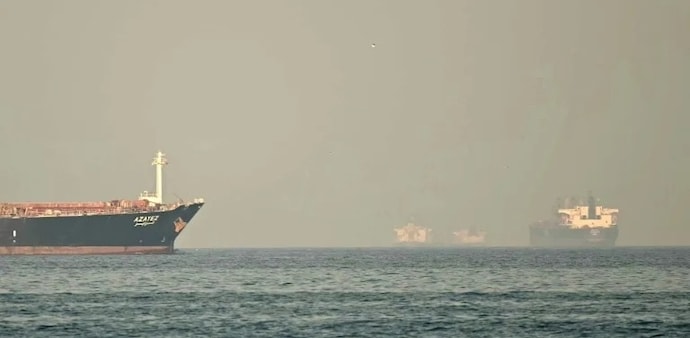
Around 3.5 lakh containers are estimated to be located in the Gulf region, while several vessels are waiting in the Arabian Sea and near Oman waters for clearance to move. Containers that are already deep inside the Gulf are proving difficult to evacuate because of security risks and congestion at ports.
Experts say the situation remains manageable for now, but a prolonged conflict could push up energy costs, delay exports, and widen India’s trade deficit, adding pressure on the rupee and inflation.
LNG imports and Strait of Hormuz
Nearly 69% of India’s liquefied natural gas (LNG) imports depend on the Strait of Hormuz, making the country highly vulnerable to disruptions in the West Asia shipping corridor, according to an Elara Securities report titled “LNG: Steering through the Hormuz bottleneck.”
The report estimates that by calendar year 2025, India will import about 17.5 million tonnes of LNG, or nearly 63 mmscmd, from Qatar, the UAE, and Oman, with most shipments passing through or close to the Strait. Even after adjusting for supply swaps, exposure remains high at around 66%, indicating significant concentration risk.
Any disruption could impact the entire gas value chain, starting from LNG terminals to transmission networks and downstream industries.
Among terminals, Petronet LNG’s Dahej facility is the most exposed, with about 76% dependence on Hormuz-linked supplies. Mundra, Dhamra, Ennore, Kochi, and Chhara terminals also show high reliance. At the corporate level, Petronet LNG and Gujarat State Petronet face the highest risk due to their heavy dependence on Gulf-linked gas supplies.
The ongoing conflict in West Asia has raised fresh concerns over India’s energy security and export trade, with government sources warning that disruptions in liquified natural gas (LNG) supplies and shipping routes through the Strait of Hormuz could create significant economic stress if the crisis continues.
According to government officials, India’s dependence on the Strait of Hormuz for energy supplies makes the situation particularly sensitive, as nearly 69% of India’s LNG imports pass through the narrow shipping corridor, which has become a potential flashpoint amid the Iran-Israel-US conflict.
Sources told Business Today that LNG imports are currently the biggest concern for policymakers, as natural gas is widely used in city gas distribution, power generation, fertiliser production, and cooking gas supplies.
Officials said the government is evaluating alternative sourcing options, including shipments from Norway and the United States, but longer distances make logistics more expensive and complicated. “We may explore longer-term LNG shipping routes if the crisis persists. Russian oil supply is providing temporary relief on the crude side, but gas imports remain a key risk,” a government source said.
Export trade also under pressure
Apart from energy imports, India’s exports to the Gulf region are also facing uncertainty. Government sources said that nearly $40–50 billion worth of exports to the Gulf Cooperation Council (GCC) countries could be affected if tensions escalate or shipping delays increase.
The sectors most exposed to the West Asia crisis include petroleum products, precious metals, gems and jewellery, along with food products, processed foods, textiles, and apparel, which rely heavily on trade routes passing through the Gulf.
Officials said exports have not stopped, but shipments are taking longer as vessels are being rerouted to avoid sensitive zones. “GCC nations are under pressure but remain keen to keep trade routes open for India. However, alternate sea routes are increasing transit time and costs,” a source said.
Shipping congestion builds in Gulf region
Logistics disruptions have already begun to show up in container movement data. Government officials stated that India has approximately 6–7 lakh TEU containers linked to Gulf trade routes, with a significant number currently stranded due to uncertainty in shipping lanes.
Around 3.5 lakh containers are estimated to be located in the Gulf region, while several vessels are waiting in the Arabian Sea and near Oman waters for clearance to move. Containers that are already deep inside the Gulf are proving difficult to evacuate because of security risks and congestion at ports.
Experts say the situation remains manageable for now, but a prolonged conflict could push up energy costs, delay exports, and widen India’s trade deficit, adding pressure on the rupee and inflation.
LNG imports and Strait of Hormuz
Nearly 69% of India’s liquefied natural gas (LNG) imports depend on the Strait of Hormuz, making the country highly vulnerable to disruptions in the West Asia shipping corridor, according to an Elara Securities report titled “LNG: Steering through the Hormuz bottleneck.”
The report estimates that by calendar year 2025, India will import about 17.5 million tonnes of LNG, or nearly 63 mmscmd, from Qatar, the UAE, and Oman, with most shipments passing through or close to the Strait. Even after adjusting for supply swaps, exposure remains high at around 66%, indicating significant concentration risk.
Any disruption could impact the entire gas value chain, starting from LNG terminals to transmission networks and downstream industries.
Among terminals, Petronet LNG’s Dahej facility is the most exposed, with about 76% dependence on Hormuz-linked supplies. Mundra, Dhamra, Ennore, Kochi, and Chhara terminals also show high reliance. At the corporate level, Petronet LNG and Gujarat State Petronet face the highest risk due to their heavy dependence on Gulf-linked gas supplies.