
Business wisdom of the day: 'Fall seven times...'
In a fast-moving, volatile market, resilience isn't just a nice leadership trait — it’s a survival strategy. Modern business spaces apply this philosophy in a few distinct ways.
- Jun 18, 2026,
- Updated Jun 18, 2026 2:09 PM IST
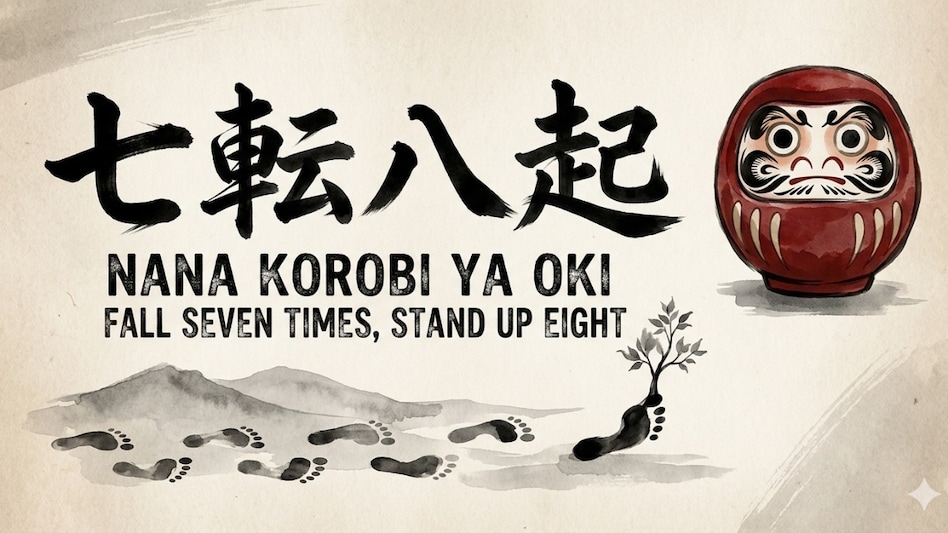
"Fall seven times, stand up eight" is an ancient Japanese proverb — nana korobi, ya oki — that perfectly captures the essence of relentless resilience. It serves as a powerful reminder that no matter how many times you face setbacks, failure, or misfortune, you can always choose to rise up one more time than you fall.
The saying is historically linked to the Daruma doll, a traditional Japanese tumbler toy weighted so it always returns to an upright position. It is a physical embodiment of bouncing back from adversity.
The beauty of nana korobi, ya oki is that its math doesn't quite add up at first glance. If you fall seven times, shouldn't you only need to stand up seven times to be back on your feet?
What the proverb means
At its core, the proverb reframes failure from a permanent destination to a temporary state.
- Inevitability of falling: The proverb doesn't say "If you fall." It assumes you will. Tumbling is treated as a natural, unavoidable part of life.
- Active choice of rising: Standing back up requires effort, intent, and agency. The proverb shifts the focus away from the external force that knocked you down and places it entirely on your internal resolve to get back up.
How it applies to businesses today
In a fast-moving, volatile market, resilience isn't just a nice leadership trait — it’s a survival strategy. Modern business spaces apply this philosophy in a few distinct ways:
- The "fail fast, learn faster" mindset: Silicon Valley's obsession with pivoting is just a modern tech translation of the Daruma doll. Exceptional companies treat a failed product launch or a missed quarter not as a fatal blow, but as a data-gathering exercise.
- Psychological safety: For a team to stand up an eighth time, they can't be terrified of the seventh fall. Leaders who cultivate resilience build environments where calculated risks are encouraged, and honest mistakes are treated as tuition for future success.
- Operational elasticity: Supply chain disruptions, sudden regulatory shifts, and economic downturns will happen. Resilient businesses design systems that can absorb shocks and adapt swiftly, rather than rigid structures that snap under pressure.
Why it remains timeless
Human beings have always looked for ways to make sense of suffering and setbacks. This proverb remains universally relevant because it speaks to a fundamental truth of the human condition: we do not control the obstacles, but we entirely control our response.
The imagery of the Daruma doll perfectly illustrates this. It isn't rigid; it yields to the push, rolls with the momentum, but because it is heavily weighted at its core, it inevitably rights itself. As long as people face hardship, heartbreak, and failure, the reminder to find that internal ballast and rise one more time will never go out of style.
"Fall seven times, stand up eight" is an ancient Japanese proverb — nana korobi, ya oki — that perfectly captures the essence of relentless resilience. It serves as a powerful reminder that no matter how many times you face setbacks, failure, or misfortune, you can always choose to rise up one more time than you fall.
The saying is historically linked to the Daruma doll, a traditional Japanese tumbler toy weighted so it always returns to an upright position. It is a physical embodiment of bouncing back from adversity.
The beauty of nana korobi, ya oki is that its math doesn't quite add up at first glance. If you fall seven times, shouldn't you only need to stand up seven times to be back on your feet?
What the proverb means
At its core, the proverb reframes failure from a permanent destination to a temporary state.
- Inevitability of falling: The proverb doesn't say "If you fall." It assumes you will. Tumbling is treated as a natural, unavoidable part of life.
- Active choice of rising: Standing back up requires effort, intent, and agency. The proverb shifts the focus away from the external force that knocked you down and places it entirely on your internal resolve to get back up.
How it applies to businesses today
In a fast-moving, volatile market, resilience isn't just a nice leadership trait — it’s a survival strategy. Modern business spaces apply this philosophy in a few distinct ways:
- The "fail fast, learn faster" mindset: Silicon Valley's obsession with pivoting is just a modern tech translation of the Daruma doll. Exceptional companies treat a failed product launch or a missed quarter not as a fatal blow, but as a data-gathering exercise.
- Psychological safety: For a team to stand up an eighth time, they can't be terrified of the seventh fall. Leaders who cultivate resilience build environments where calculated risks are encouraged, and honest mistakes are treated as tuition for future success.
- Operational elasticity: Supply chain disruptions, sudden regulatory shifts, and economic downturns will happen. Resilient businesses design systems that can absorb shocks and adapt swiftly, rather than rigid structures that snap under pressure.
Why it remains timeless
Human beings have always looked for ways to make sense of suffering and setbacks. This proverb remains universally relevant because it speaks to a fundamental truth of the human condition: we do not control the obstacles, but we entirely control our response.
The imagery of the Daruma doll perfectly illustrates this. It isn't rigid; it yields to the push, rolls with the momentum, but because it is heavily weighted at its core, it inevitably rights itself. As long as people face hardship, heartbreak, and failure, the reminder to find that internal ballast and rise one more time will never go out of style.