
Business wisdom of the day: 'In the moment of crisis, the wise...'
In today’s volatile market, a company's default instinct during a downturn is often to "build a dam" — cut all non-essential spending, hoard cash, and freeze external partnerships.
- Jun 26, 2026,
- Updated Jun 26, 2026 7:30 AM IST
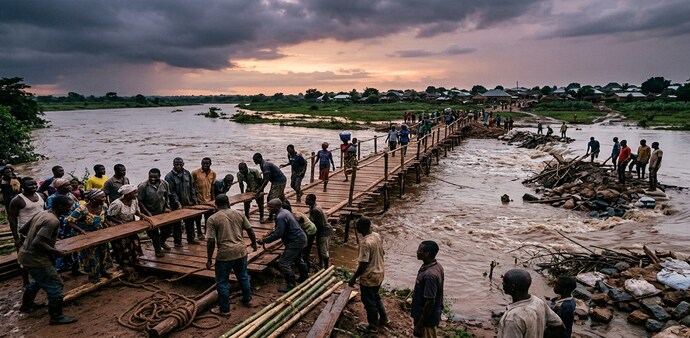
"In the moment of crisis, the wise build bridges and the foolish build dams." — a classic proverb of Nigerian origin.
While it is widely quoted online and often attributed to Nigerian or African heritage, it gained global fame in 2018 when it was quoted by the character T'Challa (Black Panther) in the post-credits scene of the Marvel Studios film Black Panther.
What the proverb means
At its core, this proverb contrasts two opposing responses to crisis: collaboration and protectionism.
- Building bridges: The wise look outward. They recognize that adversity is best managed by sharing resources, opening lines of communication, and creating alliances.
- Building dams: The foolish look inward. They attempt to hoard resources, block out external forces, and isolate themselves. While a dam might offer a temporary sense of security, it ultimately creates a bottleneck, trapping pressure until it inevitably breaks.
How the proverb applies for businesses today
In today’s volatile market, a company's default instinct during a downturn is often to "build a dam" — cut all non-essential spending, hoard cash, and freeze external partnerships. However, history shows that the most resilient businesses actively build bridges instead.
- Cross-Industry Partnerships: Companies that survive disruption don't isolate. They form strategic alliances to share the burden of innovation, such as automakers partnering with tech firms to develop autonomous software.
- Open Innovation: Rather than locking down proprietary data behind legal walls, modern enterprises often engage with open-source communities and tech incubators to solve complex systemic challenges faster.
- Supply Chain Resilience: A "dam" mindset relies on a single, isolated vendor to control risk. A "bridge" mindset builds a diversified, transparent network of suppliers, ensuring that if one route fails, others remain open.
Why it remains timeless
The proverb remains timeless because it accurately describes a fundamental law of human systems: isolationism is unsustainable.
Whether applied to geopolitical trade wars or digital-age corporate strategy, crises are fluid. You cannot stop a flood by pretending the water isn't there; you can only navigate it by building structures that allow you to cross over to safer ground together.
It reminds us that our long-term survival has never depended on how well we hide, but on how well we connect.
"In the moment of crisis, the wise build bridges and the foolish build dams." — a classic proverb of Nigerian origin.
While it is widely quoted online and often attributed to Nigerian or African heritage, it gained global fame in 2018 when it was quoted by the character T'Challa (Black Panther) in the post-credits scene of the Marvel Studios film Black Panther.
What the proverb means
At its core, this proverb contrasts two opposing responses to crisis: collaboration and protectionism.
- Building bridges: The wise look outward. They recognize that adversity is best managed by sharing resources, opening lines of communication, and creating alliances.
- Building dams: The foolish look inward. They attempt to hoard resources, block out external forces, and isolate themselves. While a dam might offer a temporary sense of security, it ultimately creates a bottleneck, trapping pressure until it inevitably breaks.
How the proverb applies for businesses today
In today’s volatile market, a company's default instinct during a downturn is often to "build a dam" — cut all non-essential spending, hoard cash, and freeze external partnerships. However, history shows that the most resilient businesses actively build bridges instead.
- Cross-Industry Partnerships: Companies that survive disruption don't isolate. They form strategic alliances to share the burden of innovation, such as automakers partnering with tech firms to develop autonomous software.
- Open Innovation: Rather than locking down proprietary data behind legal walls, modern enterprises often engage with open-source communities and tech incubators to solve complex systemic challenges faster.
- Supply Chain Resilience: A "dam" mindset relies on a single, isolated vendor to control risk. A "bridge" mindset builds a diversified, transparent network of suppliers, ensuring that if one route fails, others remain open.
Why it remains timeless
The proverb remains timeless because it accurately describes a fundamental law of human systems: isolationism is unsustainable.
Whether applied to geopolitical trade wars or digital-age corporate strategy, crises are fluid. You cannot stop a flood by pretending the water isn't there; you can only navigate it by building structures that allow you to cross over to safer ground together.
It reminds us that our long-term survival has never depended on how well we hide, but on how well we connect.