
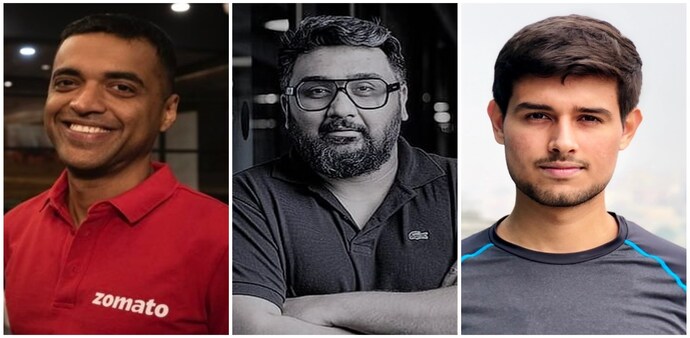
Capitalism vs Socialism debate reignites as Deepinder Goyal, Kunal Shah and Dhruv Rathee weigh in
The debate saw Deepinder Goyal, founder of Eternal, who argued that capitalism, despite its flaws, remains the most effective engine for creating value.
- Jan 3, 2026,
- Updated Jan 3, 2026 8:17 PM IST
A renewed debate over capitalism and socialism has surfaced on Indian social media against the backdrop of the ongoing gig delivery row, where questions around worker pay, platform accountability and the role of private enterprises have dominated public discourse. Prominent startup founders, investors and influencers weighed in on the role of economic systems in wealth creation and poverty alleviation.
The debate saw Deepinder Goyal, founder of Eternal, who argued that capitalism, despite its flaws, remains the most effective engine for creating value. In a post on X (formerly Twitter), Goyal wrote, “Capitalism isn’t perfect, but it’s the only engine we’ve seen that creates value. Create first, and distribute second. Reverse the order, and we distribute scarcity. Helps no one.” His remarks underline a long-standing argument among free-market advocates that wealth must be generated before it can be redistributed.
Goyal was amplifying a post by Kunal Shah, founder of fintech firm CRED, who called for greater public education on economic ideologies. Shah urged popular Indian podcasters across languages to explain both the merits and demerits of capitalism and socialism. While acknowledging capitalism’s shortcomings, Shah described it as “the only proven system which can lift us out of poverty and make a nation worth reckoning,” reflecting a view commonly held within India’s startup ecosystem.
Backing this position, Chander Bhatia, co-founder and chief investment officer at Seers Fund Management Pvt Ltd, stressed the interdependence between capitalism and social welfare. Bhatia argued that capitalism is essential to reach a level of prosperity where socialist policies can function effectively. “If the government doesn’t get enough taxes, they can’t do much on the socialism front,” he wrote, adding that private entrepreneurs play a crucial role in creating jobs and profits that ultimately fund public welfare through taxation.
However, the largely pro-capitalism chorus was countered by social media influencer and educator Dhruv Rathee, who cautioned against framing the issue as a binary choice. Rathee argued that debating labels such as capitalism and socialism in isolation is unproductive, noting that no country operates under a purely capitalist or purely socialist model. “Even the most capitalist country in the world today has elements of socialism and the most socialist country has elements of capitalism,” he wrote.
Rathee called for a more pragmatic, evidence-based approach to policymaking, urging policymakers and citizens alike to assess individual policies on their merits rather than relying on ideology. According to him, evaluating data, outcomes and track records on a case-by-case basis is a more effective way to drive national progress than “blindly trusting theoretical concepts.”
A renewed debate over capitalism and socialism has surfaced on Indian social media against the backdrop of the ongoing gig delivery row, where questions around worker pay, platform accountability and the role of private enterprises have dominated public discourse. Prominent startup founders, investors and influencers weighed in on the role of economic systems in wealth creation and poverty alleviation.
The debate saw Deepinder Goyal, founder of Eternal, who argued that capitalism, despite its flaws, remains the most effective engine for creating value. In a post on X (formerly Twitter), Goyal wrote, “Capitalism isn’t perfect, but it’s the only engine we’ve seen that creates value. Create first, and distribute second. Reverse the order, and we distribute scarcity. Helps no one.” His remarks underline a long-standing argument among free-market advocates that wealth must be generated before it can be redistributed.
Goyal was amplifying a post by Kunal Shah, founder of fintech firm CRED, who called for greater public education on economic ideologies. Shah urged popular Indian podcasters across languages to explain both the merits and demerits of capitalism and socialism. While acknowledging capitalism’s shortcomings, Shah described it as “the only proven system which can lift us out of poverty and make a nation worth reckoning,” reflecting a view commonly held within India’s startup ecosystem.
Backing this position, Chander Bhatia, co-founder and chief investment officer at Seers Fund Management Pvt Ltd, stressed the interdependence between capitalism and social welfare. Bhatia argued that capitalism is essential to reach a level of prosperity where socialist policies can function effectively. “If the government doesn’t get enough taxes, they can’t do much on the socialism front,” he wrote, adding that private entrepreneurs play a crucial role in creating jobs and profits that ultimately fund public welfare through taxation.
However, the largely pro-capitalism chorus was countered by social media influencer and educator Dhruv Rathee, who cautioned against framing the issue as a binary choice. Rathee argued that debating labels such as capitalism and socialism in isolation is unproductive, noting that no country operates under a purely capitalist or purely socialist model. “Even the most capitalist country in the world today has elements of socialism and the most socialist country has elements of capitalism,” he wrote.
Rathee called for a more pragmatic, evidence-based approach to policymaking, urging policymakers and citizens alike to assess individual policies on their merits rather than relying on ideology. According to him, evaluating data, outcomes and track records on a case-by-case basis is a more effective way to drive national progress than “blindly trusting theoretical concepts.”