
'Coaching centres, not Silicon Valley, drain India’s talent': Startup co-founder slams UPSC obsession
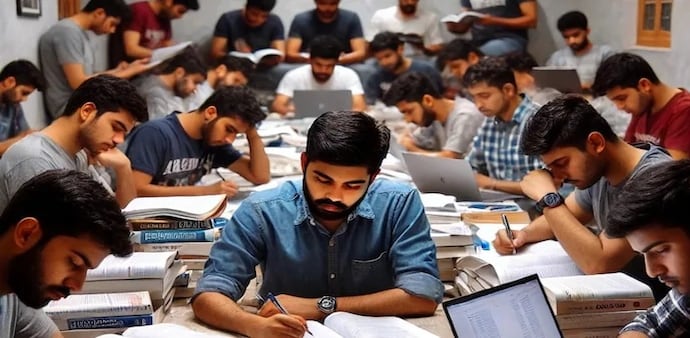
Aryan Kochhar, Co-founder of FinFloww and CrazyPart, highlighting that India produces over 2 million STEM graduates annually — outpacing the US and China. Yet, much of this talent, he argued, is funnelled into government exams, cushy jobs, or corporate optimisation roles.
- Aug 22, 2025,
- Updated Aug 22, 2025 5:12 PM IST
Aryan Kochhar, Co-founder of FinFloww and CrazyPart, has ignited debate on LinkedIn by claiming that India’s brightest minds aren’t being lured away by Silicon Valley — but by the allure of “safe” paths like UPSC prep, IIT placements, and predictable corporate jobs.
“India doesn’t lose its best minds to Silicon Valley. It loses them to coaching centres,” Kochhar wrote, highlighting that India produces over 2 million STEM graduates annually — outpacing both the US and China. Yet, instead of pioneering in frontier fields, much of this talent, he argued, is funnelled into government exams, cushy jobs, or corporate optimization roles.
Kochhar cited former RBI Governor D Subbarao’s critique of UPSC prep as an “abysmal waste of productive years” and referenced Economic Advisor Sanjeev Sanyal, who argued India could have “more billionaires, Olympic golds, and scientists — if kids don’t waste time on UPSC.” He also recalled Prime Minister Narendra Modi urging youth to become job creators, not job seekers.
“The deeper truth,” Kochhar wrote, “is that our brightest don’t pursue UPSC or IITs with a vision to change the world. They do it to seek comfort, certainty, safety… Not to create impact, but to avoid risk. That mindset is holding India back. Because certainty doesn’t create revolutions.”
He drew stark contrasts with global innovation, noting that while American and Chinese risk-takers build Tesla, OpenAI, and Nvidia, India’s brightest are often “stuck filling forms — or chasing pensions.”
“India isn’t short on brains. It’s short on guts,” he concluded, warning that the country will keep recycling bureaucrats unless bold, unconventional choices are valued over conformity.
The post struck a chord with many LinkedIn users, drawing strong reactions. One user pointed out that structural factors such as high-interest student loans, limited scholarships, and the lack of affordable housing in India make risk-taking far harder than in developed economies like Germany or the US.
Another user emphasized that the real opportunity for India’s youth lies in creating “Blue Oceans” rather than following the bandwagon. “True innovation isn’t about competing harder in crowded spaces; it’s about reimagining possibilities, creating value where none existed, and setting the pace for others to follow. This mindset change is the need of the hour now,” they wrote.
Aryan Kochhar, Co-founder of FinFloww and CrazyPart, has ignited debate on LinkedIn by claiming that India’s brightest minds aren’t being lured away by Silicon Valley — but by the allure of “safe” paths like UPSC prep, IIT placements, and predictable corporate jobs.
“India doesn’t lose its best minds to Silicon Valley. It loses them to coaching centres,” Kochhar wrote, highlighting that India produces over 2 million STEM graduates annually — outpacing both the US and China. Yet, instead of pioneering in frontier fields, much of this talent, he argued, is funnelled into government exams, cushy jobs, or corporate optimization roles.
Kochhar cited former RBI Governor D Subbarao’s critique of UPSC prep as an “abysmal waste of productive years” and referenced Economic Advisor Sanjeev Sanyal, who argued India could have “more billionaires, Olympic golds, and scientists — if kids don’t waste time on UPSC.” He also recalled Prime Minister Narendra Modi urging youth to become job creators, not job seekers.
“The deeper truth,” Kochhar wrote, “is that our brightest don’t pursue UPSC or IITs with a vision to change the world. They do it to seek comfort, certainty, safety… Not to create impact, but to avoid risk. That mindset is holding India back. Because certainty doesn’t create revolutions.”
He drew stark contrasts with global innovation, noting that while American and Chinese risk-takers build Tesla, OpenAI, and Nvidia, India’s brightest are often “stuck filling forms — or chasing pensions.”
“India isn’t short on brains. It’s short on guts,” he concluded, warning that the country will keep recycling bureaucrats unless bold, unconventional choices are valued over conformity.
The post struck a chord with many LinkedIn users, drawing strong reactions. One user pointed out that structural factors such as high-interest student loans, limited scholarships, and the lack of affordable housing in India make risk-taking far harder than in developed economies like Germany or the US.
Another user emphasized that the real opportunity for India’s youth lies in creating “Blue Oceans” rather than following the bandwagon. “True innovation isn’t about competing harder in crowded spaces; it’s about reimagining possibilities, creating value where none existed, and setting the pace for others to follow. This mindset change is the need of the hour now,” they wrote.