
‘Creating changes’: Why Ray Dalio compares PM Modi to Deng Xiaoping on economic reforms
Despite rapid growth and improving fundamentals, Dalio noted that India’s global power projection still trails that of the United States and China, reflecting the gap between economic development and geopolitical influence.
- Dec 22, 2025,
- Updated Dec 22, 2025 10:17 PM IST
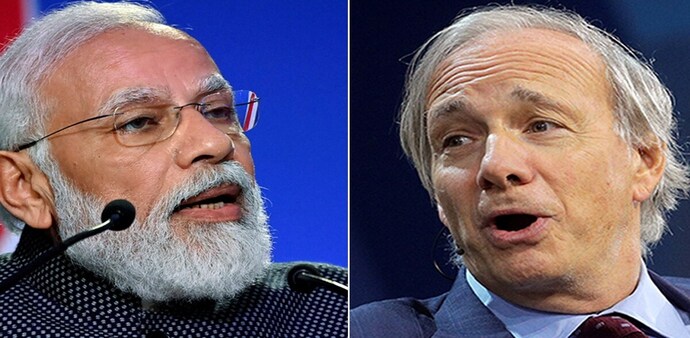
Ray Dalio underlined leadership as a decisive factor in India’s growth trajectory, drawing a direct comparison between Prime Minister Narendra Modi and Deng Xiaoping, the architect of China’s economic opening.
In a wide-ranging conversation with entrepreneur Nikhil Kamath, the Bridgewater Associates founder argued that India, despite its challenges, is uniquely positioned to emerge as one of the fastest-growing major economies over the next decade.
By referring to Deng, Dalio was pointing less to ideology and more to the ability to execute structural change, particularly through infrastructure expansion and economic reform. “What I mean by that is he’s creating changes,” Dalio said, arguing that sustained investment in roads, logistics, digital systems and financial plumbing creates the foundation for long-term growth rather than short-term spurts.
Dalio said such reforms place India in the early stages of a multi-decade expansion cycle, similar to where China stood roughly 30 years ago. However, he cautioned that strong economic momentum does not automatically translate into global dominance.
Despite rapid growth and improving fundamentals, Dalio noted that India’s global power projection still trails that of the United States and China, reflecting the gap between economic development and geopolitical influence. Closing that gap, he suggested, will depend not just on growth rates, but on how effectively India converts reforms and domestic strength into sustained strategic capacity.
According to Dalio, the post-1945 global order — built around institutions such as the United Nations, World Trade Organization and World Bank — is effectively over. What has replaced it is a system where power, not rules, shapes outcomes.
“We no longer have that kind of world order,” Dalio said, pointing to rising geopolitical fragmentation and declining trust between major powers. He argued that countries are increasingly preparing for confrontation not just on battlefields, but across trade, capital flows, technology and influence.
Ray Dalio underlined leadership as a decisive factor in India’s growth trajectory, drawing a direct comparison between Prime Minister Narendra Modi and Deng Xiaoping, the architect of China’s economic opening.
In a wide-ranging conversation with entrepreneur Nikhil Kamath, the Bridgewater Associates founder argued that India, despite its challenges, is uniquely positioned to emerge as one of the fastest-growing major economies over the next decade.
By referring to Deng, Dalio was pointing less to ideology and more to the ability to execute structural change, particularly through infrastructure expansion and economic reform. “What I mean by that is he’s creating changes,” Dalio said, arguing that sustained investment in roads, logistics, digital systems and financial plumbing creates the foundation for long-term growth rather than short-term spurts.
Dalio said such reforms place India in the early stages of a multi-decade expansion cycle, similar to where China stood roughly 30 years ago. However, he cautioned that strong economic momentum does not automatically translate into global dominance.
Despite rapid growth and improving fundamentals, Dalio noted that India’s global power projection still trails that of the United States and China, reflecting the gap between economic development and geopolitical influence. Closing that gap, he suggested, will depend not just on growth rates, but on how effectively India converts reforms and domestic strength into sustained strategic capacity.
According to Dalio, the post-1945 global order — built around institutions such as the United Nations, World Trade Organization and World Bank — is effectively over. What has replaced it is a system where power, not rules, shapes outcomes.
“We no longer have that kind of world order,” Dalio said, pointing to rising geopolitical fragmentation and declining trust between major powers. He argued that countries are increasingly preparing for confrontation not just on battlefields, but across trade, capital flows, technology and influence.