
'Extremely severe alert': Why are people getting disaster alerts on their phones?
'Extremely severe alert': Why are people getting disaster alerts on their phones?
What you experienced was India quietly switching on one of its most powerful safety systems so far. Read here for more
Business Today Desk
- May 2, 2026,
- Updated May 2, 2026 12:31 PM IST
Phones buzzed with a loud alarm. People grabbed their phones. Saw a message "Extremely Severe Alert" flashing on their screens. But here's the thing — it wasn't real. What you experienced was India quietly switching on one of its most powerful safety systems so far.
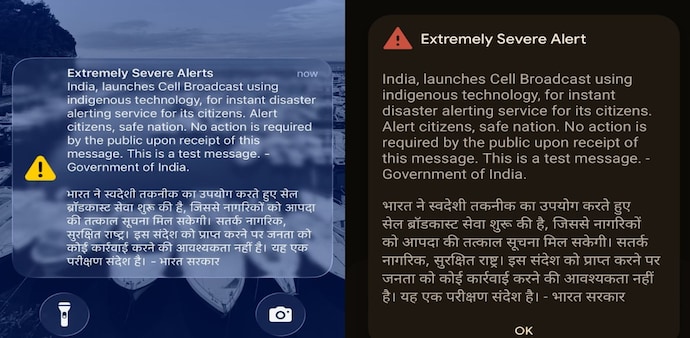
The alert urges citizens to remain alert and not to panic, while adding that this is a "test message" and that the public should not act upon it. On Saturday, India officially launched its Cell Broadcast Alert System (CBAS) — a technology that pushes disaster warnings to all phones in a region instantly.
Advertisement
No app needed. No internet required. Just your phone and a signal. Here's what it is, how it works, and why it could be a game-changer for a country that faces dozens of natural disasters every year.
The messages received on people's phones
How does it work?
Developed jointly by the Department of Telecommunications and the National Disaster Management Authority, the system is meant to send real-time warnings directly to mobile phones during disasters and emergencies.'
Advertisement
Allaying people's fears, the DoT said in a post on X (previously Twitter), "If you receive an Alert Message on your phone, do not panic. This is part of the testing of the Emergency Alert System, so that accurate information can be received on time during disasters. During testing, this message may appear repeatedly. Ignore it; you do not need to do anything."
The initiative builds on the Integrated Alert System "SACHET", developed by the Centre for Development of Telematics, which is already operational across all 36 States and Union Territories. The platform has so far sent more than 134 billion SMS alerts in over 19 Indian languages for cyclones, floods, severe weather conditions and other emergencies.
The government is now adding Cell Broadcast technology alongside the existing SMS-based system. Unlike standard text messages, Cell Broadcast can send alerts instantly to all mobile devices in a specific area, making it useful during earthquakes, tsunamis, lightning strikes, industrial accidents and other time-sensitive emergencies.
Advertisement
As part of the rollout, a nationwide testing exercise is underway, and people in several cities, including Delhi-NCR, have received loud emergency alerts on their phones in English, Hindi and regional languages.
Phones buzzed with a loud alarm. People grabbed their phones. Saw a message "Extremely Severe Alert" flashing on their screens. But here's the thing — it wasn't real. What you experienced was India quietly switching on one of its most powerful safety systems so far.
The alert urges citizens to remain alert and not to panic, while adding that this is a "test message" and that the public should not act upon it. On Saturday, India officially launched its Cell Broadcast Alert System (CBAS) — a technology that pushes disaster warnings to all phones in a region instantly.
Advertisement
No app needed. No internet required. Just your phone and a signal. Here's what it is, how it works, and why it could be a game-changer for a country that faces dozens of natural disasters every year.
The messages received on people's phones
How does it work?
Developed jointly by the Department of Telecommunications and the National Disaster Management Authority, the system is meant to send real-time warnings directly to mobile phones during disasters and emergencies.'
Advertisement
Allaying people's fears, the DoT said in a post on X (previously Twitter), "If you receive an Alert Message on your phone, do not panic. This is part of the testing of the Emergency Alert System, so that accurate information can be received on time during disasters. During testing, this message may appear repeatedly. Ignore it; you do not need to do anything."
The initiative builds on the Integrated Alert System "SACHET", developed by the Centre for Development of Telematics, which is already operational across all 36 States and Union Territories. The platform has so far sent more than 134 billion SMS alerts in over 19 Indian languages for cyclones, floods, severe weather conditions and other emergencies.
The government is now adding Cell Broadcast technology alongside the existing SMS-based system. Unlike standard text messages, Cell Broadcast can send alerts instantly to all mobile devices in a specific area, making it useful during earthquakes, tsunamis, lightning strikes, industrial accidents and other time-sensitive emergencies.
Advertisement
As part of the rollout, a nationwide testing exercise is underway, and people in several cities, including Delhi-NCR, have received loud emergency alerts on their phones in English, Hindi and regional languages.
Read more!