
'From delivery to house help': Startup founder warns gig economy is trapping India’s young
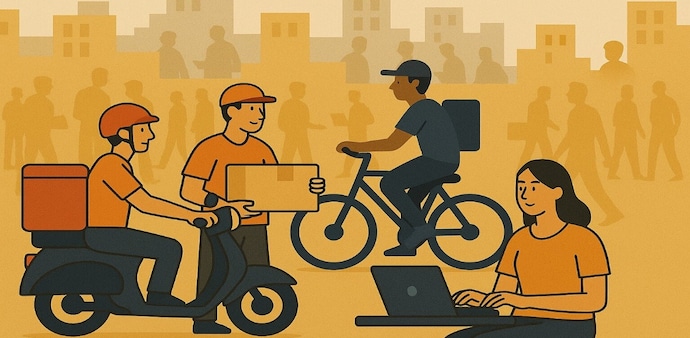
Tej Pandya, Founder of Groweasy.ai, questioned the sustainability of India’s growth narrative, highlighting that youth unemployment in the country stands at over 17%, while real wages have remained stagnant for more than a decade.
- Aug 29, 2025,
- Updated Aug 29, 2025 7:23 PM IST
Tej Pandya, Founder of Groweasy.ai, raised concerns about the direction of India’s so-called demographic dividend, questioning whether the country is truly creating opportunities that match the aspirations of its young workforce.
Sharing an incident from his own experience, Pandya recalled calling for a house help through a service platform. The worker, a 26-year-old earning ₹36,000 a month, was once employed in food delivery before being drawn to a fixed salary. “No shame in washing utensils, sweeping, mopping. But I could sense it, the quiet loss of pride, the dip in confidence. This is not the India we dreamt of,” Pandya wrote.
He noted that while venture capital once fuelled the rise of food delivery platforms, similar funding is now driving services that employ India’s youth in household chores for the urban upper middle class. “We call it the gig economy. We call it flexibility. But the truth? It’s a trap disguised as opportunity,” he argued in a thought-provoking LinkedIn post.
Pandya questioned the sustainability of India’s growth narrative, highlighting that youth unemployment in the country stands at over 17%, while real wages have remained stagnant for more than a decade. “A country can’t grow if its young are stuck serving, instead of building,” he stressed, adding that policymakers and entrepreneurs alike must ask whether India is creating “jobs worth doing, or just jobs that keep people busy.”
The post quickly went viral, drawing a flood of reactions from netizens, many of whom were divided in their responses. Some agreed with Pandya’s grim assessment, while others felt he overlooked the dignity of labour.
One user wrote, “Blaming the country is not going to help. We should first learn to respect responsible youngsters who are willing to work & earn… A fresher can learn by doing any job.”
Another pointed out, “Not everybody can do everything. That’s how life goes. If every farmer thinks his son will never do farming, how will we get food? No work is small unless done with pure hard work and honesty.”
A third user questioned Pandya’s argument altogether: “What is wrong here? In a population of 1.5 billion not everyone will be builders. Government should definitely empower youth with tools and skills, but I don’t get what this post is trying to convey.”
As the debate unfolded online, Pandya’s post underscored a larger truth: India’s promise of becoming the world’s growth engine rests not merely on numbers but on whether its young population finds work that fuels innovation, pride, and progress — beyond just survival.
Tej Pandya, Founder of Groweasy.ai, raised concerns about the direction of India’s so-called demographic dividend, questioning whether the country is truly creating opportunities that match the aspirations of its young workforce.
Sharing an incident from his own experience, Pandya recalled calling for a house help through a service platform. The worker, a 26-year-old earning ₹36,000 a month, was once employed in food delivery before being drawn to a fixed salary. “No shame in washing utensils, sweeping, mopping. But I could sense it, the quiet loss of pride, the dip in confidence. This is not the India we dreamt of,” Pandya wrote.
He noted that while venture capital once fuelled the rise of food delivery platforms, similar funding is now driving services that employ India’s youth in household chores for the urban upper middle class. “We call it the gig economy. We call it flexibility. But the truth? It’s a trap disguised as opportunity,” he argued in a thought-provoking LinkedIn post.
Pandya questioned the sustainability of India’s growth narrative, highlighting that youth unemployment in the country stands at over 17%, while real wages have remained stagnant for more than a decade. “A country can’t grow if its young are stuck serving, instead of building,” he stressed, adding that policymakers and entrepreneurs alike must ask whether India is creating “jobs worth doing, or just jobs that keep people busy.”
The post quickly went viral, drawing a flood of reactions from netizens, many of whom were divided in their responses. Some agreed with Pandya’s grim assessment, while others felt he overlooked the dignity of labour.
One user wrote, “Blaming the country is not going to help. We should first learn to respect responsible youngsters who are willing to work & earn… A fresher can learn by doing any job.”
Another pointed out, “Not everybody can do everything. That’s how life goes. If every farmer thinks his son will never do farming, how will we get food? No work is small unless done with pure hard work and honesty.”
A third user questioned Pandya’s argument altogether: “What is wrong here? In a population of 1.5 billion not everyone will be builders. Government should definitely empower youth with tools and skills, but I don’t get what this post is trying to convey.”
As the debate unfolded online, Pandya’s post underscored a larger truth: India’s promise of becoming the world’s growth engine rests not merely on numbers but on whether its young population finds work that fuels innovation, pride, and progress — beyond just survival.