
Is smog a sign of growth? Founder's historical comparison of pollution sparks viral social media debate
In a social media post, Ritesh Jain, Founder of Pinetree Macro and Nrizen, contended that India’s smog-heavy urbanisation mirrors phases once experienced by Western nations and later by China — only now the impact is amplified by real-time visibility through social media.
- Feb 22, 2026,
- Updated Feb 22, 2026 2:54 PM IST
As India battles recurring air-quality crises, a market expert has sparked debate by arguing that the country’s pollution challenges are not an anomaly, but part of a historical pattern seen in every major industrialising economy.
In a recent LinkedIn post, Ritesh Jain, Founder of Pinetree Macro and Nrizen, contended that India’s smog-heavy urbanisation mirrors phases once experienced by Western nations and later by China — only now the impact is amplified by real-time visibility through social media.
Pollution & prosperity
Jain’s central argument is that nations transitioning through the roughly $3,000-5,000 per-capita income stage have historically endured severe environmental degradation as they industrialised rapidly.
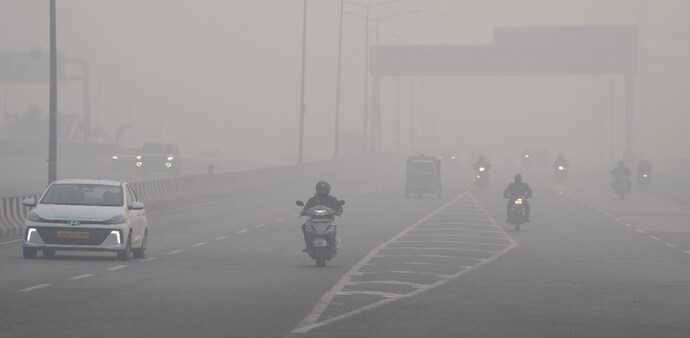
Pointing to present-day Delhi, where AQI levels frequently reach the “very poor” to “severe” range (300-500), he wrote that the phenomenon is often framed as evidence of a “broken” development model. However, he argued that similar or worse conditions marked earlier industrial revolutions elsewhere.
During the 19th and early 20th centuries, cities such as Manchester and Birmingham in the United Kingdom were enveloped in coal smoke so dense it reportedly blocked sunlight for days. London struggled with extreme pollution and sanitation crises, with the River Thames functioning as an open sewer during parts of its industrial rise.
The infamous 1952 “Great Smog” in London — often cited as a turning point in environmental regulation — killed an estimated 12,000 people within weeks, at a time when there was little global scrutiny or instant documentation.
More recent example: China
Jain also drew comparisons with China during the early 2000s, when manufacturing-led growth pushed pollution levels in cities like Beijing to hazardous extremes. AQI readings reportedly crossed 500 and even 1,000 during peak episodes, while coal-powered industry contributed to widespread environmental and public-health damage.
Industrial hubs such as Shenzhen embodied the intensity of that phase, with high steel and coal usage underpinning export-driven expansion. China later responded with sweeping clean-air policies after 2013, cutting pollution levels significantly over the following decade.
'Visibility effect' of social media
According to Jain, what distinguishes India’s experience is not necessarily the scale of pollution, but its unprecedented visibility.
He argued that earlier industrial societies did not face the same level of global attention because there were no smartphones or social platforms to broadcast daily realities, whereas India’s environmental stress is now continuously captured and shared online — shaping international perception in real time.
Environmental trade-off
Jain framed pollution as a difficult but historically consistent by-product of industrial acceleration, describing a recurring arc followed by many economies: Growth → Rising incomes → Stronger regulation → Cleaner technology → Environmental recovery
He pointed to Western environmental legislation in the mid-20th century and China’s later regulatory crackdown as examples of how wealth accumulation eventually enables investment in cleaner infrastructure and enforcement.
India, he suggested, may be traversing the same trajectory as it moves from a roughly $4 trillion economy toward a projected multi-trillion-dollar expansion in the coming decades.
What netizens said
The post triggered a lively discussion online, with several users challenging both the historical comparison and the assumption that pollution must accompany growth.
One user argued that the reasoning leans heavily on the Environmental Kuznets Curve — the theory that environmental damage rises before falling with prosperity — but fails to account for technological advantages available today.
“Modern India has access to green technologies (solar, EVs) that 1850s Manchester did not… the global climate crisis means we no longer have the luxury of ‘pollute now, clean later’ without risking irreversible ecological collapse,” the comment read, adding that Delhi’s landlocked geography and stagnant winter air make its smog more persistent than pollution in many coastal industrial cities.
Another commenter highlighted structural differences between India and earlier industrialisers, noting that manufacturing intensity remains far lower than what China or the UK experienced during their peak pollution eras.
“India’s democracy always trades speed for accountability… we may not have the same sharp rise and fall but a very long drawn cycle of push and pull between polluting cities and economic development,” the user wrote.
A third response questioned whether India’s pollution can be explained primarily by industrialisation at all.
“They had their pollution problem when they were industrialising at a massive pace while ours is mostly consumption. Manufacturing is only 13% of our GDP,” the comment said, expressing scepticism that the problem could ease quickly without deeper structural change.
While acknowledging the severe quality-of-life implications of pollution during this transition, Jain characterised the phase as one that has historically coincided with strong economic opportunity, arguing that such periods were often attractive for investors even if they posed serious challenges for residents.
As India battles recurring air-quality crises, a market expert has sparked debate by arguing that the country’s pollution challenges are not an anomaly, but part of a historical pattern seen in every major industrialising economy.
In a recent LinkedIn post, Ritesh Jain, Founder of Pinetree Macro and Nrizen, contended that India’s smog-heavy urbanisation mirrors phases once experienced by Western nations and later by China — only now the impact is amplified by real-time visibility through social media.
Pollution & prosperity
Jain’s central argument is that nations transitioning through the roughly $3,000-5,000 per-capita income stage have historically endured severe environmental degradation as they industrialised rapidly.
Pointing to present-day Delhi, where AQI levels frequently reach the “very poor” to “severe” range (300-500), he wrote that the phenomenon is often framed as evidence of a “broken” development model. However, he argued that similar or worse conditions marked earlier industrial revolutions elsewhere.
During the 19th and early 20th centuries, cities such as Manchester and Birmingham in the United Kingdom were enveloped in coal smoke so dense it reportedly blocked sunlight for days. London struggled with extreme pollution and sanitation crises, with the River Thames functioning as an open sewer during parts of its industrial rise.
The infamous 1952 “Great Smog” in London — often cited as a turning point in environmental regulation — killed an estimated 12,000 people within weeks, at a time when there was little global scrutiny or instant documentation.
More recent example: China
Jain also drew comparisons with China during the early 2000s, when manufacturing-led growth pushed pollution levels in cities like Beijing to hazardous extremes. AQI readings reportedly crossed 500 and even 1,000 during peak episodes, while coal-powered industry contributed to widespread environmental and public-health damage.
Industrial hubs such as Shenzhen embodied the intensity of that phase, with high steel and coal usage underpinning export-driven expansion. China later responded with sweeping clean-air policies after 2013, cutting pollution levels significantly over the following decade.
'Visibility effect' of social media
According to Jain, what distinguishes India’s experience is not necessarily the scale of pollution, but its unprecedented visibility.
He argued that earlier industrial societies did not face the same level of global attention because there were no smartphones or social platforms to broadcast daily realities, whereas India’s environmental stress is now continuously captured and shared online — shaping international perception in real time.
Environmental trade-off
Jain framed pollution as a difficult but historically consistent by-product of industrial acceleration, describing a recurring arc followed by many economies: Growth → Rising incomes → Stronger regulation → Cleaner technology → Environmental recovery
He pointed to Western environmental legislation in the mid-20th century and China’s later regulatory crackdown as examples of how wealth accumulation eventually enables investment in cleaner infrastructure and enforcement.
India, he suggested, may be traversing the same trajectory as it moves from a roughly $4 trillion economy toward a projected multi-trillion-dollar expansion in the coming decades.
What netizens said
The post triggered a lively discussion online, with several users challenging both the historical comparison and the assumption that pollution must accompany growth.
One user argued that the reasoning leans heavily on the Environmental Kuznets Curve — the theory that environmental damage rises before falling with prosperity — but fails to account for technological advantages available today.
“Modern India has access to green technologies (solar, EVs) that 1850s Manchester did not… the global climate crisis means we no longer have the luxury of ‘pollute now, clean later’ without risking irreversible ecological collapse,” the comment read, adding that Delhi’s landlocked geography and stagnant winter air make its smog more persistent than pollution in many coastal industrial cities.
Another commenter highlighted structural differences between India and earlier industrialisers, noting that manufacturing intensity remains far lower than what China or the UK experienced during their peak pollution eras.
“India’s democracy always trades speed for accountability… we may not have the same sharp rise and fall but a very long drawn cycle of push and pull between polluting cities and economic development,” the user wrote.
A third response questioned whether India’s pollution can be explained primarily by industrialisation at all.
“They had their pollution problem when they were industrialising at a massive pace while ours is mostly consumption. Manufacturing is only 13% of our GDP,” the comment said, expressing scepticism that the problem could ease quickly without deeper structural change.
While acknowledging the severe quality-of-life implications of pollution during this transition, Jain characterised the phase as one that has historically coincided with strong economic opportunity, arguing that such periods were often attractive for investors even if they posed serious challenges for residents.