
'Long-term effects a little worrisome': Ex-NASA astronaut Sunita Williams about life on Earth after 286-day-long space mission
Speaking on a podcast, Williams said prolonged exposure to microgravity can have lasting effects on the body, some of which continue to concern astronauts and scientists.
- Jan 23, 2026,
- Updated Jan 23, 2026 5:56 PM IST
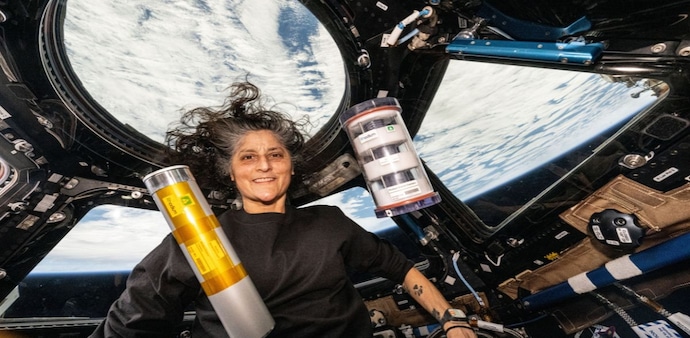
NASA astronaut (Ret.) Sunita Williams has spoken about the physical challenges astronauts face after returning from long-duration space missions, noting that the human body takes time to readjust to Earth’s gravity after months in space.
Speaking on a podcast with entrepreneur Raj Shamani, Williams said prolonged exposure to microgravity can have lasting effects on the body, some of which continue to concern astronauts and scientists. “Some of those long-term effects of being in space are, in general health-wise, a little worrisome,” she said, adding that astronauts take as many precautions as possible.
Williams said astronauts typically feel unwell immediately after landing, though the discomfort eases over time. Recalling her 286-day mission, she said nausea was one of the biggest challenges, particularly because the spacecraft landed in water, which worsened the disorientation after splashdown.
She explained that in space, the body’s balance system is largely inactive because gravity no longer affects the inner ear. When astronauts return to Earth, gravity suddenly becomes dominant again, often leading to dizziness and nausea that can last up to two days. “For me, I felt pretty nauseous for about 24 hours,” Williams said.
Even small movements, such as lifting or tilting the head while removing a spacesuit, can intensify the discomfort. Due to balance issues, astronauts are assisted while exiting the spacecraft to prevent falls and injuries. Once out of their suits, they are able to walk short distances with support, including to a waiting helicopter.
Williams said the body also needs time to retrain muscles essential for balance on Earth but weakened in microgravity, particularly small stabilising muscles in the neck. Full recovery, she said, is gradual and can take about a month, during which astronauts work closely with physical trainers and undergo regular medical assessments.
She added that astronauts sometimes briefly forget how gravity works after returning, such as instinctively letting go of objects — a habit formed in space that quickly corrects itself back on Earth. Balance support, she noted, is usually required only for the first couple of days.
Williams also said astronauts avoid driving immediately after their return, as reaction times may be slower during the initial recovery phase.
Beyond the physical adjustment, she spoke about how sensory experiences on Earth feel stronger after spaceflight. Recalling her first mission, she said the smell of the ground after landing stood out as a powerful reminder of being back home. “That smell was so predominant,” she said.
She added that astronauts miss simple sensations in space, such as wind, running water and everyday routines, noting that ordinary activities like taking a shower or washing hands feel especially meaningful after months in orbit.
NASA astronaut (Ret.) Sunita Williams has spoken about the physical challenges astronauts face after returning from long-duration space missions, noting that the human body takes time to readjust to Earth’s gravity after months in space.
Speaking on a podcast with entrepreneur Raj Shamani, Williams said prolonged exposure to microgravity can have lasting effects on the body, some of which continue to concern astronauts and scientists. “Some of those long-term effects of being in space are, in general health-wise, a little worrisome,” she said, adding that astronauts take as many precautions as possible.
Williams said astronauts typically feel unwell immediately after landing, though the discomfort eases over time. Recalling her 286-day mission, she said nausea was one of the biggest challenges, particularly because the spacecraft landed in water, which worsened the disorientation after splashdown.
She explained that in space, the body’s balance system is largely inactive because gravity no longer affects the inner ear. When astronauts return to Earth, gravity suddenly becomes dominant again, often leading to dizziness and nausea that can last up to two days. “For me, I felt pretty nauseous for about 24 hours,” Williams said.
Even small movements, such as lifting or tilting the head while removing a spacesuit, can intensify the discomfort. Due to balance issues, astronauts are assisted while exiting the spacecraft to prevent falls and injuries. Once out of their suits, they are able to walk short distances with support, including to a waiting helicopter.
Williams said the body also needs time to retrain muscles essential for balance on Earth but weakened in microgravity, particularly small stabilising muscles in the neck. Full recovery, she said, is gradual and can take about a month, during which astronauts work closely with physical trainers and undergo regular medical assessments.
She added that astronauts sometimes briefly forget how gravity works after returning, such as instinctively letting go of objects — a habit formed in space that quickly corrects itself back on Earth. Balance support, she noted, is usually required only for the first couple of days.
Williams also said astronauts avoid driving immediately after their return, as reaction times may be slower during the initial recovery phase.
Beyond the physical adjustment, she spoke about how sensory experiences on Earth feel stronger after spaceflight. Recalling her first mission, she said the smell of the ground after landing stood out as a powerful reminder of being back home. “That smell was so predominant,” she said.
She added that astronauts miss simple sensations in space, such as wind, running water and everyday routines, noting that ordinary activities like taking a shower or washing hands feel especially meaningful after months in orbit.