
'Not the abundance era we were promised': CEO flags viral ‘Stop Hiring Humans’ AI ads in NYC
The campaign behind the provocative ads was created by Artisan, a San Francisco-based startup that markets AI-powered “employees” designed to automate outbound sales work.
- May 17, 2026,
- Updated May 17, 2026 3:51 PM IST
As artificial intelligence reshapes industries at breakneck speed, a controversial advertising campaign in the United States has reignited fears about automation, job displacement, and the future of human work in the AI era.
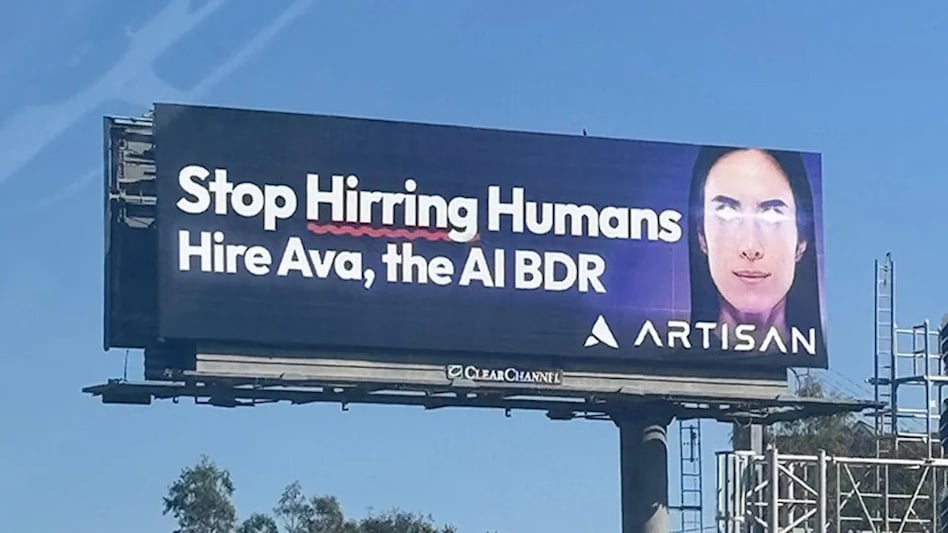
The debate intensified after entrepreneur and commentator Mario Nawfal highlighted viral “Stop Hiring Humans” billboards appearing across San Francisco and New York City. In a post on X (formally twitter), Nawfal argued that after decades of offshoring jobs overseas, companies are now moving toward directly replacing workers with AI-powered systems.
“The isn’t the era of abundance we were promised,” he wrote, reflecting growing anxieties over the rapid adoption of generative AI tools across white-collar sectors.
Startup behind the controversy
The campaign behind the provocative ads was created by Artisan, a San Francisco-based startup that markets AI-powered “employees” designed to automate outbound sales work.
The company’s flagship product, “Ava,” functions as an autonomous AI business development representative capable of list-building, cold emailing, and lead generation with minimal human oversight.
The billboards carry deliberately inflammatory slogans such as “Artisans won’t complain about work-life balance” and “Artisans won’t come to work hungover,” sparking criticism from labour advocates and social media users who accuse tech firms of normalising the replacement of workers with bots.
‘Ragebait’ marketing strategy
Artisan founder and CEO Jaspar Carmichael-Jack, who is only 23, has openly acknowledged that the campaign is designed as “ragebait” to capture public attention and provoke discussion.
He later clarified that the company is not advocating the complete replacement of humans, but rather targeting repetitive and tedious work categories.
“The billboard is supposed to be provocative,” Carmichael-Jack said, adding that “it works because it’s uncomfortable. The belief underneath is more careful than three words on a wall.”
AI layoffs intensify global anxiety
The campaign arrives at a time when concerns about AI-driven job losses are no longer theoretical. Major global corporations have already announced workforce reductions while simultaneously expanding investments in artificial intelligence.
Earlier this year, Google continued restructuring across several divisions as it accelerated AI integration into its products and operations. Microsoft also trimmed jobs in multiple teams while pouring billions into AI infrastructure and partnerships.
Meanwhile, IBM has indicated that AI could replace thousands of back-office and administrative roles over the coming years. Other technology and outsourcing firms have also increasingly deployed AI chatbots and automation systems to reduce operational costs.
Recruiters, copywriters, junior programmers, customer service workers, and sales teams are among the professions facing growing pressure as companies experiment with AI tools capable of performing routine tasks faster and at lower cost.
Unlike previous waves of automation focused largely on factory work, generative AI is now entering knowledge-based professions once considered relatively secure.
Economists and labour experts warn that while AI could create new industries and boost productivity, the transition may also trigger widespread labour disruption if governments and businesses fail to rapidly retrain workers.
As artificial intelligence reshapes industries at breakneck speed, a controversial advertising campaign in the United States has reignited fears about automation, job displacement, and the future of human work in the AI era.
The debate intensified after entrepreneur and commentator Mario Nawfal highlighted viral “Stop Hiring Humans” billboards appearing across San Francisco and New York City. In a post on X (formally twitter), Nawfal argued that after decades of offshoring jobs overseas, companies are now moving toward directly replacing workers with AI-powered systems.
“The isn’t the era of abundance we were promised,” he wrote, reflecting growing anxieties over the rapid adoption of generative AI tools across white-collar sectors.
Startup behind the controversy
The campaign behind the provocative ads was created by Artisan, a San Francisco-based startup that markets AI-powered “employees” designed to automate outbound sales work.
The company’s flagship product, “Ava,” functions as an autonomous AI business development representative capable of list-building, cold emailing, and lead generation with minimal human oversight.
The billboards carry deliberately inflammatory slogans such as “Artisans won’t complain about work-life balance” and “Artisans won’t come to work hungover,” sparking criticism from labour advocates and social media users who accuse tech firms of normalising the replacement of workers with bots.
‘Ragebait’ marketing strategy
Artisan founder and CEO Jaspar Carmichael-Jack, who is only 23, has openly acknowledged that the campaign is designed as “ragebait” to capture public attention and provoke discussion.
He later clarified that the company is not advocating the complete replacement of humans, but rather targeting repetitive and tedious work categories.
“The billboard is supposed to be provocative,” Carmichael-Jack said, adding that “it works because it’s uncomfortable. The belief underneath is more careful than three words on a wall.”
AI layoffs intensify global anxiety
The campaign arrives at a time when concerns about AI-driven job losses are no longer theoretical. Major global corporations have already announced workforce reductions while simultaneously expanding investments in artificial intelligence.
Earlier this year, Google continued restructuring across several divisions as it accelerated AI integration into its products and operations. Microsoft also trimmed jobs in multiple teams while pouring billions into AI infrastructure and partnerships.
Meanwhile, IBM has indicated that AI could replace thousands of back-office and administrative roles over the coming years. Other technology and outsourcing firms have also increasingly deployed AI chatbots and automation systems to reduce operational costs.
Recruiters, copywriters, junior programmers, customer service workers, and sales teams are among the professions facing growing pressure as companies experiment with AI tools capable of performing routine tasks faster and at lower cost.
Unlike previous waves of automation focused largely on factory work, generative AI is now entering knowledge-based professions once considered relatively secure.
Economists and labour experts warn that while AI could create new industries and boost productivity, the transition may also trigger widespread labour disruption if governments and businesses fail to rapidly retrain workers.