
Portable AC vs Air cooler: Cooling, cost, electricity consumption- which one should you buy
Portable ACs and air coolers offer a simpler alternative: no drilling, no permanent fixtures, and the freedom to move the unit wherever it's needed most
- May 21, 2026,
- Updated May 21, 2026 1:22 PM IST
When the summer heat becomes unbearable, not everyone has the option, or the inclination, to get a split or window AC installed. Portable ACs and air coolers offer a simpler alternative: no drilling, no permanent fixtures, and the freedom to move the unit wherever it's needed most. But while the two may look like they belong in the same category, they work quite differently, and the choice between them can have a real impact on your electricity bill and comfort.
How they work
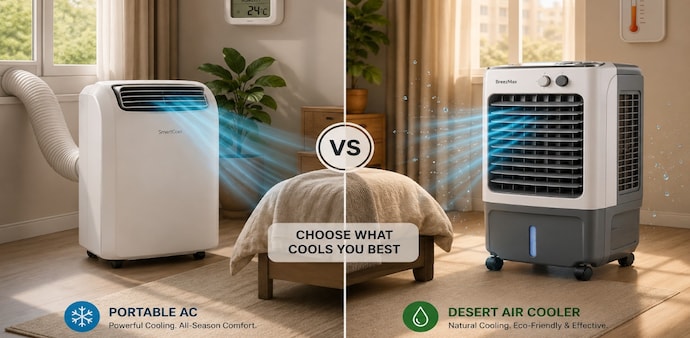
A portable AC operates on the same principle as a conventional AC, a compressor and refrigerant gas cool the air, removing both heat and humidity from the room, while an exhaust pipe pushes hot air outside. An air cooler takes a simpler approach: it draws in warm air, passes it through water-soaked pads, and circulates cooler air back into the room. No compressor, no refrigerant, just evaporation.
Electricity consumption
The difference in how they work shows up starkly in how much power they draw. Most air coolers run on 80 to 250 watts. Portable ACs, because of their compressors, consume between 900 and upwards of 1,800 watts. If keeping electricity costs down is a priority, the air cooler wins this comparison without much contest.
Running and maintenance costs
Air coolers are also the simpler and cheaper option to maintain. They need regular water refilling and occasional cleaning of the tank and cooling pads, nothing more. Portable ACs demand more attention: filters need periodic cleaning, and the unit may eventually require servicing for the refrigerant or internal components.
Which one should you buy?
The answer depends largely on where you live and what you need. A portable AC makes more sense in humid climates, where evaporative cooling is less effective, and you need the unit to actively remove moisture from the air. It delivers faster, stronger cooling, but at a higher operating cost.
An air cooler is better suited to dry regions, where evaporation works efficiently, and the lower purchase price and electricity costs make it a practical long-term choice. The cooling may not match that of an AC, but for a dry summer climate on a budget, it is hard to beat.
When the summer heat becomes unbearable, not everyone has the option, or the inclination, to get a split or window AC installed. Portable ACs and air coolers offer a simpler alternative: no drilling, no permanent fixtures, and the freedom to move the unit wherever it's needed most. But while the two may look like they belong in the same category, they work quite differently, and the choice between them can have a real impact on your electricity bill and comfort.
How they work
A portable AC operates on the same principle as a conventional AC, a compressor and refrigerant gas cool the air, removing both heat and humidity from the room, while an exhaust pipe pushes hot air outside. An air cooler takes a simpler approach: it draws in warm air, passes it through water-soaked pads, and circulates cooler air back into the room. No compressor, no refrigerant, just evaporation.
Electricity consumption
The difference in how they work shows up starkly in how much power they draw. Most air coolers run on 80 to 250 watts. Portable ACs, because of their compressors, consume between 900 and upwards of 1,800 watts. If keeping electricity costs down is a priority, the air cooler wins this comparison without much contest.
Running and maintenance costs
Air coolers are also the simpler and cheaper option to maintain. They need regular water refilling and occasional cleaning of the tank and cooling pads, nothing more. Portable ACs demand more attention: filters need periodic cleaning, and the unit may eventually require servicing for the refrigerant or internal components.
Which one should you buy?
The answer depends largely on where you live and what you need. A portable AC makes more sense in humid climates, where evaporative cooling is less effective, and you need the unit to actively remove moisture from the air. It delivers faster, stronger cooling, but at a higher operating cost.
An air cooler is better suited to dry regions, where evaporation works efficiently, and the lower purchase price and electricity costs make it a practical long-term choice. The cooling may not match that of an AC, but for a dry summer climate on a budget, it is hard to beat.