
The vow venture: French groom’s $7,500 ‘ad-covered tuxedo’ turns wedding into viral startup moment
Online, his post quickly went viral, drawing a mix of admiration and amusement. Whether it becomes a new trend or remains a one-off viral story, his creative approach has already left a mark.
- Oct 30, 2025,
- Updated Oct 30, 2025 8:24 PM IST
In an age where creativity meets commerce, a French groom found an unconventional way to fund his wedding — by turning his tuxedo into an advertising board.
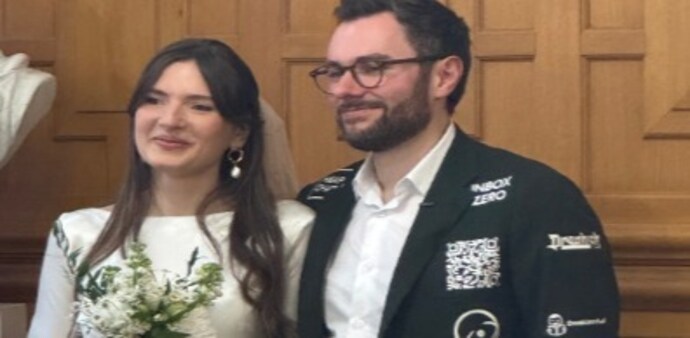
Dagobert Renouf, a tech entrepreneur from Lille, France, made headlines this week after revealing how he covered much of his wedding expenses by selling ad spots on his wedding suit to tech startups.
On October 25, Renouf walked down the aisle in a sleek black tuxedo covered with 26 embroidered company logos — from AI ventures to SaaS and software tool firms. Even his own company, CompAi, bought one of the spots.
“It was a beautiful day,” Renouf wrote in a post on X (formerly Twitter), sharing photos of his logo-studded tuxedo alongside a heartfelt message thanking the startups that contributed. “The idea wasn’t just about money — it was about doing something fun and memorable for the tech community.”
A startup twist on ‘something new’
Renouf’s idea took shape back in July, when he announced online that he would be selling sponsorship slots on his tuxedo. Within weeks, every slot was sold. He then teamed up with a tailor who meticulously embroidered each logo, transforming his wedding outfit into a mosaic of brand identities.
The sponsorships, he said, brought in around $7,500 (roughly ₹6.2 lakh). But in true startup fashion, most of that went back into the project — with $5,500 reportedly spent on creating the custom suit itself.
“It was as much an experiment as it was a statement,” Renouf said in one of his follow-up posts. “People often think you need to do things the traditional way. I just wanted to show that creativity still pays off — even at your wedding.”
From burnout to a viral breakthrough
Renouf’s story resonated not just for its humour, but for his background. Before launching CompAi, an AI-powered business tool, he had spent over five years and more than $100,000 trying to build a startup from scratch — an effort that ended, by his own account, in “massive burnout.”
His “sponsored tuxedo” moment, then, became more than a publicity stunt — it symbolised a kind of comeback for a founder who once struggled under the weight of entrepreneurial failure.
Online, his post quickly went viral, drawing a mix of admiration and amusement. “Bro, insane that you spent $5.5k of the $7.5k you made on the suit,” one user commented. Another joked, “Seems like your suit sponsorships will be more lucrative than your LaunchDay business.”
Several others even asked how they could sponsor his reception table cards or send him a tip via Venmo.
In an industry where founders are constantly pitching ideas and seeking funding, Renouf managed to flip the script — turning his own wedding into a startup showcase.
Whether it becomes a new trend or remains a one-off viral story, his creative approach has already left a mark. After all, few can say their wedding vows came with a side of brand promotion — and even fewer can say they got paid for it.
In an age where creativity meets commerce, a French groom found an unconventional way to fund his wedding — by turning his tuxedo into an advertising board.
Dagobert Renouf, a tech entrepreneur from Lille, France, made headlines this week after revealing how he covered much of his wedding expenses by selling ad spots on his wedding suit to tech startups.
On October 25, Renouf walked down the aisle in a sleek black tuxedo covered with 26 embroidered company logos — from AI ventures to SaaS and software tool firms. Even his own company, CompAi, bought one of the spots.
“It was a beautiful day,” Renouf wrote in a post on X (formerly Twitter), sharing photos of his logo-studded tuxedo alongside a heartfelt message thanking the startups that contributed. “The idea wasn’t just about money — it was about doing something fun and memorable for the tech community.”
A startup twist on ‘something new’
Renouf’s idea took shape back in July, when he announced online that he would be selling sponsorship slots on his tuxedo. Within weeks, every slot was sold. He then teamed up with a tailor who meticulously embroidered each logo, transforming his wedding outfit into a mosaic of brand identities.
The sponsorships, he said, brought in around $7,500 (roughly ₹6.2 lakh). But in true startup fashion, most of that went back into the project — with $5,500 reportedly spent on creating the custom suit itself.
“It was as much an experiment as it was a statement,” Renouf said in one of his follow-up posts. “People often think you need to do things the traditional way. I just wanted to show that creativity still pays off — even at your wedding.”
From burnout to a viral breakthrough
Renouf’s story resonated not just for its humour, but for his background. Before launching CompAi, an AI-powered business tool, he had spent over five years and more than $100,000 trying to build a startup from scratch — an effort that ended, by his own account, in “massive burnout.”
His “sponsored tuxedo” moment, then, became more than a publicity stunt — it symbolised a kind of comeback for a founder who once struggled under the weight of entrepreneurial failure.
Online, his post quickly went viral, drawing a mix of admiration and amusement. “Bro, insane that you spent $5.5k of the $7.5k you made on the suit,” one user commented. Another joked, “Seems like your suit sponsorships will be more lucrative than your LaunchDay business.”
Several others even asked how they could sponsor his reception table cards or send him a tip via Venmo.
In an industry where founders are constantly pitching ideas and seeking funding, Renouf managed to flip the script — turning his own wedding into a startup showcase.
Whether it becomes a new trend or remains a one-off viral story, his creative approach has already left a mark. After all, few can say their wedding vows came with a side of brand promotion — and even fewer can say they got paid for it.