
Viral 'war lockdown' notice triggers rumours online: What’s really going on
The message, shared across platforms like WhatsApp and X, appeared to be an official government notice. With tensions rising globally due to the ongoing conflict in West Asia
- Apr 1, 2026,
- Updated Apr 1, 2026 1:32 PM IST
A sudden surge in searches around the phrase “war lockdown” on April 1 triggered confusion and concern online, as a widely circulated document led many to believe fresh restrictions could be on the horizon.
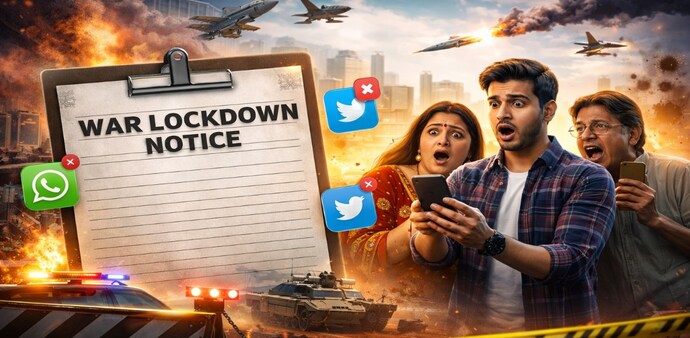
The message, shared across platforms like WhatsApp and X, appeared to be an official government notice. With tensions rising globally due to the ongoing conflict in West Asia, the document struck a nerve, prompting many to question whether India was heading towards another lockdown.
What the viral PDF actually said
The document, titled “War Lockdown Notice,” was designed to resemble a formal government order. Its layout and tone added to its credibility, leading many users to open it out of concern.
However, those who viewed the file found a different reality inside, the words “April Fool” prominently displayed, revealing it to be a prank rather than an official directive.
The timing amplified its impact. With global uncertainty already high, the message spread quickly before users realised it was a hoax.
Why the rumour gained traction
The viral scare appears to have drawn momentum from recent remarks by Prime Minister Narendra Modi.
In an address to the Lok Sabha, he spoke about the evolving situation in West Asia and called for preparedness and unity. He referred to the kind of discipline seen during the COVID-19 period, urging citizens and states to stay alert and ensure supply chains remain stable.
While no mention of a lockdown was made, parts of the message were misinterpreted and repackaged online, turning references to “COVID-like discipline” into speculation about possible restrictions.
Global backdrop adds to anxiety
The confusion comes at a time when the conflict between Israel and Iran has escalated, with the United States also involved.
Concerns around disruptions in the Strait of Hormuz, a critical route for oil supplies, have added to the uncertainty, particularly for countries like India that depend heavily on energy imports.
Against this backdrop, even an unverified message was enough to trigger fears of potential curbs on movement or supply.
A prank that hit a nerve
The “war lockdown” message ultimately turned out to be an April Fools’ prank, but its rapid spread highlighted how easily misinformation can gain traction during periods of heightened global tension.
For many users, the episode served as a reminder to verify information before sharing — especially when it mimics official communication.
A sudden surge in searches around the phrase “war lockdown” on April 1 triggered confusion and concern online, as a widely circulated document led many to believe fresh restrictions could be on the horizon.
The message, shared across platforms like WhatsApp and X, appeared to be an official government notice. With tensions rising globally due to the ongoing conflict in West Asia, the document struck a nerve, prompting many to question whether India was heading towards another lockdown.
What the viral PDF actually said
The document, titled “War Lockdown Notice,” was designed to resemble a formal government order. Its layout and tone added to its credibility, leading many users to open it out of concern.
However, those who viewed the file found a different reality inside, the words “April Fool” prominently displayed, revealing it to be a prank rather than an official directive.
The timing amplified its impact. With global uncertainty already high, the message spread quickly before users realised it was a hoax.
Why the rumour gained traction
The viral scare appears to have drawn momentum from recent remarks by Prime Minister Narendra Modi.
In an address to the Lok Sabha, he spoke about the evolving situation in West Asia and called for preparedness and unity. He referred to the kind of discipline seen during the COVID-19 period, urging citizens and states to stay alert and ensure supply chains remain stable.
While no mention of a lockdown was made, parts of the message were misinterpreted and repackaged online, turning references to “COVID-like discipline” into speculation about possible restrictions.
Global backdrop adds to anxiety
The confusion comes at a time when the conflict between Israel and Iran has escalated, with the United States also involved.
Concerns around disruptions in the Strait of Hormuz, a critical route for oil supplies, have added to the uncertainty, particularly for countries like India that depend heavily on energy imports.
Against this backdrop, even an unverified message was enough to trigger fears of potential curbs on movement or supply.
A prank that hit a nerve
The “war lockdown” message ultimately turned out to be an April Fools’ prank, but its rapid spread highlighted how easily misinformation can gain traction during periods of heightened global tension.
For many users, the episode served as a reminder to verify information before sharing — especially when it mimics official communication.