
WATCH: Dramatic videos of flash floods from Himachal, Uttarakhand go viral as rain rampages North India
Himachal Pradesh has been particularly susceptible to landslides and flash floods triggered by incessant rainfall, resulting in damage to homes, infrastructure, and severe disruptions to normal life
- Jul 10, 2023,
- Updated Jul 10, 2023 3:45 PM IST
In the past three days, heavy rainfall has unleashed chaos and devastation across various parts of North India. According to a report by Reuters, at least 22 lives have been lost, and widespread destruction has ensued. Cities and towns have been severely impacted, with roads and buildings submerged under knee-deep water.
The Indian Meteorological Department (IMD) on Monday said that it has issued warnings of further downpours expected in Himachal Pradesh, Uttarakhand, Punjab, Haryana, Jammu and Kashmir, Rajasthan, Delhi, and neighbouring areas over the coming days.
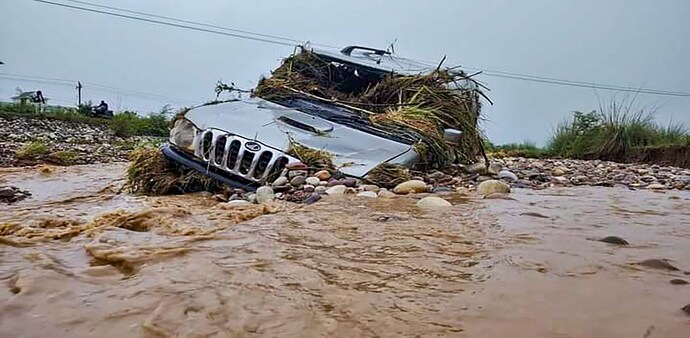
Disturbing images and videos depicting the havoc wreaked by the floods have gone viral, displaying scenes of vehicles floating like mere paper boats, residential areas engulfed by muddy waters, and structures completely submerged along swollen riverbanks.
Himachal Pradesh has been particularly susceptible to landslides and flash floods triggered by incessant rainfall, resulting in damage to homes, infrastructure, and severe disruptions to normal life. Flash floods in Manali, Kullu, Kinnaur, and Chamba have swept away shops and vehicles, while major rivers such as Ravi, Beas, Satluj, Swan, and Chenab have surged beyond their banks.
Uttarakhand has also experienced landslides and flash floods, with water levels in rivers and streams surpassing dangerous levels.
In response to the dire situation, schools in Gurgaon and Delhi have remained closed, and the Gurgaon administration has advised corporate offices to adopt a work-from-home policy to alleviate traffic congestion.
The Delhi government has set up 16 control rooms to monitor flood-prone areas, particularly after a significant amount of water was released into the Yamuna River from the Hathnikund barrage in Haryana. Chief Minister Arvind Kejriwal will chair a high-level meeting to address the issue of water-logging and rising water levels in the Yamuna.
A red alert has been issued for the Kathua and Samba districts in Jammu and Kashmir. However, the Amarnath Yatra, a prominent religious pilgrimage, has resumed from the Panjtarni and Sheshnag base camps following a three-day suspension.
Heavy rainfall in Rajasthan, Punjab, and Haryana has also led to extensive water-logging and flooding in low-lying areas, prompting immediate action by authorities in the most affected regions.
The IMD has attributed the torrential rainfall to the interaction between a western disturbance and monsoonal winds over northwest India. With the situation still critical, continued vigilance and preparedness are imperative to mitigate the impact of the heavy rains and ensure the safety of the affected population.
In the past three days, heavy rainfall has unleashed chaos and devastation across various parts of North India. According to a report by Reuters, at least 22 lives have been lost, and widespread destruction has ensued. Cities and towns have been severely impacted, with roads and buildings submerged under knee-deep water.
The Indian Meteorological Department (IMD) on Monday said that it has issued warnings of further downpours expected in Himachal Pradesh, Uttarakhand, Punjab, Haryana, Jammu and Kashmir, Rajasthan, Delhi, and neighbouring areas over the coming days.
Disturbing images and videos depicting the havoc wreaked by the floods have gone viral, displaying scenes of vehicles floating like mere paper boats, residential areas engulfed by muddy waters, and structures completely submerged along swollen riverbanks.
Himachal Pradesh has been particularly susceptible to landslides and flash floods triggered by incessant rainfall, resulting in damage to homes, infrastructure, and severe disruptions to normal life. Flash floods in Manali, Kullu, Kinnaur, and Chamba have swept away shops and vehicles, while major rivers such as Ravi, Beas, Satluj, Swan, and Chenab have surged beyond their banks.
Uttarakhand has also experienced landslides and flash floods, with water levels in rivers and streams surpassing dangerous levels.
In response to the dire situation, schools in Gurgaon and Delhi have remained closed, and the Gurgaon administration has advised corporate offices to adopt a work-from-home policy to alleviate traffic congestion.
The Delhi government has set up 16 control rooms to monitor flood-prone areas, particularly after a significant amount of water was released into the Yamuna River from the Hathnikund barrage in Haryana. Chief Minister Arvind Kejriwal will chair a high-level meeting to address the issue of water-logging and rising water levels in the Yamuna.
A red alert has been issued for the Kathua and Samba districts in Jammu and Kashmir. However, the Amarnath Yatra, a prominent religious pilgrimage, has resumed from the Panjtarni and Sheshnag base camps following a three-day suspension.
Heavy rainfall in Rajasthan, Punjab, and Haryana has also led to extensive water-logging and flooding in low-lying areas, prompting immediate action by authorities in the most affected regions.
The IMD has attributed the torrential rainfall to the interaction between a western disturbance and monsoonal winds over northwest India. With the situation still critical, continued vigilance and preparedness are imperative to mitigate the impact of the heavy rains and ensure the safety of the affected population.