
Who is Venki Ramakrishnan? Nobel Prize winning scientist who missed IIT but changed chemistry
Venkatraman Venki Ramakrishnan's life story stands as a reminder that success is rarely decided by one exam result
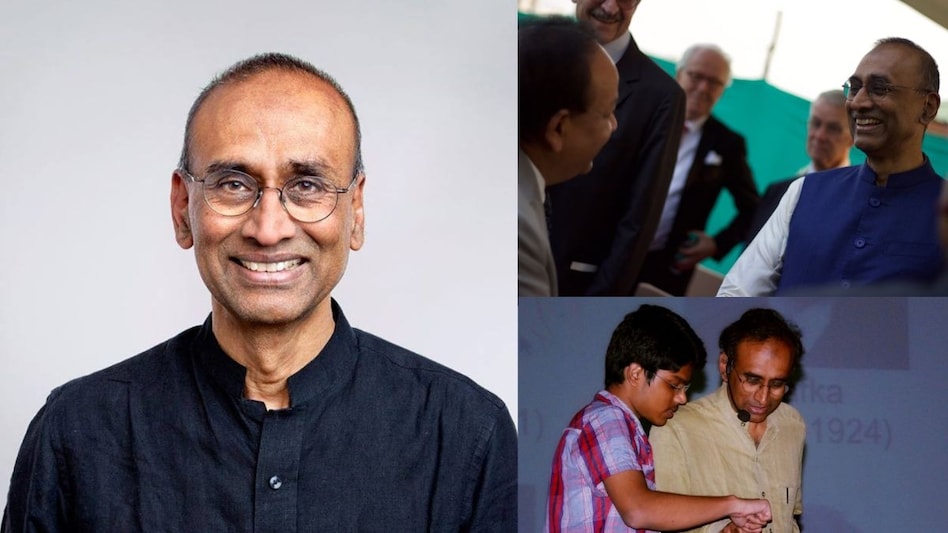
- Apr 15, 2026,
- Updated Apr 15, 2026 8:35 AM IST
For countless students, getting into elite institutions such as the IITs is seen as a defining milestone. Competitive entrance exams often come with intense pressure and high expectations, making setbacks feel far more final than they truly are.
Venkatraman "Venki" Ramakrishnan's life story stands as a reminder that success is rarely decided by one exam result. Long before he became a Nobel Prize winner, his academic journey followed a route far different from the conventional script.
Early life and family background
Venkatraman Ramakrishnan was born on April 5, 1952, in Chidambaram, Tamil Nadu. He later moved with his family to Vadodara, where he spent much of his growing-up years. His parents, C.V. Ramakrishnan and Rajalakshmi, were both scientists and academics, giving him early exposure to higher education and research culture.
Because of his parents' academic careers, he also spent time in different cities and educational settings during childhood. This environment helped nurture intellectual curiosity, though there was no indication at the time that he would one day become a global scientific figure.
Not the typical topper story
Ramakrishnan's school years were not built around the stereotype of a flawless academic prodigy. He developed interests across subjects and was known to be curious beyond textbooks. Science attracted him strongly, but so did reading and broader learning.
His progress gathered momentum gradually rather than through a single dramatic breakthrough. That slower, steady growth would later define much of his scientific career as well.
When IIT did not happen
Like many bright students of his generation, he explored admission to top Indian institutions, including the IIT system and Christian Medical College, Vellore. Those plans did not materialise.
Instead of treating those setbacks as career-ending moments, he chose another route and continued focusing on learning. The shift would ultimately prove more valuable than a conventional path.
The Baroda turning point
He enrolled at Maharaja Sayajirao University of Baroda, where he studied physics and completed his undergraduate degree at a young age. The decision laid the foundation for his future career.
Studying physics sharpened his quantitative thinking and problem-solving skills, tools that later became crucial in biological research. His years in Baroda also gave him independence and the freedom to pursue ideas without the pressure attached to elite-brand institutions.
The move abroad and reinvention
Ramakrishnan later moved to the United States for graduate studies, earning a PhD in physics from Ohio University. But in one of the boldest decisions of his career, he later shifted from physics into biology.
That transition was unconventional and risky, requiring him to learn an entirely new field. Yet it eventually led him into structural biology, where his background in physics became a major advantage.
The work that changed science
He went on to study ribosomes, molecular machines inside cells responsible for making proteins. His research helped reveal their three-dimensional atomic structure, a breakthrough that transformed understanding of how life functions at the cellular level. In 2009, he was awarded the Nobel Prize in Chemistry for this work.
For countless students, getting into elite institutions such as the IITs is seen as a defining milestone. Competitive entrance exams often come with intense pressure and high expectations, making setbacks feel far more final than they truly are.
Venkatraman "Venki" Ramakrishnan's life story stands as a reminder that success is rarely decided by one exam result. Long before he became a Nobel Prize winner, his academic journey followed a route far different from the conventional script.
Early life and family background
Venkatraman Ramakrishnan was born on April 5, 1952, in Chidambaram, Tamil Nadu. He later moved with his family to Vadodara, where he spent much of his growing-up years. His parents, C.V. Ramakrishnan and Rajalakshmi, were both scientists and academics, giving him early exposure to higher education and research culture.
Because of his parents' academic careers, he also spent time in different cities and educational settings during childhood. This environment helped nurture intellectual curiosity, though there was no indication at the time that he would one day become a global scientific figure.
Not the typical topper story
Ramakrishnan's school years were not built around the stereotype of a flawless academic prodigy. He developed interests across subjects and was known to be curious beyond textbooks. Science attracted him strongly, but so did reading and broader learning.
His progress gathered momentum gradually rather than through a single dramatic breakthrough. That slower, steady growth would later define much of his scientific career as well.
When IIT did not happen
Like many bright students of his generation, he explored admission to top Indian institutions, including the IIT system and Christian Medical College, Vellore. Those plans did not materialise.
Instead of treating those setbacks as career-ending moments, he chose another route and continued focusing on learning. The shift would ultimately prove more valuable than a conventional path.
The Baroda turning point
He enrolled at Maharaja Sayajirao University of Baroda, where he studied physics and completed his undergraduate degree at a young age. The decision laid the foundation for his future career.
Studying physics sharpened his quantitative thinking and problem-solving skills, tools that later became crucial in biological research. His years in Baroda also gave him independence and the freedom to pursue ideas without the pressure attached to elite-brand institutions.
The move abroad and reinvention
Ramakrishnan later moved to the United States for graduate studies, earning a PhD in physics from Ohio University. But in one of the boldest decisions of his career, he later shifted from physics into biology.
That transition was unconventional and risky, requiring him to learn an entirely new field. Yet it eventually led him into structural biology, where his background in physics became a major advantage.
The work that changed science
He went on to study ribosomes, molecular machines inside cells responsible for making proteins. His research helped reveal their three-dimensional atomic structure, a breakthrough that transformed understanding of how life functions at the cellular level. In 2009, he was awarded the Nobel Prize in Chemistry for this work.