
How 'drinking Indian' is transforming bar menus, spaces through regional storytelling
Across India’s leading bars and beverage programmes, there is growing interest in building drinks that feel rooted in the country’s own culinary memory, agricultural diversity and regional traditions.
- Apr 13, 2026,
- Updated Apr 13, 2026 4:34 PM IST
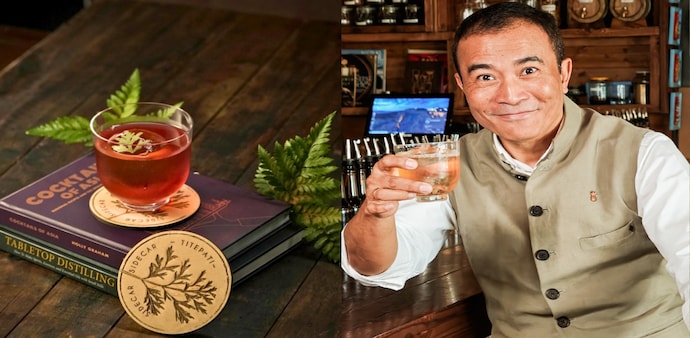
On a balmy evening at Delhi’s Sidecar, a bar that has become a regular on prestigious global rankings, I found a very unique ingredient I never expected to see in a cocktail glass. It was titepati, the leafy mugwort I grew up knowing in Darjeeling not as something elegant or aspirational, but as a sharp-smelling home remedy for cuts, bruises and scraped knees.
So when it appeared in a nearly Rs 1,000 cocktail, the leaf folded into a vermouth-infused drink with this atypical ingredient, the surprise was not just culinary, it was also nostalgic. Here was something deeply familiar, lifted out of childhood memory and recast in an entirely different language. The medicinal paste once applied to wounds had been transformed into a spirit-forward, layered and unmistakably modern drink, carrying with it a strong regional accent and a quiet sense of place. In that moment, the cocktail felt like a small but telling sign of how Indian bars are beginning to turn memory, geography and local ingredients into something far more distinctive.
India’s cocktail culture is definitely entering a more self-assured phase. For a long time, bar menus across the country leaned heavily on Western classics, imported flavour cues and a familiar idea of what a premium cocktail should look like. This is beginning to change. Across India’s leading bars and beverage programmes, there is growing interest in building drinks that feel rooted in the country’s own culinary memory, agricultural diversity and regional traditions.
That shift was at the heart of the session ‘Drinking Indian - The Future of Indian Cocktail Culture’ at India Bartender Show 2026, presented by Bar Kraft in partnership with Aazol. What emerged from the discussion was a sense that Indian cocktail culture is no longer interested in simply adding a local flourish to a global template. It is beginning to ask deeper questions about identity, craft and what it really means to build drinks that belong to this place.
The change is visible in the ingredients now appearing behind the bar. Bartenders are working with kokum, liquid jaggery, gondhoraj lemon, regional herbs, indigenous ferments and traditional sweeteners not as gimmicks, but as serious flavour elements. These ingredients carry memory, geography and cultural context. They also speak to a wider shift in consumer behaviour, where people are paying closer attention to provenance, sourcing and authenticity.
As Yangdup Lama, serial ‘bartrepreneur’ and Co-founder of India Bartender Show, put it, “Over the last few years, we have seen a lot more incorporation of local ingredients into our menus, but what ‘drinking Indian’ means beyond that is the diversity of our concepts.”
This idea of diversity has taken centre stage and is at the time constantly evolving. Indian cocktail culture is not just finding its voice through ingredients, but also through the kinds of spaces and experiences being created. Lama pointed to concepts such as Jaipur’s ghazal-inspired Paro and Gurgaon’s The Brook, which draws on the produce and spirit of the Himalayas. In his view, the real advantage Indian bars have is cultural richness at scale, paired now with a level of craft that can hold its own internationally. “The strength of the Indian bar industry lies in the fact that we are culturally very rich, and that’s an advantage very few countries have at this scale,” said Lama.
Still, the movement comes with its own set of questions. Simply swapping a Western ingredient for an Indian one does not automatically produce authenticity. Bartenders have to understand where ingredients come from, how they are grown, when they are in season and how they have traditionally been used. Without that depth, Indianisation risks becoming a surface treatment rather than meaningful innovation.
That is why sourcing is becoming central to the conversation. More bars and brands are beginning to see that using local ingredients responsibly means building real relationships with farmers and producers, supporting ethical supply chains and bringing more transparency into the system. Done well, this can do much more than improve what ends up in the glass. It can support rural livelihoods, preserve traditional knowledge and bring long-overlooked producers into the premium hospitality conversation.
This is also shaping the future of Indian spirits. Craft brands are starting to challenge old assumptions around what is considered premium, drawing from Indian ingredients, older distillation wisdom and stronger storytelling. Techniques such as herbal infusions and smoking are being revisited in new ways, showing that tradition and innovation do not need to be in conflict.
Lama believes the next stage of the industry will also depend on how much room it creates for originality. “Bartenders creating their own bars and concepts is something we will definitely continue to see,” he said. But he also stressed that this growth will need the right support system, from investors and collaborators who believe in long-term vision rather than quick trend cycles.
What he hopes returns, above all, is a certain sincerity in the craft. “Instead of blindly following trends, it should be about creating drinks and concepts out of genuine interest and passion, with more personality and a stronger focus on guest experience,” he said.
That may be the clearest sign of where Indian cocktail culture is heading. The future is unlikely to belong to bars that merely borrow global ideas and add local garnish. It will belong to those that can build something rooted, original and recognisably Indian, while still speaking the language of great cocktail culture anywhere in the world.
On a balmy evening at Delhi’s Sidecar, a bar that has become a regular on prestigious global rankings, I found a very unique ingredient I never expected to see in a cocktail glass. It was titepati, the leafy mugwort I grew up knowing in Darjeeling not as something elegant or aspirational, but as a sharp-smelling home remedy for cuts, bruises and scraped knees.
So when it appeared in a nearly Rs 1,000 cocktail, the leaf folded into a vermouth-infused drink with this atypical ingredient, the surprise was not just culinary, it was also nostalgic. Here was something deeply familiar, lifted out of childhood memory and recast in an entirely different language. The medicinal paste once applied to wounds had been transformed into a spirit-forward, layered and unmistakably modern drink, carrying with it a strong regional accent and a quiet sense of place. In that moment, the cocktail felt like a small but telling sign of how Indian bars are beginning to turn memory, geography and local ingredients into something far more distinctive.
India’s cocktail culture is definitely entering a more self-assured phase. For a long time, bar menus across the country leaned heavily on Western classics, imported flavour cues and a familiar idea of what a premium cocktail should look like. This is beginning to change. Across India’s leading bars and beverage programmes, there is growing interest in building drinks that feel rooted in the country’s own culinary memory, agricultural diversity and regional traditions.
That shift was at the heart of the session ‘Drinking Indian - The Future of Indian Cocktail Culture’ at India Bartender Show 2026, presented by Bar Kraft in partnership with Aazol. What emerged from the discussion was a sense that Indian cocktail culture is no longer interested in simply adding a local flourish to a global template. It is beginning to ask deeper questions about identity, craft and what it really means to build drinks that belong to this place.
The change is visible in the ingredients now appearing behind the bar. Bartenders are working with kokum, liquid jaggery, gondhoraj lemon, regional herbs, indigenous ferments and traditional sweeteners not as gimmicks, but as serious flavour elements. These ingredients carry memory, geography and cultural context. They also speak to a wider shift in consumer behaviour, where people are paying closer attention to provenance, sourcing and authenticity.
As Yangdup Lama, serial ‘bartrepreneur’ and Co-founder of India Bartender Show, put it, “Over the last few years, we have seen a lot more incorporation of local ingredients into our menus, but what ‘drinking Indian’ means beyond that is the diversity of our concepts.”
This idea of diversity has taken centre stage and is at the time constantly evolving. Indian cocktail culture is not just finding its voice through ingredients, but also through the kinds of spaces and experiences being created. Lama pointed to concepts such as Jaipur’s ghazal-inspired Paro and Gurgaon’s The Brook, which draws on the produce and spirit of the Himalayas. In his view, the real advantage Indian bars have is cultural richness at scale, paired now with a level of craft that can hold its own internationally. “The strength of the Indian bar industry lies in the fact that we are culturally very rich, and that’s an advantage very few countries have at this scale,” said Lama.
Still, the movement comes with its own set of questions. Simply swapping a Western ingredient for an Indian one does not automatically produce authenticity. Bartenders have to understand where ingredients come from, how they are grown, when they are in season and how they have traditionally been used. Without that depth, Indianisation risks becoming a surface treatment rather than meaningful innovation.
That is why sourcing is becoming central to the conversation. More bars and brands are beginning to see that using local ingredients responsibly means building real relationships with farmers and producers, supporting ethical supply chains and bringing more transparency into the system. Done well, this can do much more than improve what ends up in the glass. It can support rural livelihoods, preserve traditional knowledge and bring long-overlooked producers into the premium hospitality conversation.
This is also shaping the future of Indian spirits. Craft brands are starting to challenge old assumptions around what is considered premium, drawing from Indian ingredients, older distillation wisdom and stronger storytelling. Techniques such as herbal infusions and smoking are being revisited in new ways, showing that tradition and innovation do not need to be in conflict.
Lama believes the next stage of the industry will also depend on how much room it creates for originality. “Bartenders creating their own bars and concepts is something we will definitely continue to see,” he said. But he also stressed that this growth will need the right support system, from investors and collaborators who believe in long-term vision rather than quick trend cycles.
What he hopes returns, above all, is a certain sincerity in the craft. “Instead of blindly following trends, it should be about creating drinks and concepts out of genuine interest and passion, with more personality and a stronger focus on guest experience,” he said.
That may be the clearest sign of where Indian cocktail culture is heading. The future is unlikely to belong to bars that merely borrow global ideas and add local garnish. It will belong to those that can build something rooted, original and recognisably Indian, while still speaking the language of great cocktail culture anywhere in the world.