
India is ready for a new style of whisky: Tilaknagar Industries' Sanaya Dahanukar on launch of Seven Islands Pure Malt Whisky
Tilaknagar Industries Ltd, long recognised for its leadership in brandy with their marquee product Mansion House, is now stepping confidently into this high-growth space of premium whiskeys with the launch of Seven Islands Pure Malt Whisky.
- Nov 21, 2025,
- Updated Nov 21, 2025 12:41 PM IST
India’s alcoholic beverage industry is riding an unmistakable premiumisation wave, and whisky continues to dominate the conversation, accounting for nearly 66% of total spirits consumption in 2024, as per IWSR. Tilaknagar Industries Ltd, long recognised for its leadership in brandy with their marquee product Mansion House, is now stepping confidently into this high-growth space of premium whiskeys with the launch of Seven Islands Pure Malt Whisky. Speaking with Business Today, Sanaya Dahanukar, Marketing Manager at Tilaknagar Industries, discusses the debut of Seven Islands and what it means for the company as it expands its whisky ambitions amid the landmark acquisition of Imperial Blue from Pernod Ricard.
Tilaknagar Industries has always been known as a brandy-first company. How have you shaped that category over time?
SD: Tilaknagar Industries began its journey in 1933 as Maharashtra Sugarmill, a sugar manufacturer. Over the years, we began distilling molasses, a by-product of sugar production, which is how we entered the alcohol space. In the 1980s, we moved into the branded alcohol business with Mansion House Brandy, now an iconic brand that remains our flagship. Today, Mansion House is India’s largest-selling brandy and the second largest globally. Brandy as a category has low awareness even though it holds over 20% of India’s IMFL volume. Its share of voice has historically been far behind whisky, gin, rum, or vodka. We’ve spent decades building this narrative. While whisky has strong price laddering reflecting consumer aspirations, brandy lacked that. Last year, we launched Monarch Legacy Edition, a 100% pure-grape brandy with no ENA. This repositions Indian brandy alongside global premium spirits.
What led to the decision to enter the premium whisky category now?
SD: We have been exploring different avenues of growth, and India being one of the largest whisky markets in the world, we see whisky as the natural next step for our organisation. Whisky is a very aspirational spirit with nearly 60% share within IMFL in India. We are looking to enter the whiskey space in a big way, make a mark in this category and bolster it as a second growth pillar for our organisation. We’re also exploring new avenues of growth beyond brandy, and entering whisky allows us to diversify and scale.
The planned acquisition of Imperial Blue is one of the largest alco-bev transactions by an Indian company. How does this transform Tilaknagar Industries?
SD: Imperial Blue gives TI a transformational entry into whisky. Currently, TI is dominant mainly in the south with around 90% of our business in the states there. With Imperial Blue, that dependence reduces to 50%. Similarly, dependence on the brandy category reduces from 90% to about 30%. The brand’s strong pan-India distribution will serve as the backbone for us to continue enhancing our portfolio across categories and segments.
Your latest launch builds on the luxury category TI first teased with the launch of Monarch Legacy brandy. What’s the story behind the ‘Seven Islands Pure Malt Whisky’ and how are you expecting to make this a standout offering?
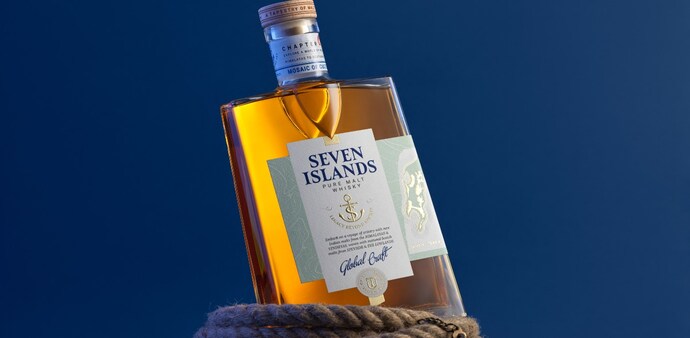
SD: Seven Islands pays homage to Mumbai, which 400 years ago was an archipelago of seven islands that were eventually reclaimed to form the Mumbai we know today. The label reflects this history. Single malts come from one distillery and one region. Pure malts are also 100% malted barley but combine malts from different regions. We’re trying to pioneer a different style of whiskey, which is an Indo-Scottish, pure malt whisky – a blend of four different malts, two of which are Indian and two of which are Scottish. The Indian malts are from the Himalayas and the Vindhyas, and the Scottish malts are from the Speyside and the Lowlands of Scotland. So we blend all of these malts together and add our history in Nasik to create Seven Islands. Each malt has a very neat profile and unique characteristic depending on which region they’re coming from, because the soil and the water that’s used impact the tasting notes of that particular malt. Seven Islands is aged for up to 8 years in two different kinds of casks – ex-bourbon American oak casks and ex-wine French oak casks.
What makes Seven Islands different in flavour and profile? What challenges did TI face while creating this whisky?
SD: It’s a layered, complex yet approachable whisky, palatable to first-time drinkers and connoisseurs alike. Our blend has a hint of smoke but it’s not a peated whisky. I think Indian consumers have still not fully accepted the flavour profile of peat yet and that will continue to evolve over time. This is why it is interesting how we have this unique element with just a subtle hint of smoke in our blend. We definitely faced challenges in perfecting the blend. We held multiple expert tasting panels with connoisseurs comparing it against global and domestic benchmarks. Achieving a blend that met global standards took over a year of trial and error.
How have you priced Seven Islands in the market? What is your strategy around this launch?
SD: It has been launched first in Mumbai in late November to leverage the continued festive season leading to New Year so this presents a lot of gifting opportunities as well. Pricing in Maharashtra is ₹5,200 for a 750ml bottle. Competition in this segment typically ranges from ₹4,800 to ₹6,000 and this is the space we are targeting.
From a category standpoint, what do you think is driving premiumisation in Indian spirits?
SD: There are two main reasons that I believe we're seeing these premiumization trends. One is the success of Indian craft spirits, especially the gin revolution that we saw over COVID, where we saw a lot of Indian craft gins coming out of Goa that people started preferring over even internationally acclaimed brands. This proves that India can produce high quality spirits, not just for Indians but also for the world. Overall too, there has been a growing appreciation for Indian homegrown products in the luxury space and the obsession with the West has dimmed.
Secondly, the premiumization trend not only in the alco-bev industry but across categories. One key statistic that really points to is the fact that the affluent population in India is set to double by the year 2027. So this indicates that the premiumization journey has really just started. We are still in the early days of this journey and it will be very interesting to see how Indian consumers continue to evolve in their preferences.
What is the long-term vision for TI across categories? How does TI’s investment ecosystem fit into this luxury strategy?
SD: Imperial Blue is currently the 3rd largest-selling whiskey in the world. Mansion House is the 2nd largest-selling brandy in the world. But that said, I think there is a lot of headroom to still grow for both of our brands. In addition to this, we definitely have aspirations to continue to grow our portfolio across categories. For the next year or so, we have a high focus on managing the transition of integrating Imperial Blue, as well as ensuring a successful launch and scaling up of Seven Islands.
Under the House of TI, we host our luxury brands Monarch Legacy Edition, a 100% pure brandy, and now Seven Islands, a pure malt whiskey. In addition to that, TI has also invested in a number of different craft brands. One of them is Bartisans, in which we have a 36% stake. Bartisans is known for premium artisanal cocktail mixers with very interesting flavour combinations, made entirely from real ingredients. We also hold a 21% stake in Spaceman Spirits Lab, the makers of Samsara Gin, Sitara Rum, and more recently, Amara Vodka.
How are you seeing the Indian consumer evolve, especially Gen Z?
SD: Gen Z is more experimental, they're choosing to spend on experiences and on premium brands that they feel already speak to them and that they can connect with. Earlier, there was chatter about Gen Z drinking less, but that isn’t the case. It’s just that Gen Z has now been in the workforce for a certain number of years and has that propensity to spend. I do think that brand loyalty for this demographic, as well as for this luxury category, is not as strong as we would see in other segments. For our latest launch Seven Islands Pure Malt Whisky, this is a very encouraging insight because it gives us the confidence to be able to provide a product with a clutter-breaking, extremely premium design, look and feel, but also a blend that ticks all the right boxes.
Sustainability is becoming critical in spirits. What is TI doing on this front?
SD: On a mass scale, we're always looking for ways in which we can replace plastic in our packaging, reduce glass weight and additional waste. We have already removed monocartons from a lot of our product designs. For Seven Islands as well, we have taken a completely sustainable approach with paper-based labels, no canister or monocarton, which is extremely common even in the luxury category, and the usage of a natural-wood closure.
India’s alcoholic beverage industry is riding an unmistakable premiumisation wave, and whisky continues to dominate the conversation, accounting for nearly 66% of total spirits consumption in 2024, as per IWSR. Tilaknagar Industries Ltd, long recognised for its leadership in brandy with their marquee product Mansion House, is now stepping confidently into this high-growth space of premium whiskeys with the launch of Seven Islands Pure Malt Whisky. Speaking with Business Today, Sanaya Dahanukar, Marketing Manager at Tilaknagar Industries, discusses the debut of Seven Islands and what it means for the company as it expands its whisky ambitions amid the landmark acquisition of Imperial Blue from Pernod Ricard.
Tilaknagar Industries has always been known as a brandy-first company. How have you shaped that category over time?
SD: Tilaknagar Industries began its journey in 1933 as Maharashtra Sugarmill, a sugar manufacturer. Over the years, we began distilling molasses, a by-product of sugar production, which is how we entered the alcohol space. In the 1980s, we moved into the branded alcohol business with Mansion House Brandy, now an iconic brand that remains our flagship. Today, Mansion House is India’s largest-selling brandy and the second largest globally. Brandy as a category has low awareness even though it holds over 20% of India’s IMFL volume. Its share of voice has historically been far behind whisky, gin, rum, or vodka. We’ve spent decades building this narrative. While whisky has strong price laddering reflecting consumer aspirations, brandy lacked that. Last year, we launched Monarch Legacy Edition, a 100% pure-grape brandy with no ENA. This repositions Indian brandy alongside global premium spirits.
What led to the decision to enter the premium whisky category now?
SD: We have been exploring different avenues of growth, and India being one of the largest whisky markets in the world, we see whisky as the natural next step for our organisation. Whisky is a very aspirational spirit with nearly 60% share within IMFL in India. We are looking to enter the whiskey space in a big way, make a mark in this category and bolster it as a second growth pillar for our organisation. We’re also exploring new avenues of growth beyond brandy, and entering whisky allows us to diversify and scale.
The planned acquisition of Imperial Blue is one of the largest alco-bev transactions by an Indian company. How does this transform Tilaknagar Industries?
SD: Imperial Blue gives TI a transformational entry into whisky. Currently, TI is dominant mainly in the south with around 90% of our business in the states there. With Imperial Blue, that dependence reduces to 50%. Similarly, dependence on the brandy category reduces from 90% to about 30%. The brand’s strong pan-India distribution will serve as the backbone for us to continue enhancing our portfolio across categories and segments.
Your latest launch builds on the luxury category TI first teased with the launch of Monarch Legacy brandy. What’s the story behind the ‘Seven Islands Pure Malt Whisky’ and how are you expecting to make this a standout offering?
SD: Seven Islands pays homage to Mumbai, which 400 years ago was an archipelago of seven islands that were eventually reclaimed to form the Mumbai we know today. The label reflects this history. Single malts come from one distillery and one region. Pure malts are also 100% malted barley but combine malts from different regions. We’re trying to pioneer a different style of whiskey, which is an Indo-Scottish, pure malt whisky – a blend of four different malts, two of which are Indian and two of which are Scottish. The Indian malts are from the Himalayas and the Vindhyas, and the Scottish malts are from the Speyside and the Lowlands of Scotland. So we blend all of these malts together and add our history in Nasik to create Seven Islands. Each malt has a very neat profile and unique characteristic depending on which region they’re coming from, because the soil and the water that’s used impact the tasting notes of that particular malt. Seven Islands is aged for up to 8 years in two different kinds of casks – ex-bourbon American oak casks and ex-wine French oak casks.
What makes Seven Islands different in flavour and profile? What challenges did TI face while creating this whisky?
SD: It’s a layered, complex yet approachable whisky, palatable to first-time drinkers and connoisseurs alike. Our blend has a hint of smoke but it’s not a peated whisky. I think Indian consumers have still not fully accepted the flavour profile of peat yet and that will continue to evolve over time. This is why it is interesting how we have this unique element with just a subtle hint of smoke in our blend. We definitely faced challenges in perfecting the blend. We held multiple expert tasting panels with connoisseurs comparing it against global and domestic benchmarks. Achieving a blend that met global standards took over a year of trial and error.
How have you priced Seven Islands in the market? What is your strategy around this launch?
SD: It has been launched first in Mumbai in late November to leverage the continued festive season leading to New Year so this presents a lot of gifting opportunities as well. Pricing in Maharashtra is ₹5,200 for a 750ml bottle. Competition in this segment typically ranges from ₹4,800 to ₹6,000 and this is the space we are targeting.
From a category standpoint, what do you think is driving premiumisation in Indian spirits?
SD: There are two main reasons that I believe we're seeing these premiumization trends. One is the success of Indian craft spirits, especially the gin revolution that we saw over COVID, where we saw a lot of Indian craft gins coming out of Goa that people started preferring over even internationally acclaimed brands. This proves that India can produce high quality spirits, not just for Indians but also for the world. Overall too, there has been a growing appreciation for Indian homegrown products in the luxury space and the obsession with the West has dimmed.
Secondly, the premiumization trend not only in the alco-bev industry but across categories. One key statistic that really points to is the fact that the affluent population in India is set to double by the year 2027. So this indicates that the premiumization journey has really just started. We are still in the early days of this journey and it will be very interesting to see how Indian consumers continue to evolve in their preferences.
What is the long-term vision for TI across categories? How does TI’s investment ecosystem fit into this luxury strategy?
SD: Imperial Blue is currently the 3rd largest-selling whiskey in the world. Mansion House is the 2nd largest-selling brandy in the world. But that said, I think there is a lot of headroom to still grow for both of our brands. In addition to this, we definitely have aspirations to continue to grow our portfolio across categories. For the next year or so, we have a high focus on managing the transition of integrating Imperial Blue, as well as ensuring a successful launch and scaling up of Seven Islands.
Under the House of TI, we host our luxury brands Monarch Legacy Edition, a 100% pure brandy, and now Seven Islands, a pure malt whiskey. In addition to that, TI has also invested in a number of different craft brands. One of them is Bartisans, in which we have a 36% stake. Bartisans is known for premium artisanal cocktail mixers with very interesting flavour combinations, made entirely from real ingredients. We also hold a 21% stake in Spaceman Spirits Lab, the makers of Samsara Gin, Sitara Rum, and more recently, Amara Vodka.
How are you seeing the Indian consumer evolve, especially Gen Z?
SD: Gen Z is more experimental, they're choosing to spend on experiences and on premium brands that they feel already speak to them and that they can connect with. Earlier, there was chatter about Gen Z drinking less, but that isn’t the case. It’s just that Gen Z has now been in the workforce for a certain number of years and has that propensity to spend. I do think that brand loyalty for this demographic, as well as for this luxury category, is not as strong as we would see in other segments. For our latest launch Seven Islands Pure Malt Whisky, this is a very encouraging insight because it gives us the confidence to be able to provide a product with a clutter-breaking, extremely premium design, look and feel, but also a blend that ticks all the right boxes.
Sustainability is becoming critical in spirits. What is TI doing on this front?
SD: On a mass scale, we're always looking for ways in which we can replace plastic in our packaging, reduce glass weight and additional waste. We have already removed monocartons from a lot of our product designs. For Seven Islands as well, we have taken a completely sustainable approach with paper-based labels, no canister or monocarton, which is extremely common even in the luxury category, and the usage of a natural-wood closure.