
Gold's New Stand, Silver's Bright Rise
Even seasoned traders have been startled by the rise this year, with gold prices up roughly 70% in 2025, and silver surging over 150%.
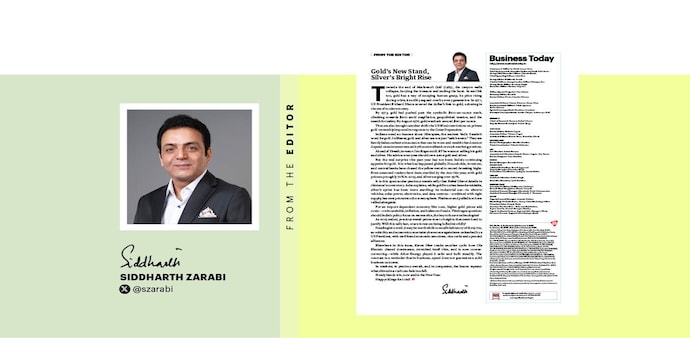
- Jan 2, 2026,
- Updated Jan 2, 2026 6:28 PM IST
Towards the end of Mackenna’s Gold (1969), the canyon walls collapse, burying the treasure and ending the hunt. In real life too, gold has a way of escaping human grasp, its price rising during crisis, its utility argued over by every generation. In 1971, US President Richard Nixon severed the dollar’s link to gold, ushering in the era of modern money.
By 1973, gold had pushed past the symbolic $100-an-ounce mark, climbing towards $200 amid stagflation, geopolitical tension, and the search for safety. By August 1976, gold was back around $110 per ounce.
That era also brought another shift: the US lifted restrictions on private gold ownership imposed in response to the Great Depression.
Indians need no lessons about Hiranyam, the ancient Vedic Sanskrit word for gold. In Bharat, gold and silver are not just “safe havens.” They are family balance sheets: insurance that can be worn and wealth that does not depend on an interest rate set by the central bank or stock market gyrations.
Ahead of Diwali, investor Jim Rogers told BT he was not selling his gold and silver. His advice: everyone should own some gold and silver.
But the real surprise this past year has not been India’s continuing appetite for gold. It is what has happened globally. Households, investors, and central banks have chased the yellow metal to record-breaking highs. Even seasoned traders have been startled by the rise this year, with gold prices up roughly 70% in 2025, and silver surging over 150%.
It is this spectacular precious-metals rally that Rahul Oberoi details in this issue’s cover story. As he explains, while gold’s run has been formidable, silver’s sprint has been more startling: its industrial use—in electric vehicles, solar power, electronics, and data centres—combined with tight supply, has sent prices into the stratosphere. Platinum and palladium have rallied alongside.
For an import-dependent economy like ours, higher gold prices add costs—on households, inflation, and balance of trade. This begs a question: should India’s policy focus on rare earths, the key to future technologies?
As 2025 ended, precious metal prices rose to heights that seem hard to justify. Will this rally last, or are investors being lulled into folly?
Heading into 2026, it may be worthwhile to recall the history of the 1970s, as volatility and economic uncertainty have once again been unleashed by a US President, with tariffs and economic sanctions, visa curbs and upended alliances.
Elsewhere in this issue, Karan Dhar tracks another cycle: how Ola Electric chased dominance, stretched itself thin, and is now course-correcting—while Ather Energy played it safer and built steadily. The contrast is a reminder that in business, speed does not guarantee a solid business outcome.
In markets, in precious metals, and in companies, the lesson repeats: what shines in a rush can fade in a fall.
Steady hands win, now and in the New Year.
Happy tidings for 2026!
Towards the end of Mackenna’s Gold (1969), the canyon walls collapse, burying the treasure and ending the hunt. In real life too, gold has a way of escaping human grasp, its price rising during crisis, its utility argued over by every generation. In 1971, US President Richard Nixon severed the dollar’s link to gold, ushering in the era of modern money.
By 1973, gold had pushed past the symbolic $100-an-ounce mark, climbing towards $200 amid stagflation, geopolitical tension, and the search for safety. By August 1976, gold was back around $110 per ounce.
That era also brought another shift: the US lifted restrictions on private gold ownership imposed in response to the Great Depression.
Indians need no lessons about Hiranyam, the ancient Vedic Sanskrit word for gold. In Bharat, gold and silver are not just “safe havens.” They are family balance sheets: insurance that can be worn and wealth that does not depend on an interest rate set by the central bank or stock market gyrations.
Ahead of Diwali, investor Jim Rogers told BT he was not selling his gold and silver. His advice: everyone should own some gold and silver.
But the real surprise this past year has not been India’s continuing appetite for gold. It is what has happened globally. Households, investors, and central banks have chased the yellow metal to record-breaking highs. Even seasoned traders have been startled by the rise this year, with gold prices up roughly 70% in 2025, and silver surging over 150%.
It is this spectacular precious-metals rally that Rahul Oberoi details in this issue’s cover story. As he explains, while gold’s run has been formidable, silver’s sprint has been more startling: its industrial use—in electric vehicles, solar power, electronics, and data centres—combined with tight supply, has sent prices into the stratosphere. Platinum and palladium have rallied alongside.
For an import-dependent economy like ours, higher gold prices add costs—on households, inflation, and balance of trade. This begs a question: should India’s policy focus on rare earths, the key to future technologies?
As 2025 ended, precious metal prices rose to heights that seem hard to justify. Will this rally last, or are investors being lulled into folly?
Heading into 2026, it may be worthwhile to recall the history of the 1970s, as volatility and economic uncertainty have once again been unleashed by a US President, with tariffs and economic sanctions, visa curbs and upended alliances.
Elsewhere in this issue, Karan Dhar tracks another cycle: how Ola Electric chased dominance, stretched itself thin, and is now course-correcting—while Ather Energy played it safer and built steadily. The contrast is a reminder that in business, speed does not guarantee a solid business outcome.
In markets, in precious metals, and in companies, the lesson repeats: what shines in a rush can fade in a fall.
Steady hands win, now and in the New Year.
Happy tidings for 2026!