
Overcoming Dependence: The Present Moment Provides an Opportunity to Reform and Strengthen the Economy
There is a difference between healthy trade and risky dependence, and this moment provides an opportunity to safeguard the economy.
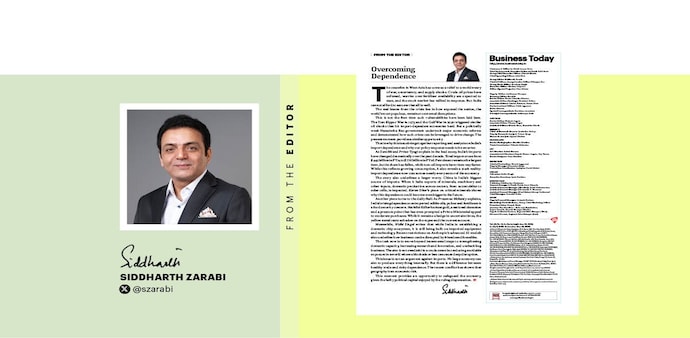
- Jun 20, 2026,
- Updated Jun 20, 2026 2:38 PM IST
The ceasefire in West Asia has come as a relief to a world weary of war, uncertainty, and supply shocks. Crude oil prices have softened, worries over fertiliser availability are expected to ease, and the stock market has rallied in response. But India cannot afford to assume that all is well.
The real lesson from the crisis lies in how exposed the nation, the world’s most populous, remains to external disruptions.
This is not the first time such vulnerabilities have been laid bare. The Yom Kippur War in 1973 and the Gulf War in 1990 triggered similar oil shocks that hit import-dependent economies hard. But a politically weak Narasimha Rao government undertook major economic reforms and demonstrated how such crises can be leveraged to drive change. The present moment provides a similar opportunity.
That is why this issue brings together reporting and analysis on India’s import dependence and why our policy response needs to be smarter.
As Surabhi and Prince Tyagi explain in the lead essay, India’s imports have changed dramatically over the past decade. Total imports rose from $449 billion in FY14 to $776 billion in FY26. Petroleum remains the largest item, but its share has fallen, while non-oil imports have risen way faster. While this reflects growing consumption, it also reveals a stark reality: import dependence now cuts across nearly every sector of the economy.
The story also underlines a larger worry. China is India’s biggest source of imports. When it halts exports of minerals, machinery and other inputs, domestic production across sectors, from automobiles to solar cells, is impacted. Karan Dhar’s piece on critical minerals shows why this dependence could become even bigger in the future.
Another piece turns to the daily thali. As Prasanna Mohanty explains, India’s rising dependence on imported edible oils, pulses and fertilisers is a food security concern. Nachiket Kelkar looks at gold, a national obsession and a pressure point that has even prompted a Prime Ministerial appeal to moderate purchases. While it remains a hedge in uncertain times, the yellow metal casts a shadow on the rupee and the current account.
Meanwhile, Nidhi Singal writes that while India is establishing a domestic chip ecosystem, it is still being built on imported equipment and technology. Recent restrictions on Anthropic’s advanced AI models also underline how business can be disrupted by friends and foes alike.
The task now is to move beyond incremental steps to strengthening domestic capacity, increasing research and innovation, and unshackling business. The aim is not swadeshi in a crude sense but reducing avoidable exposure in a world where a blockade or ban can cause deep disruption.
This issue is not an argument against imports. No large economy can aim to produce everything internally. But there is a difference between healthy trade and risky dependence. The recent conflict has shown that geography is an economic risk.
This moment provides an opportunity to safeguard the economy, given the hefty political capital enjoyed by the ruling dispensation.
The ceasefire in West Asia has come as a relief to a world weary of war, uncertainty, and supply shocks. Crude oil prices have softened, worries over fertiliser availability are expected to ease, and the stock market has rallied in response. But India cannot afford to assume that all is well.
The real lesson from the crisis lies in how exposed the nation, the world’s most populous, remains to external disruptions.
This is not the first time such vulnerabilities have been laid bare. The Yom Kippur War in 1973 and the Gulf War in 1990 triggered similar oil shocks that hit import-dependent economies hard. But a politically weak Narasimha Rao government undertook major economic reforms and demonstrated how such crises can be leveraged to drive change. The present moment provides a similar opportunity.
That is why this issue brings together reporting and analysis on India’s import dependence and why our policy response needs to be smarter.
As Surabhi and Prince Tyagi explain in the lead essay, India’s imports have changed dramatically over the past decade. Total imports rose from $449 billion in FY14 to $776 billion in FY26. Petroleum remains the largest item, but its share has fallen, while non-oil imports have risen way faster. While this reflects growing consumption, it also reveals a stark reality: import dependence now cuts across nearly every sector of the economy.
The story also underlines a larger worry. China is India’s biggest source of imports. When it halts exports of minerals, machinery and other inputs, domestic production across sectors, from automobiles to solar cells, is impacted. Karan Dhar’s piece on critical minerals shows why this dependence could become even bigger in the future.
Another piece turns to the daily thali. As Prasanna Mohanty explains, India’s rising dependence on imported edible oils, pulses and fertilisers is a food security concern. Nachiket Kelkar looks at gold, a national obsession and a pressure point that has even prompted a Prime Ministerial appeal to moderate purchases. While it remains a hedge in uncertain times, the yellow metal casts a shadow on the rupee and the current account.
Meanwhile, Nidhi Singal writes that while India is establishing a domestic chip ecosystem, it is still being built on imported equipment and technology. Recent restrictions on Anthropic’s advanced AI models also underline how business can be disrupted by friends and foes alike.
The task now is to move beyond incremental steps to strengthening domestic capacity, increasing research and innovation, and unshackling business. The aim is not swadeshi in a crude sense but reducing avoidable exposure in a world where a blockade or ban can cause deep disruption.
This issue is not an argument against imports. No large economy can aim to produce everything internally. But there is a difference between healthy trade and risky dependence. The recent conflict has shown that geography is an economic risk.
This moment provides an opportunity to safeguard the economy, given the hefty political capital enjoyed by the ruling dispensation.