
Trump’s Tariffs Test India Inc’s Confidence
India’s macroeconomic outlook points to growth of 6-6.5% this fiscal, but caution pervades boardrooms as Trump’s tariff escalation threatens to dampen sentiment and disrupt business.
- Aug 19, 2025,
- Updated Aug 19, 2025 9:58 PM IST
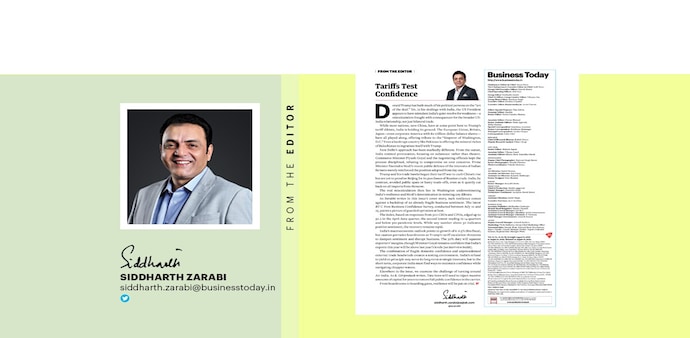
Donald Trump has built much of his political persona on the “art of the deal.” Yet, in his dealings with India, the US President appears to have mistaken India’s quiet resolve for weakness—a miscalculation fraught with consequences for the broader US-India relationship, not just bilateral trade.
While most nations, save China, have at some point bent to Trump’s tariff diktats, India is holding its ground. The European Union, Britain, Japan—even corporate America with its trillion-dollar balance sheets—have all played along, offering tribute to the “Emperor of Washington, D.C.” Even a bankrupt country like Pakistan is offering the mineral riches of Balochistan to ingratiate itself with Trump.
New Delhi’s approach has been markedly different. From the outset, India resisted provocation, focusing on substance rather than theatre. Commerce Minister Piyush Goyal and the negotiating officials kept the process disciplined, refusing to compromise on core concerns. Prime Minister Narendra Modi’s recent public defence of the interests of Indian farmers merely reinforced the position adopted from day one.
Trump and his trade hawks began their tariff war to curb China’s rise but are yet to penalise Beijing for its purchases of Russian crude. India, by contrast, avoided public spats or hasty trade-offs, even as it quietly cut back on oil imports from Moscow.
The real miscalculation then lies in Washington underestimating India’s resilience and Modi’s determination in resisting any diktats.
As Surabhi writes in this issue’s cover story, such resilience comes against a backdrop of an already fragile business sentiment. The latest BT-C Fore Business Confidence Survey, conducted between July 10 and 25, paints a picture of guarded optimism at best.
The index, based on responses from 500 CEOs and CFOs, edged up to 50.2 in the April-June quarter, the second-lowest reading in 14 quarters and below pre-pandemic levels. While any number above 50 indicates positive sentiment, the recovery remains tepid.
India’s macroeconomic outlook points to growth of 6-6.5% this fiscal, but caution pervades boardrooms as Trump’s tariff escalation threatens to dampen sentiment and disrupt business. The 50% duty will squeeze exporters’ margins, though Minister Goyal remains confident that India’s exports this year will be above last year’s levels (see interview inside).
The combination of fragile domestic confidence and unprecedented external trade headwinds creates a testing environment. India’s refusal to yield on principle may serve its long-term strategic interests, but in the short term, corporate India must find ways to maintain confidence while navigating choppier waters.
Elsewhere in the issue, we examine the challenge of turning around Air India. As K. Giriprakash writes, Tata Sons will need to inject massive amounts of capital for years to restore full public confidence in the carrier.
From boardrooms to boarding gates, resilience will be put on trial. @szarabi
Donald Trump has built much of his political persona on the “art of the deal.” Yet, in his dealings with India, the US President appears to have mistaken India’s quiet resolve for weakness—a miscalculation fraught with consequences for the broader US-India relationship, not just bilateral trade.
While most nations, save China, have at some point bent to Trump’s tariff diktats, India is holding its ground. The European Union, Britain, Japan—even corporate America with its trillion-dollar balance sheets—have all played along, offering tribute to the “Emperor of Washington, D.C.” Even a bankrupt country like Pakistan is offering the mineral riches of Balochistan to ingratiate itself with Trump.
New Delhi’s approach has been markedly different. From the outset, India resisted provocation, focusing on substance rather than theatre. Commerce Minister Piyush Goyal and the negotiating officials kept the process disciplined, refusing to compromise on core concerns. Prime Minister Narendra Modi’s recent public defence of the interests of Indian farmers merely reinforced the position adopted from day one.
Trump and his trade hawks began their tariff war to curb China’s rise but are yet to penalise Beijing for its purchases of Russian crude. India, by contrast, avoided public spats or hasty trade-offs, even as it quietly cut back on oil imports from Moscow.
The real miscalculation then lies in Washington underestimating India’s resilience and Modi’s determination in resisting any diktats.
As Surabhi writes in this issue’s cover story, such resilience comes against a backdrop of an already fragile business sentiment. The latest BT-C Fore Business Confidence Survey, conducted between July 10 and 25, paints a picture of guarded optimism at best.
The index, based on responses from 500 CEOs and CFOs, edged up to 50.2 in the April-June quarter, the second-lowest reading in 14 quarters and below pre-pandemic levels. While any number above 50 indicates positive sentiment, the recovery remains tepid.
India’s macroeconomic outlook points to growth of 6-6.5% this fiscal, but caution pervades boardrooms as Trump’s tariff escalation threatens to dampen sentiment and disrupt business. The 50% duty will squeeze exporters’ margins, though Minister Goyal remains confident that India’s exports this year will be above last year’s levels (see interview inside).
The combination of fragile domestic confidence and unprecedented external trade headwinds creates a testing environment. India’s refusal to yield on principle may serve its long-term strategic interests, but in the short term, corporate India must find ways to maintain confidence while navigating choppier waters.
Elsewhere in the issue, we examine the challenge of turning around Air India. As K. Giriprakash writes, Tata Sons will need to inject massive amounts of capital for years to restore full public confidence in the carrier.
From boardrooms to boarding gates, resilience will be put on trial. @szarabi