
AI stock rout: Jefferies increases India allocation to 14%, trims exposure to Korea and Taiwan
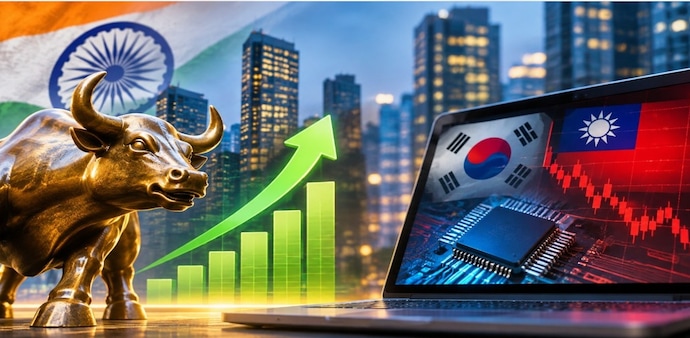
Jefferies' Christopher Wood has raised India's weight in his Asia-Pacific ex-Japan portfolio to 14%, while cutting allocations to South Korea and Taiwan. The shift comes amid a sharp sell-off in AI-linked semiconductor stocks and growing concerns that the global AI spending boom may be nearing its peak.
- Nov 8, 2026,
- Updated Nov 8, 2026 6:00 AM IST
Global brokerage Jefferies has increased India's allocation in its Asia-Pacific ex-Japan model portfolio to 14%, while reducing exposure to South Korea and Taiwan, amid growing concerns that the global artificial intelligence (AI) investment boom may be approaching its peak.
In his latest GREED & fear report, dated November 5, Christopher Wood raised India's recommended weighting by two percentage points, maintaining an overweight position against its 12% benchmark weight.
At the same time, Jefferies reduced South Korea's allocation by one percentage point to 18% and Taiwan's by one percentage point to 24%, retaining underweight positions in both markets.
The changes come as AI-linked semiconductor stocks face sharp corrections and investors reassess the sustainability of massive technology infrastructure spending.
Why is Jefferies increasing India's allocation?
The portfolio adjustment increases India's relative importance in Jefferies' regional investment strategy.
India now carries a two-percentage-point overweight against its benchmark allocation, while South Korea is underweight by one percentage point and Taiwan by 2.8 percentage points.
However, the report does not explicitly attribute India's higher allocation to domestic earnings growth, valuations or economic fundamentals.
Instead, the adjustment comes against the backdrop of growing concerns about AI-related investments and their impact on technology-heavy markets.
Importantly, these are changes to Jefferies' recommended model portfolio, not actual foreign institutional investor inflows into Indian equities.
MUST READ: South Korea crashed 15.57%, China fell 7.17% in October: Are emerging-market funds getting riskier?
AI stocks face sharp correction
Wood's report highlights a significant correction in Chinese semiconductor stocks, suggesting that investor enthusiasm for AI-related companies is weakening.
The China AI Semiconductor Top 10 Index surged 109% in dollar terms during the first half of 2026, reaching a peak in June.
However, the index has subsequently declined 50%, compared with a much smaller 1% fall in the broader MSCI China index.
Meanwhile, an index comprising memory-chip companies Micron, Samsung Electronics and SK Hynix has fallen approximately 40% from its late-June peak.
These developments are particularly relevant for South Korea and Taiwan because of their substantial exposure to semiconductor manufacturing and the global technology supply chain.
ALSO READ: Gold outlook: Why Jim Rogers says everybody should have gold under their bed
Could AI spending peak in 2026?
Jefferies believes the unprecedented AI capital expenditure cycle could peak this year, although actual spending data has yet to confirm a slowdown.
Consensus estimates suggest that Microsoft, Amazon, Alphabet and Meta could collectively spend $1.04 trillion on capital expenditure in 2027.
However, Wood questions whether financial markets will continue supporting investments of this magnitude.
The report notes that AI-related capital expenditure contributed 1.39 percentage points, or 67%, of US real GDP growth of 2.1% in the four quarters to September 2026.
A sharp slowdown could therefore have broader implications for economic growth and global equity markets.
What does this mean for Indian investors?
Jefferies' decision signals a relative preference for India within its regional portfolio as AI-related risks intensify.
For Indian investors, the development highlights the importance of monitoring global technology exposure, particularly through international funds and ETFs.
However, a higher model allocation does not guarantee stronger Indian equity returns or increased foreign portfolio investment.
The key question is whether the correction in AI-heavy markets will encourage broader portfolio diversification towards markets such as India.